
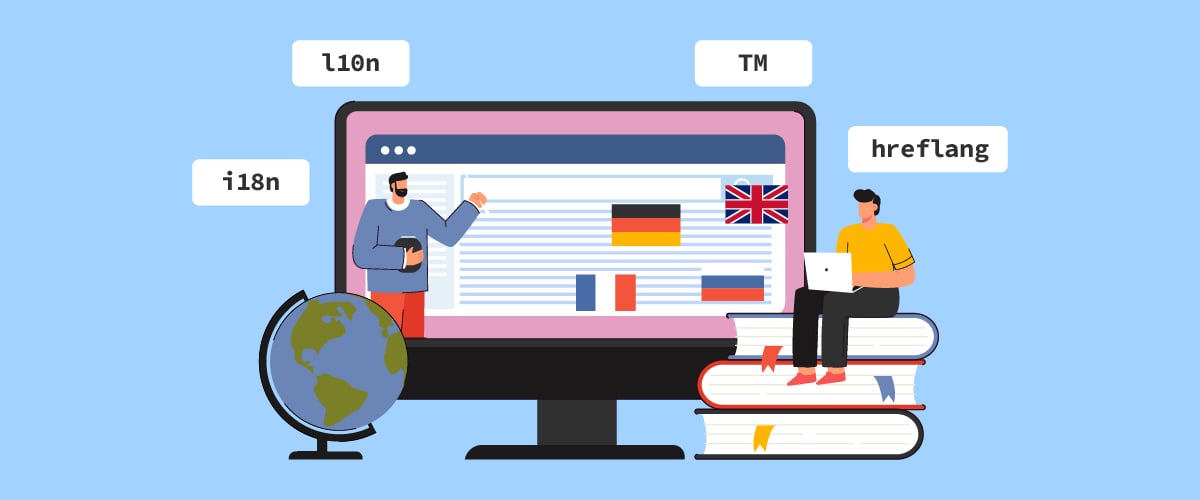
Understanding multilingual website terminology helps site owners manage translated content, improve international SEO, and maintain a consistent experience across different language versions. From preparing a website for multiple languages to managing translation workflows, these concepts provide a foundation for building and maintaining a multilingual online presence.
Whether you are expanding into new markets, localizing existing pages, or managing translations across a growing website, knowing these terms helps you make better decisions about your multilingual strategy. Read on to discover ten essential terms, what they mean, and why they matter for website owners.
要点:每个网站所有者都应了解的多语言网站术语
Understand key multilingual terms
Learn essential concepts such as internationalization, localization, and locales to build a website that supports global audiences.
Improve international SEO
Discover how hreflang and localized content help search engines understand language versions and serve relevant pages to international users.
Manage translations efficiently
Explore machine translation, post-editing, translation memory, and translation management systems to maintain consistent multilingual content.
1. 国际化 (i18n)
Internationalization (i18n) is the process of designing a website, application, or digital product so it can support multiple languages and regional formats without requiring major changes to its underlying code. The abbreviation i18n represents the first and last letters of the word, with 18 letters in between.
For example, a website designed exclusively for English may struggle with longer German translations or right-to-left Arabic text if its layout has not been prepared for these differences. Key internationalization considerations include:
- Designing flexible layouts that accommodate different text lengths.
- Supporting Unicode and different writing systems.
- Separating website content from interface code.
- Preparing date, number, and currency formats for regional variations.
Internationalization is especially important when planning a new website or redesigning an existing one because addressing these requirements early can reduce the effort needed to support additional languages later.
2. 本地化 (l10n)
Localization (l10n) is the process of adapting website content, design, and functionality to the language, cultural expectations, and preferences of a specific target market. Unlike internationalization, which prepares a website for multiple languages, localization makes the experience relevant to individual audiences.
Localization goes beyond translating words. It may involve adapting currencies, date formats, images, product descriptions, measurement units, and calls to action to reflect local conventions.
For example, an online store targeting the United States and the United Kingdom may need different spelling, currency displays, delivery information, and product descriptions for each market. Effective localization helps site owners:
- Make content sound natural to local audiences.
- Adapt visual elements and examples to cultural expectations.
- Display relevant regional information and formats.
- Maintain a consistent experience across localized pages.
Localization is particularly valuable when a business enters a new market because a direct translation may not communicate the same meaning or provide the same experience as content adapted to local expectations.
3. 区域设置
A locale is a combination of language and regional preferences that determines how information is presented to users. It can influence spelling, date formats, numbers, currencies, and other conventions associated with a particular region.
For example, en-US represents American English, while en-GB represents British English. Both use English, but they may require different spelling conventions and regional formatting.
Consider a website serving customers in the United States and the United Kingdom. Both audiences may use English, but the website might display prices in USD or GBP, use different date formats, and adapt certain terms to match local expectations. When managing locales, site owners should:
- Identify the language and regional variants they need to support.
- Maintain consistent spelling and terminology within each locale.
- Apply appropriate date, number, and currency formats.
- Ensure regional content matches the needs of its intended audience.
Locale planning helps prevent inconsistencies across regional website versions and supports a more tailored experience for international visitors.
4. Hreflang
Hreflang is an HTML attribute that helps search engines understand which language or regional version of a webpage is intended for a particular audience. It is commonly used on multilingual websites to connect equivalent pages available in different languages or regional variants.
For example, a business may maintain separate pages for English-speaking visitors in the United States and the United Kingdom, alongside a French version for visitors in France. Hreflang annotations help search engines understand the relationship between these alternatives and can help them serve a more appropriate version in search results. Key hreflang practices include:
- Using valid language codes and, where appropriate, regional codes.
- Adding reciprocal annotations between equivalent pages.
- Ensuring referenced URLs are accessible and point to the intended versions.
- Keeping hreflang annotations consistent with canonical URLs.
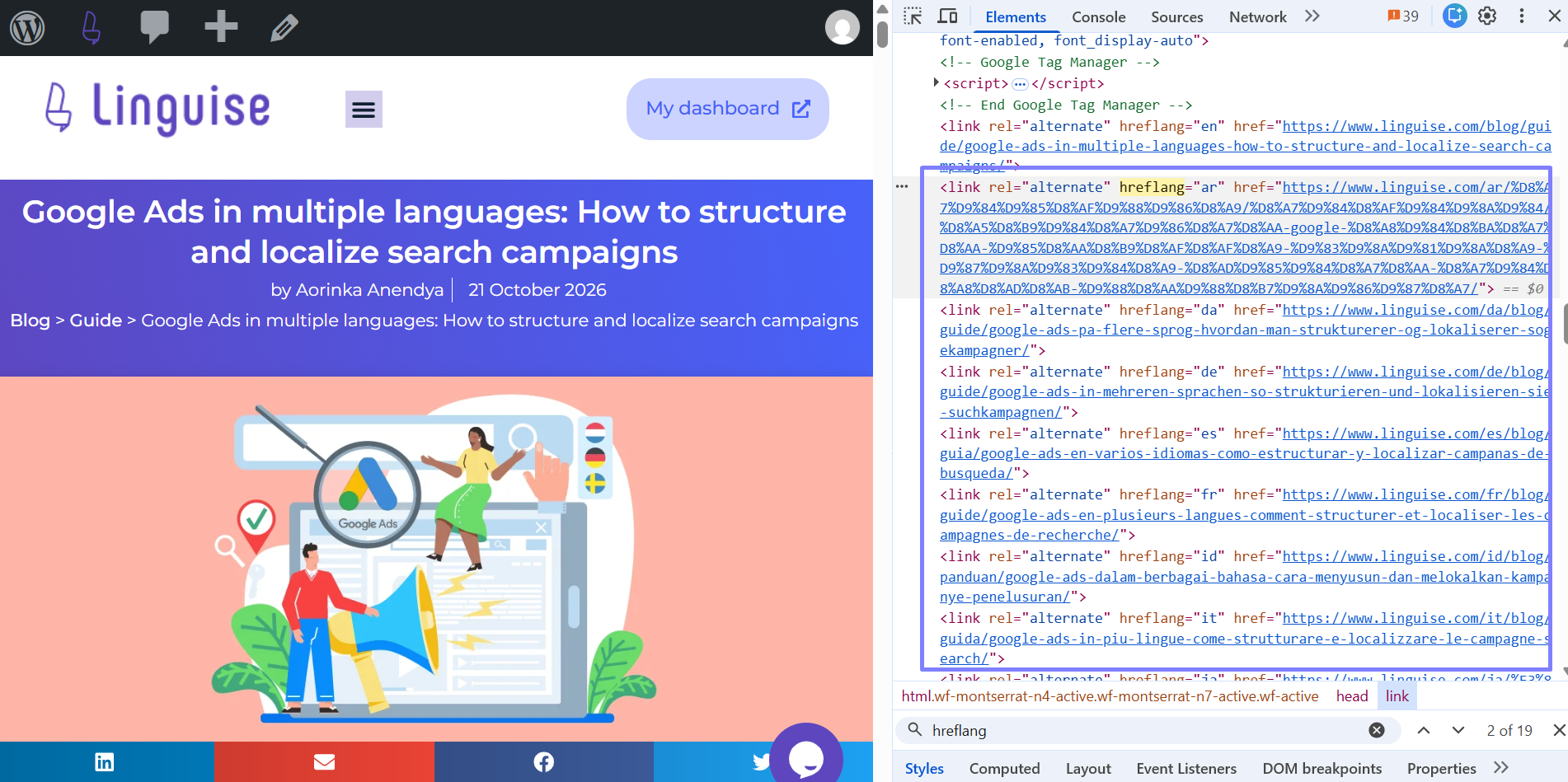
Correct implementation helps search engines understand the relationships between multilingual pages. It should complement other international SEO practices, including localized metadata, appropriate URL structures, and clear navigation between language versions.
5. 翻译记忆库 (TM)
Translation memory (TM) is a database that stores previously translated text segments, such as sentences or phrases, so they can be reused in future translation projects. When similar content appears again, a translation tool can suggest a matching translation instead of requiring the translator to start from scratch.
For example, an online store may use the same product descriptions, shipping messages, or customer support instructions across multiple pages. Translation memory helps teams reuse existing translations for recurring content while keeping terminology more consistent. Common benefits of translation memory include:
- Reusing previously translated content.
- Maintaining consistency across website pages.
- Reducing repetitive translation work.
- Supporting updates to existing multilingual content.
Translation memory is particularly useful for websites that publish regular updates or manage extensive product catalogs and documentation. However, stored translations should still be reviewed when the context changes.
It is also important to distinguish translation memory from machine translation. Translation memory retrieves existing translations, while machine translation automatically generates new translations.
6. 机器翻译 (MT)
Machine translation (MT) is the use of software to translate text automatically from one language into another. Modern systems may use artificial intelligence to generate translations for website pages, product descriptions, blog posts, and other digital content.
For example, a business expanding into several new markets can use machine translation to create initial versions of its website pages in additional languages. The resulting content can then be reviewed or refined according to its importance and quality requirements. When using machine translation, site owners should consider:
- The reliability of the selected language pair.
- The accuracy of terminology and context.
- The cultural suitability of the translated content.
- The need for human review on important pages.
Machine translation is useful for scaling multilingual content, but its output may contain inaccuracies, awkward phrasing, or inconsistent terminology. A suitable review process helps ensure that translated pages remain clear, accurate, and appropriate for their intended audiences.
7. 后期编辑
Post-editing is the process of reviewing and correcting machine-translated content to improve its accuracy, fluency, terminology, and suitability for its intended purpose.
Rather than translating everything from scratch, editors work with machine-generated translations and make the necessary improvements. The amount of editing depends on the content’s quality requirements and how it will be used.
For example, an automatically translated blog post may need corrections to grammar, technical terminology, and sentence structure before publication. A legal or product safety page may require a more thorough review because inaccuracies could have greater consequences. Post-editing typically involves:
- Correcting mistranslations and grammatical errors.
- Improving unnatural or unclear wording.
- Checking terminology and brand consistency.
- Verifying factual accuracy and cultural suitability.
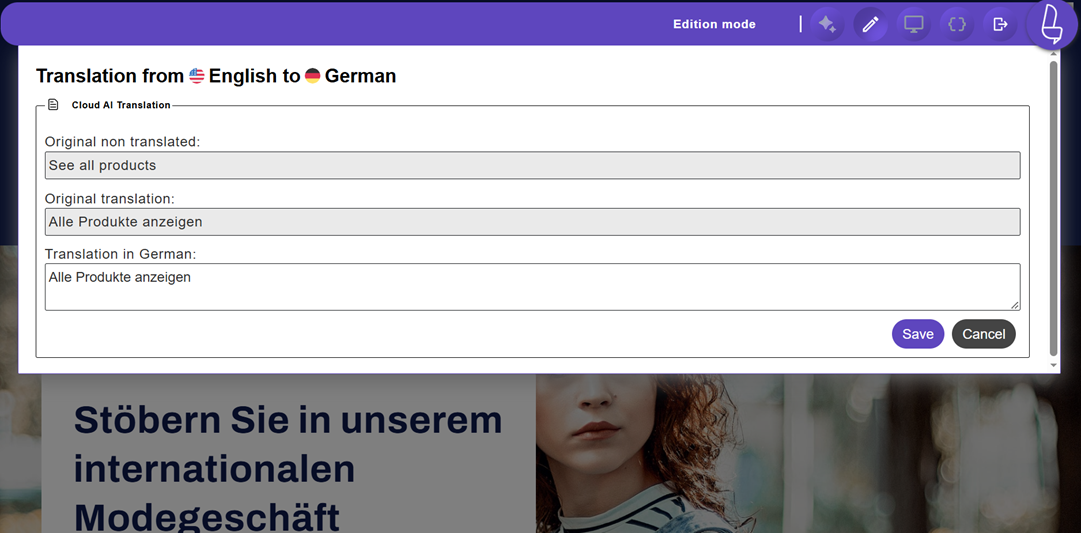
Linguise also provides post-editing capabilities, allowing website owners to review and refine translated content when adjustments are needed. This helps improve translation accuracy, maintain consistent terminology, and ensure the translated content fits the intended context.
8. 创译
Transcreation combines translation and creative adaptation to preserve a message’s intent, tone, emotional impact, and persuasive effect in another language or culture. Instead of translating every word directly, the process focuses on communicating the same underlying idea in a way that resonates with the target audience.
Transcreation is particularly useful for creative and brand-focused website content, such as slogans, campaign messages, product taglines, and calls to action. A phrase that sounds engaging in one language may seem awkward or culturally inappropriate when translated literally.
For example, a brand slogan based on wordplay in English may not have a natural equivalent in another language. Transcreation allows the wording to change while preserving the original message and intended effect. Transcreation may be appropriate when:
- Adapting brand slogans and creative messaging.
- Preserving humor, emotion, or brand personality.
- Reworking calls to action for cultural relevance.
- Creating market-specific content that reflects local expectations.
While standard translation prioritizes the accurate transfer of meaning, transcreation allows greater creative freedom when the intended effect matters as much as the original wording.
For website owners, it is most valuable for content where brand perception and emotional connection are important. Not every page requires transcreation; straightforward informational content can often be handled through standard translation and localization.
9. 术语表
A translation glossary is a collection of approved terms and their definitions or translations that helps maintain consistent terminology across multilingual content. It can also specify which terms should remain untranslated and how certain expressions should be used.
For website owners, a glossary is especially useful when managing technical documentation, product information, brand terminology, and content created by multiple writers or translators. A useful translation glossary may include:
- Source terms and their approved translations.
- Definitions or context for potentially ambiguous terms.
- Instructions for terms that must remain untranslated.
- Examples of preferred usage and terms to avoid.
A glossary works well alongside translation memory, but the two serve different purposes. A glossary defines preferred terminology, while translation memory stores previously translated segments for reuse.
Maintaining a glossary helps website owners reduce terminology inconsistencies and make it easier for different contributors to follow the same language standards.
10. 翻译管理系统 (TMS)
A translation management system (TMS) is software that helps businesses organize, coordinate, and manage translation projects across multiple languages and teams. Depending on the platform, it may include translation memory, glossary management, review workflows, collaboration features, automation, and integrations with content management systems. When evaluating a TMS, consider whether it offers:
- Integration with your website platform or content management system.
- Translation memory and glossary support.
- Collaboration features for translators and editors.
- Automation that fits your publishing process.
A TMS can be valuable for businesses with complex translation workflows, multiple contributors, or frequently updated content. Smaller websites with limited translation needs may not require a dedicated system.
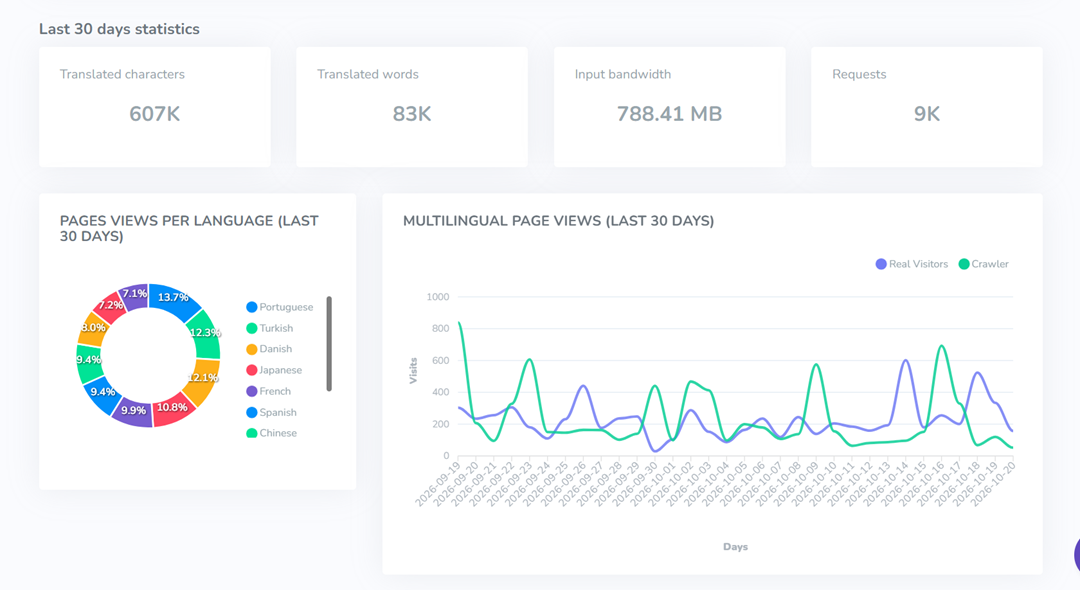
For website owners who want better visibility into their multilingual content, Linguise provides a translation dashboard with statistics showing translation activity across different languages. This makes it easier to monitor translated content and understand how translation is distributed across a multilingual website, while the dashboard provides a centralized place to manage translations.
Conclusion
Understanding these ten multilingual website terms helps site owners make informed decisions about internationalization, localization, international SEO, and translation workflows. Each concept addresses a different part of building and maintaining a multilingual website, from preparing its technical foundation to ensuring translated content remains accurate and consistent.
As a website grows, managing multiple language versions can become increasingly complex. Using Linguise can help simplify multilingual website management by automatically translating website content and supporting the maintenance of language versions, making it easier to provide a consistent experience for international visitors.