

Running Google Ads in multiple languages helps businesses reach potential customers in different markets with search ads that match their language preferences and local needs. However, simply translating existing campaigns is not enough. Advertisers also need to consider campaign structure, location targeting, budgets, ad copy, and local search behavior.
A well-organized multilingual campaign makes it easier to manage performance across markets while keeping messaging relevant to each audience. In this guide, you’ll learn how to structure campaigns, configure targeting settings, localize search ads within character limits, and refine your keyword strategy to improve campaign relevance across languages.
Poin-poin penting: Membuat dan mengoptimalkan kampanye Google Ads multibahasa
Build a market-specific campaign structure
Organize campaigns by language, country, and business goals to manage budgets, bidding strategies, and performance across international markets more effectively.
Adapt ad copy to local audiences
Localize headlines, descriptions, and calls to action to reflect local language, search behavior, and cultural expectations while meeting Google Ads character limits.
Refine keywords and targeting strategies
Analyze local search intent, review search term reports, and manage negative keywords in each language to reduce irrelevant clicks and improve campaign relevance.
Mengapa menjalankan Google Ads dalam berbagai bahasa?

Running multilingual Google Ads allows businesses to connect with audiences who search in different languages, even when they are looking for similar products or services. It also creates opportunities to expand into new markets without relying exclusively on English-language campaigns. Key benefits include:
- Reach more potential customers: Connect with users who prefer searching in their native language. For example, a software company can target both English-speaking and Spanish-speaking customers in the United States.
- Improve ad relevance: Match ad copy to the language and terminology users employ in their searches.
- Support market expansion: Test demand in new countries or regions without building an entirely separate marketing strategy from scratch.
- Manage performance more effectively: Compare results by language, location, and campaign to identify which markets deserve additional investment.
- Create a more consistent customer journey: Align search ads with localized landing pages, product information, and calls to action.
Struktur kampanye Google Ads multibahasa

A clear campaign structure helps advertisers organize keywords, ad copy, budgets, and targeting settings across languages and markets. The right setup depends on the number of countries targeted, differences in customer demand, and whether each market requires a distinct advertising strategy.
Campaigns by language or country
When setting up Google Ads in multiple languages, advertisers must decide whether to organize campaigns by language, country, or both. The choice should depend on how much control they need over budgets, bidding strategies, promotions, and performance reporting.
Campaigns organized by country are useful when each market has different business priorities or commercial requirements. Language-based campaigns can work when audiences across several locations share similar needs and can be managed under the same advertising strategy.
For example, a SaaS company targeting Spain and Mexico could use Spanish-language ads in both markets. If each country requires different pricing, budgets, or promotions, separate campaigns would make it easier to manage those differences. When choosing a structure, consider:
- Separate campaigns by country: When markets require independent budgets, bidding strategies, or reporting.
- Group campaigns by language: When audiences share similar advertising goals and market requirements.
- Combine both approaches: When language and country require different levels of campaign control.
Budget and bidding by market
Once the campaign structure is established, advertisers need to determine how much to invest in each market and which bidding strategy best supports their goals. Performance can vary between countries due to differences in competition, conversion rates, and customer value.
Review metrics such as cost per click (CPC), cost per acquisition (CPA), conversion rate, and return on ad spend (ROAS) to evaluate how efficiently each market uses its budget.
For example, a SaaS company may find that its US campaign generates more qualified leads than its French campaign. Rather than automatically increasing US spending, the company should compare acquisition costs, lead quality, and conversion value before reallocating its budget. To guide budget and bidding decisions:
- Compare market performance: Evaluate acquisition costs and conversion quality.
- Set appropriate bidding goals: Choose targets that reflect each market’s business objectives.
- Adjust spending gradually: Use performance data to guide budget changes.
- Check conversion tracking: Ensure that conversions are measured consistently across markets.
Automated bidding strategies can help optimize campaigns toward conversions or conversion value when tracking and data are sufficient. Avoid setting overly restrictive targets before understanding each market’s performance.
Language-specific ad groups
Ad groups organize related keywords and ads around a specific product, service, or search intent. In multilingual campaigns, this structure helps advertisers create focused messaging for each keyword theme without duplicating campaigns unnecessarily.
For example, a shoe retailer targeting French-speaking customers could create separate ad groups for running shoes, trail-running shoes, and affordable running shoes. Each group would contain closely related keywords and ads that direct users to relevant product pages. Create separate campaigns instead when markets require different budgets or geographic settings.
Penargetan bahasa vs. lokasi di Google Ads

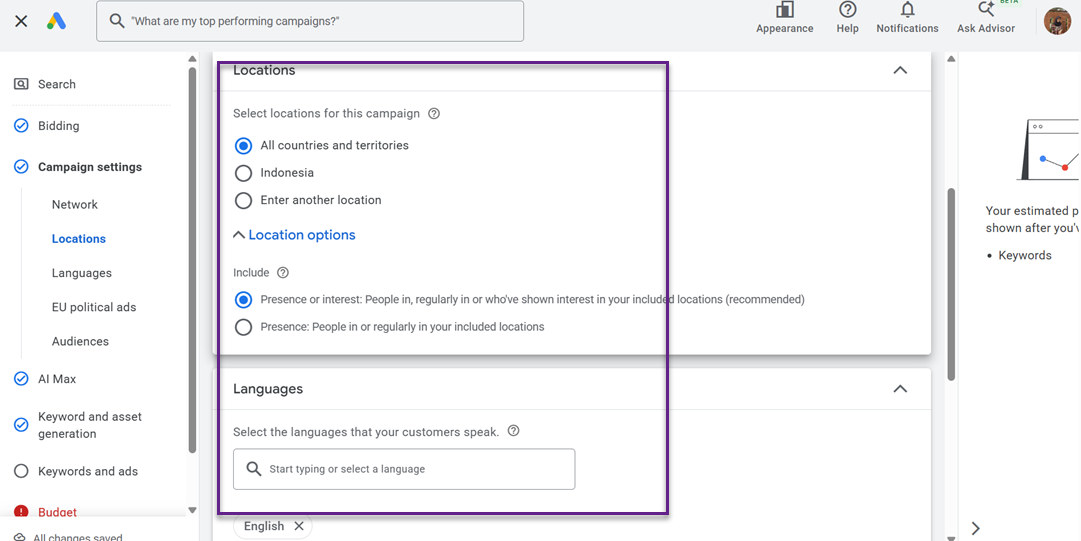
Language and location targeting serve different purposes in Google Ads. Language targeting helps advertisers reach users who are likely to understand selected languages, while location targeting defines the geographic areas where ads can appear. Combining both settings helps businesses reach relevant audiences across different markets.
Google Ads language targeting
Google Ads language targeting has changed for Search campaigns. Since September 2026, Google has automatically matched Search ads based on language signals, prioritizing ads that correspond to the language of a user’s search query. Google also considers whether users understand the language of the ad and landing page. For Performance Max campaigns, which use Google AI to run ads across multiple Google channels, this change applies to ads on Google Search, while language settings continue to apply to other eligible channels.
For multilingual advertisers, this makes the quality and language of ad assets and landing pages especially important. Create localized ads that reflect how people search in each market, and ensure that landing pages provide a consistent experience in the same language. Geographic targeting remains a separate setting that defines where ads can appear.
Language vs. geographic targeting
Language and geographic considerations serve different purposes when planning multilingual campaigns. While localized ad assets help communicate with audiences in their preferred languages, geographic targeting determines the areas where ads can appear. A single language may serve customers in several countries, but those markets may have different product preferences, pricing expectations, and purchasing requirements.
For example, a business could create Spanish-language ads for customers in Spain and Mexico while using separate campaigns when each market requires different budgets or geographic settings. Similarly, a business targeting French-speaking customers in Canada can use French ad assets and select locations relevant to its intended audience.
Choose geographic targets according to where the business operates, delivers products, or provides services. Avoid assuming that advertising in a particular language means targeting only one country.
Targeting settings by market
After identifying the relevant markets, advertisers should review their geographic targeting settings. Google Ads provides location options that determine whether ads can reach people based on their presence in a targeted area or their interest in it. The right setting depends on the business’s service area, delivery coverage, and campaign objectives.
Before launching, verify the targeted regions, location exclusions, ad and landing page languages, service or delivery coverage, and conversion tracking by market. After launch, review geographic performance reports to identify areas generating relevant clicks and conversions. Use these insights to refine targeting and exclude locations that consistently attract irrelevant traffic.
Melokalkan iklan penelusuran dalam batas karakter

Localizing search ads requires adapting ad copy to each audience’s language and search behavior while staying within Google’s character limits. The goal is to create relevant, natural-sounding ads that communicate the intended message clearly across markets.
Translating ad copy
Translating ad copy requires adapting the original message to local search behavior rather than translating each word literally. Advertisers should preserve the product’s main benefits while using terminology and phrasing that sound natural to the target audience.
For example, an English ad for a project management tool might use the headline “Manage Projects Easily.” Its French version should communicate the same benefit in concise, natural French rather than reproduce the English sentence structure word for word. When localizing ad copy, focus on:
- Keywords: Use search terms that match local usage.
- Benefits: Preserve the main value proposition.
- Offers: Adapt prices, promotions, and delivery details where necessary.
- Tone: Maintain the brand voice while respecting local conventions.
Translation tools can speed up the process, but review the final copy for accuracy and consistency with the landing page. This is particularly important when a translation changes the meaning of an offer or introduces wording that could mislead potential customers. For businesses running multilingual campaigns, tools like Linguise can also help translate website content into different languages, making it easier to align localized ads with the landing page experience.
Responsive search ads limits
Responsive Search Ads (RSAs) combine multiple headlines and descriptions to create ad variations suited to different searches. Each headline can contain up to 30 characters, each description up to 90 characters, and each display path field up to 15 characters.
Text customisation in Google Ads AI Max complements RSAs by adapting headlines and descriptions to better match users’ search queries, using existing website content and advertising assets. This helps create more relevant ad messaging based on users’ search intent.
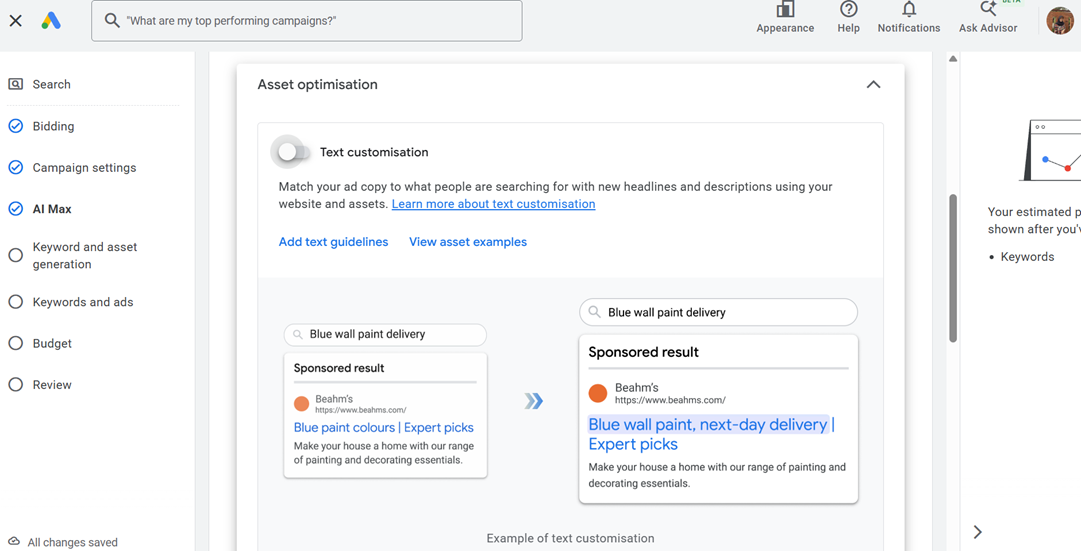
For multilingual campaigns, translations should remain natural and concise while meeting character limits. Advertisers should also preview ad combinations before publishing and avoid unnecessary pinning, which limits the combinations Google can test.
Localized calls to action
A call to action (CTA) encourages users to take the next step, such as making a purchase, registering, or requesting a quote. Localizing CTAs helps ensure the wording sounds natural and aligns with the campaign objective and target audience.
For example, an English SaaS ad might use “Get Started,” while a French version could use “Commencez” or “Inscrivez-vous,” depending on the intended action. Choose wording that fits the goal, such as “Buy now” for purchases, “Sign up” for registrations, or “Request a quote” for lead generation, rather than translating phrases word for word.
Ensure each CTA matches the action available on the landing page, and only promote a free trial if one is genuinely offered. Test different localized CTAs and compare click-through rates, conversion rates, and lead quality to identify which wording performs best.
Kata kunci negatif & istilah penelusuran multibahasa

Managing negative keywords and reviewing search terms in multiple languages helps advertisers reduce irrelevant clicks and improve campaign relevance. By understanding how users search in each market, businesses can refine their keyword lists, exclude unwanted traffic, and identify new opportunities to reach potential customers.
Negative keywords by language
Negative keywords help prevent ads from appearing for irrelevant searches, but managing them across languages requires more than translating an existing list. Advertisers need to understand the meaning and context of local search terms before excluding them, especially when the team does not speak the target language.
For example, an online store selling premium running shoes may want to exclude searches related to free products. Its English campaign might use “free,” while its French campaign could require “gratuit.” However, a translated term may have different meanings depending on the query, so advertisers should verify its relevance before adding it to a negative keyword list. To manage negative keywords across languages:
- Translate and review terms: Use translation tools to understand unfamiliar search queries and potential negative keywords.
- Check search intent: Confirm that a term indicates irrelevant traffic rather than a potential customer.
- Review match types: Understand how negative keyword match types affect which searches are excluded.
- Validate ambiguous terms: Ask a native speaker or local market specialist to review terms whose meaning is unclear.
- Monitor exclusions: Check search term reports after applying changes to ensure relevant traffic is not being blocked.
Keep in mind that negative keywords do not automatically exclude every synonym, related expression, or variation. For example, excluding “free” does not necessarily exclude every equivalent expression in another language. Review relevant variations individually and organize negative keyword lists by market when necessary.
Search term reviews
Search term reports show the actual queries that triggered ads and how those searches perform. In multilingual campaigns, reviewing these reports helps advertisers identify irrelevant traffic, discover new keyword opportunities, and understand local search behavior.
For example, a French-language campaign for accounting software might attract searches for free accounting templates. After checking the query’s meaning and performance data, advertisers can decide whether to exclude it or retain it if it attracts valuable traffic.
Review search terms regularly, paying attention to relevance, spending, and conversions. When a query is unfamiliar, or its intent is unclear, use translation tools and consult a native speaker or local market specialist before making changes.
Local search intent
Local search intent refers to what users want to accomplish when searching for a product or service in a particular language or market. Understanding these differences helps advertisers create relevant keywords and ads instead of relying on direct translations that may not reflect how local customers actually search.
For example, an online shoe store targeting France might find that some users search broadly for running shoes, while others use more specific phrases related to trail running or affordable footwear. These variations can indicate different levels of purchase intent and help the business organize its campaigns more effectively. To understand local search intent:
- Research keywords using the target language.
- Identify informational, commercial, and transactional searches.
- Analyze local competitors and their advertising messages.
- Review search terms and conversion data by market.
- Match ad copy and landing pages to users’ needs.
For instance, users searching for how to choose running shoes may need educational content, while those searching for where to buy trail-running shoes may be closer to making a purchase. Aligning keywords, ads, and landing pages with these different intents helps attract more relevant traffic and supports better campaign performance.
Kesimpulan
Running Google Ads in multiple languages requires more than translating keywords and ad copy. Advertisers need a campaign structure that supports market-specific budgets, relevant keyword groups, localized messaging, and ongoing performance analysis to reach the right audiences.
Start by identifying each market’s search intent and creating relevant ads and landing pages. Using Linguise to translate your website can help deliver a consistent experience for international visitors. Combined with regular reviews of search terms, conversions, and geographic performance, this approach helps businesses improve campaign relevance and support international growth.