

Currency localization vs. currency conversion is a distinction every international business should understand. While currency conversion simply applies the latest exchange rate, currency localization adapts prices to match local market expectations, customer behavior, and regional pricing practices. Knowing the difference can help you create a better shopping experience and improve customer trust.
A successful international pricing strategy involves more than displaying prices in different currencies. This guide explains the key differences between currency localization and currency conversion, why exchange rates alone aren’t enough, and how to implement effective localized pricing on your website.
Key points: Differences between currency localization and currency conversion
Currency conversion vs Currency localization
Currency conversion only updates prices based on exchange rates, while currency localization adapts pricing to local market expectations, purchasing power, and cultural preferences.
Localized pricing improves customer trust and conversions
Displaying familiar prices, formats, and psychologically appropriate price points reduces purchase hesitation and creates a more seamless shopping experience for international customers.
Effective international pricing relies on localization and automation
The right tools can automatically display localized currencies, formats, and region-specific pricing while keeping your multilingual website consistent and easy to manage.
Understanding currency localization vs. currency conversion

Although the terms currency localization and currency conversion are often used interchangeably, they represent two different approaches to displaying prices for international customers. Understanding the difference is the first step toward building a pricing strategy that improves customer trust and conversions.
What is currency localization?
Currency localization is the process of adapting prices for a specific market rather than simply converting them using the latest exchange rate. The goal is to make prices feel familiar, trustworthy, and appropriate for local customers while supporting your overall pricing strategy.
Instead of displaying the exact converted value, businesses can adjust prices based on factors such as:
- Local purchasing power
- Regional pricing expectations
- Psychological pricing conventions
- Taxes and regulatory requirements
- Competitive pricing within the target market
For example, a product priced at $49.99 in the United States may not simply convert to ¥7,436 in Japan. Instead, the business might set the price at ¥7,500 or ¥7,980, depending on local pricing practices and customer expectations.
What is currency conversion?
Currency conversion is the process of calculating a product’s price using the current exchange rate between two currencies. The converted price updates as exchange rates change, ensuring the displayed amount reflects the latest market value.
This approach is commonly used because it is simple to automate and requires minimal pricing management. For example, if a product costs $100 USD and the exchange rate changes, the displayed price in euros, yen, or another currency updates automatically.
While currency conversion helps customers understand prices in their own currency, it does not account for local purchasing habits, pricing psychology, or regional business strategies. As a result, automatically converted prices can sometimes appear unusual or less appealing.
Key differences between currency localization and currency conversion
Although both approaches display prices in a customer’s preferred currency, they serve different business objectives.
Aspect | Currency Localization | Currency Conversion |
Purpose | Optimize pricing for each local market | Calculate prices using the latest exchange rate |
Pricing method | Uses market-specific pricing strategies | Uses real-time or fixed exchange rates |
Price stability | Usually fixed until manually updated | Changes as exchange rates fluctuate |
Customer experience | Feels natural and aligns with local expectations | May display irregular or unfamiliar prices |
Best for |
|
|
Considers local purchasing power | ✅Yes | ❌No |
Supports psychological pricing | ✅Yes | ❌No |
In many cases, businesses combine both approaches. They use currency conversion to calculate a baseline price, then apply currency localization to adjust the final amount according to local market conditions. This hybrid strategy helps balance operational efficiency with a better customer experience.
Why exchange rates alone aren't enough for international pricing

Using live exchange rates is a convenient way to display prices in different currencies, but it doesn’t guarantee an effective international pricing strategy. Customer expectations, regional regulations, and local market conditions all influence how a price is perceived. That’s why businesses should look beyond exchange rates when expanding into global markets.
Exchange rates don't reflect local purchasing power
An exchange rate simply tells you how much one currency is worth compared to another. It doesn’t account for how much consumers in different countries are willing or able to spend on a product. Two customers may see the same converted price, but their perceptions of affordability can vary significantly due to differences in income levels, living costs, and purchasing power.
For example, converting a $50 product directly into another currency may produce an accurate numerical value, but that price could be considered too expensive in one market and relatively affordable in another. Instead of relying solely on exchange rates, businesses should evaluate local market conditions before setting prices. When determining localized prices, consider factors such as:
- Average consumer income
- Cost of living in the target country
- Local competitors’ pricing
- Customer demand and willingness to pay
By considering purchasing power alongside exchange rates, businesses can create prices that are both competitive and more appealing to local customers.
Psychological pricing differs by country
Customers don’t evaluate prices based only on their numerical value—they also respond to how prices are presented. This concept, known as psychological pricing, varies across countries and cultures.
For example, prices ending in .99 are widely used in the United States because they create the perception of a better deal. In contrast, some markets, such as Japan, often favor clean, rounded prices that appear simpler and more trustworthy. A price that looks natural in one country may feel unusual or even discourage purchases in another. Common psychological pricing practices include:
- United States: Prices ending in .99 or .95
- Japan: Rounded prices, such as ¥1,000 or ¥5,000
- European markets: Prices often end in .90, .95, or .99, depending on local retail practices
Instead of displaying awkward converted amounts like €18.73, businesses often adjust prices to values such as €18.99 or €19.00 to better match local customer expectations.
VAT-inclusive vs. VAT-exclusive pricing
Tax display requirements also vary by country, making simple currency conversion insufficient for international pricing. Customers expect prices to be displayed in accordance with local regulations, and failing to do so can cause confusion at checkout.
In many European countries and the UK, businesses typically display VAT-inclusive prices, meaning the tax is already included in the advertised amount. Customers know the price they see is the amount they’ll pay. In contrast, businesses in the United States commonly display VAT-exclusive or sales-tax-exclusive prices, with taxes added during checkout because tax rates vary by state and locality. When localizing prices, make sure your website:
- Displays taxes according to local regulations
- Clearly indicates whether taxes are included
- Maintains consistent pricing throughout the checkout process
Providing tax information in the expected format helps improve transparency and reduces the risk of unexpected costs that could lead to cart abandonment.
Fixed local prices vs. live currency conversion
Businesses that sell internationally typically choose between fixed local prices and live currency conversion, each with its own advantages and trade-offs.
Fixed local pricing allows businesses to set stable prices for each market. Customers always see the same amount, regardless of exchange rate fluctuations, making it easier to maintain psychological pricing and predictable profit margins.
Live currency conversion, on the other hand, updates prices automatically based on current exchange rates. This approach requires less manual management but may cause prices to change frequently, resulting in inconsistent customer experiences and awkward pricing. Here’s a quick comparison:
Fixed local prices
- Stable and predictable pricing
- Supports localized pricing strategies
- Easier to maintain psychological pricing
- Requires periodic manual review
Live currency conversion
- Automatically reflects exchange rate changes
- Reduces manual maintenance
- Prices may fluctuate daily
- Can produce irregular price endings
For many international businesses, a hybrid approach works best. Live exchange rates can serve as a starting point, while localized pricing adjustments ensure prices remain competitive, culturally appropriate, and consistent across different markets.
How to implement currency localization on your website

Once you’ve decided to move beyond simple currency conversion, the next step is implementing currency localization on your website. The goal isn’t just to display prices in another currency, but to create a shopping experience that feels familiar and trustworthy for customers in different markets. Here are three key practices to get started.
Display the correct local currency
Showing prices in a visitor’s local currency is one of the easiest ways to improve the shopping experience. When customers immediately recognize a familiar currency, they can understand prices more easily and make purchasing decisions with greater confidence.
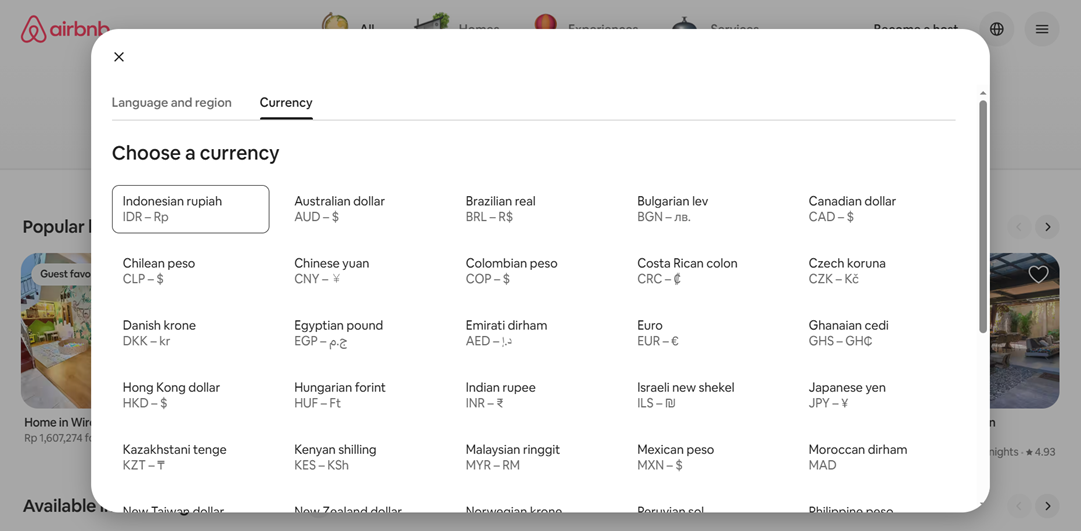
Many international websites automatically detect a visitor’s location or browser language to display the appropriate currency. It’s also a good practice to let users manually switch currencies based on their preferences. Airbnb, for example, provides a dedicated currency selector that lets visitors choose their preferred currency, making prices easier to understand wherever they’re browsing.
Country | Correct Display |
United States | $1,299.99 |
Germany | 1.299,99 € |
Japan | ¥1,300 |
Indonesia | Rp1.299.000 |
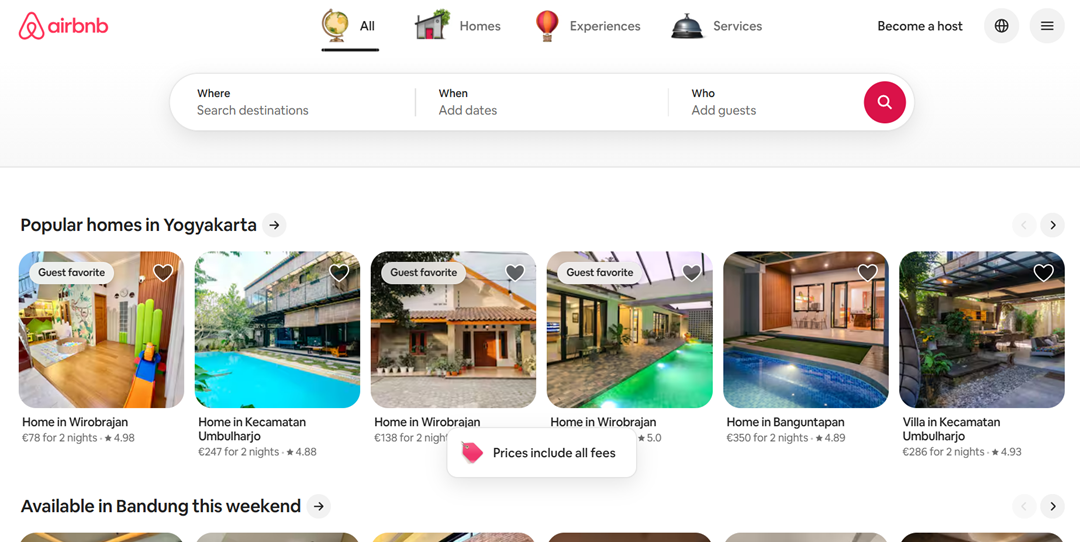
Using familiar formatting makes prices easier to read and creates a more localized shopping experience. Once visitors select their preferred currency, prices should also remain consistent across the website. The example below shows how Airbnb displays accommodation prices in euros after a visitor selects EUR as the preferred currency.
To provide a better currency display experience:
- Detect the visitor’s country or preferred language.
- Display the correct currency symbol, number format, and ISO currency code (such as USD, EUR, or JPY).
- Allow customers to change currencies manually.
- Keep the selected currency consistent across product, cart, and checkout pages.
A consistent, localized currency display helps reduce confusion and makes your website feel more tailored to international visitors.
While displaying localized currencies is an important step, it works best when paired with website localization. When visitors see prices, language, and other regional elements tailored to their market, they’re more likely to trust your website and complete a purchase. For multilingual websites, tools like Linguise make it easier to localize content across languages, helping deliver a more consistent experience alongside localized pricing.
Support multi-currency checkout
Displaying localized prices is only effective if customers can complete their purchases in the same currency. Imagine browsing products in euros but being charged in U.S. dollars at checkout—this unexpected change can reduce trust and increase cart abandonment.
A multi-currency checkout ensures customers see the same currency throughout the buying journey, from the product page to the payment confirmation. Many modern payment providers and eCommerce platforms support multiple currencies, making it easier to provide a seamless checkout experience.
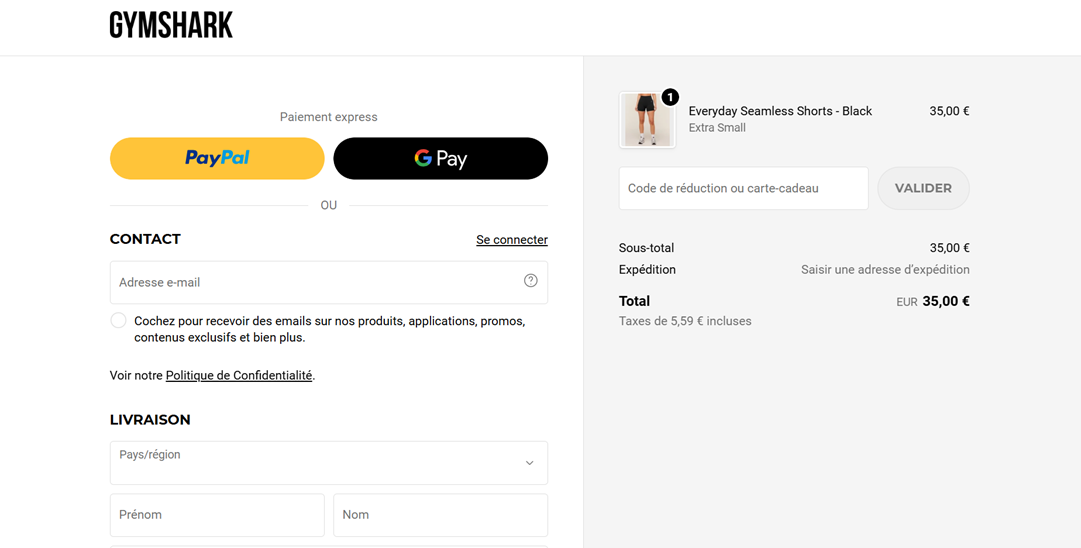
Gymshark, for example, maintains the selected currency throughout the checkout process. After customers select EUR, the product price, taxes, and final payment total remain displayed in euros, ensuring a transparent and consistent purchasing experience.
When implementing multi-currency checkout, make sure to:
- Keep the displayed currency consistent throughout the checkout process.
- Clearly indicate the currency before completing payment.
- Support payment gateways that accept multiple currencies.
- Avoid unexpected currency conversions or hidden fees during checkout.
Providing a transparent checkout process helps customers feel more confident and reduces friction before completing their purchase.
Keep pricing consistent
Localized pricing should remain consistent across your entire website. If customers see different prices for the same product on category pages, product pages, or checkout, they may question your pricing accuracy or lose trust in your store.
Consistency also means maintaining your pricing strategy over time. Whether you use fixed local prices or live exchange rates, prices should be reviewed regularly to ensure they remain competitive and aligned with your business goals. To maintain pricing consistency:
- Use the same localized price across all pages.
- Regularly review prices after significant exchange rate changes.
- Keep promotional discounts consistent across all supported currencies.
- Test your pricing across different countries and devices.
Regular monitoring helps ensure your localized pricing continues to reflect customer expectations while supporting a reliable and professional shopping experience.
Best practices for optimizing your international pricing strategy

Creating a localized pricing strategy isn’t a one-time task. As markets, customer expectations, and exchange rates change, your pricing should evolve as well. Regularly reviewing and optimizing your approach helps you remain competitive while providing a consistent experience for international customers.
Audit localized prices regularly
Even if your pricing strategy works well today, it may not stay effective over time. Market trends, competitor pricing, and customer expectations can change, making previously optimized prices less appealing. Regular pricing audits help ensure your localized prices remain competitive and aligned with each target market.
During an audit, review not only the price itself but also how it’s displayed throughout the customer journey. A consistent and natural-looking price builds trust and reduces confusion. When auditing localized prices, check whether:
- Prices follow local psychological pricing conventions.
- Currency symbols and formats are displayed correctly.
- Prices remain consistent across product, cart, and checkout pages.
- Competitor pricing has changed significantly.
Monitor exchange rate changes
Even if you use fixed local pricing, exchange rate fluctuations can gradually affect your profit margins. Businesses that rely on live currency conversion should pay even closer attention, as frequent rate changes directly impact the prices customers see.
Monitoring exchange rates allows you to decide when price adjustments are necessary, rather than reacting only after profits are affected. Establishing a regular review schedule helps maintain pricing stability. Consider monitoring:
- Major exchange rate fluctuations.
- Their impact on product margins.
- Whether localized prices still align with your pricing strategy.
- Opportunities to update prices without disrupting the customer experience.
Test pricing from the customer's perspective
The best way to evaluate localized pricing is to experience your website as an international customer would. A price may look correct internally, but customers could still encounter confusing currency displays, inconsistent pricing, or unexpected changes during checkout.
Testing the entire buying journey helps identify issues before they affect conversions. It’s especially important when launching in new markets or updating your pricing strategy. During testing, verify that:
- The correct currency is displayed from the first visit.
- Prices remain consistent throughout the purchase journey.
- Taxes and additional fees are clearly communicated.
- Checkout uses the same currency shown on product pages.
Balance localization with profitability
Localized pricing should improve the customer experience without reducing profitability. While adjusting prices to suit each market is important, businesses also need to consider operating costs, exchange rate risks, and long-term revenue goals.
Instead of offering the lowest possible price, aim for pricing that reflects local expectations while supporting sustainable business growth. Finding this balance allows you to remain competitive without sacrificing profit margins. To achieve this balance:
- Set minimum profit margin targets for each market.
- Review localized prices periodically instead of changing them too frequently.
- Consider regional operating costs and taxes.
- Use pricing data to support long-term business decisions.
Conclusion
Currency localization vs. currency conversion is more than a technical distinction, it’s a key factor in building an effective international pricing strategy. While currency conversion helps customers view prices in their local currency, currency localization goes further by considering purchasing power, psychological pricing, tax regulations, and market expectations. Combining both approaches allows businesses to deliver a smoother shopping experience while improving customer trust and conversion opportunities.
If you’re looking for an easier way to create a localized experience for international visitors, Linguise can help. Beyond translating your multilingual website, Linguise supports language-based localization that helps businesses deliver a more natural experience for customers worldwide. Try Linguise to simplify your global expansion and create a website that feels local in every market.