
Multilingual GEO (Generative Engine Optimization) is becoming increasingly important as users shift from traditional search engines to AI-powered platforms like ChatGPT, Perplexity, Claude, and Gemini to find information. Instead of browsing multiple search results, users can now ask questions in their preferred language and receive direct answers from AI. This changes how businesses need to approach online visibility, especially when reaching audiences across different countries.
Your website needs more than English content to earn AI citations in international markets. It must provide accessible, relevant, and naturally written content in your target audiences’ languages, supported by proper technical optimization, structured data, and local terminology.
Key points: Getting your website cited by ChatGPT and Perplexity across languages
Create Localized content for every target market
Publish naturally written multilingual content that reflects local search intent, industry terminology, regional preferences, and audience questions to improve its relevance across different languages.
Optimize technical SEO and structured data
Ensure AI crawlers can access localized pages through clean URLs, hreflang tags, sitemaps, and translated metadata and structured data.
Build brand authority and monitor AI visibility
Strengthen content credibility through accurate information, relevant local terminology, reliable references, and high-quality translations. Regularly monitor brand mentions and website citations across ChatGPT and Perplexity to identify areas for improvement.
What is multilingual GEO and why does it matter for AI search?

Multilingual GEO combines content localization with Generative Engine Optimization (GEO) to help websites become more visible in AI-generated answers across different languages. To understand its importance, it helps to look at how AI search works and why multilingual content plays a key role.
The shift to AI search
Users are increasingly turning to AI-powered platforms like ChatGPT, Perplexity, Claude, and Gemini to find information, compare products, and explore solutions. Instead of browsing multiple search results, they can ask questions in natural language and receive summarized answers with references to relevant sources.
This changes how businesses approach online visibility. Beyond ranking in traditional search results, brands also need to make their content useful and accessible enough for AI engines to reference in their responses.
Understanding GEO
Generative Engine Optimization (GEO) is the practice of optimizing website content so AI-powered search engines and assistants can discover, understand, and potentially cite it in their generated answers. While traditional SEO focuses on improving visibility in search engine results, GEO also considers how information is selected and presented in AI-generated responses.
GEO does not replace SEO. Both approaches work together to improve online visibility through practices such as:
- Creating clear and informative content that answers users’ questions.
- Organizing information with descriptive headings and structured data.
- Providing accurate and consistent information across website pages.
- Building brand credibility through relevant sources and references.
The role of multilingual content
Multilingual content is an important foundation of GEO because users do not always search for information in English. When someone asks an AI assistant a question in French, Spanish, or German, the system may retrieve and consider relevant sources in those languages, depending on the query and available information.
Although modern AI models can understand multiple languages, this doesn’t mean every website is equally visible across different language markets. English-only websites may struggle to address local search intent, industry terminology, and market-specific questions.
Publishing localized content helps businesses:
- Reach users who interact with AI assistants in their preferred languages.
- Provide information that matches local search intent.
- Make products and services easier to understand across markets.
- Use familiar terminology that resonates with local audiences.
- Create more opportunities to be referenced in AI-generated answers.
Therefore, multilingual GEO requires adapting content to the language, context, and search behavior of each target market.
Why AI search engines need native multilingual content

AI search engines need information that matches the language, location, and context of users’ queries. Native multilingual content helps businesses provide relevant information for AI engines to retrieve and reference across international markets.
How AI sources local references across languages
When users ask questions in French, Spanish, German, or other languages, AI search engines can retrieve information from relevant web sources. Depending on the platform and query, these sources may include local-language websites, industry publications, product pages, and regional references.
This is important because local sources often provide context that general international content may not cover. Websites written in the target audience’s language can offer more relevant information about regional preferences, terminology, and market conditions.
For example, searching for the best AI plugins for websites in English and German produces mostly similar recommendations in ChatGPT, although one recommendation differs in the second position. This shows that AI-generated answers may contain variations depending on the language and context of a user’s query.
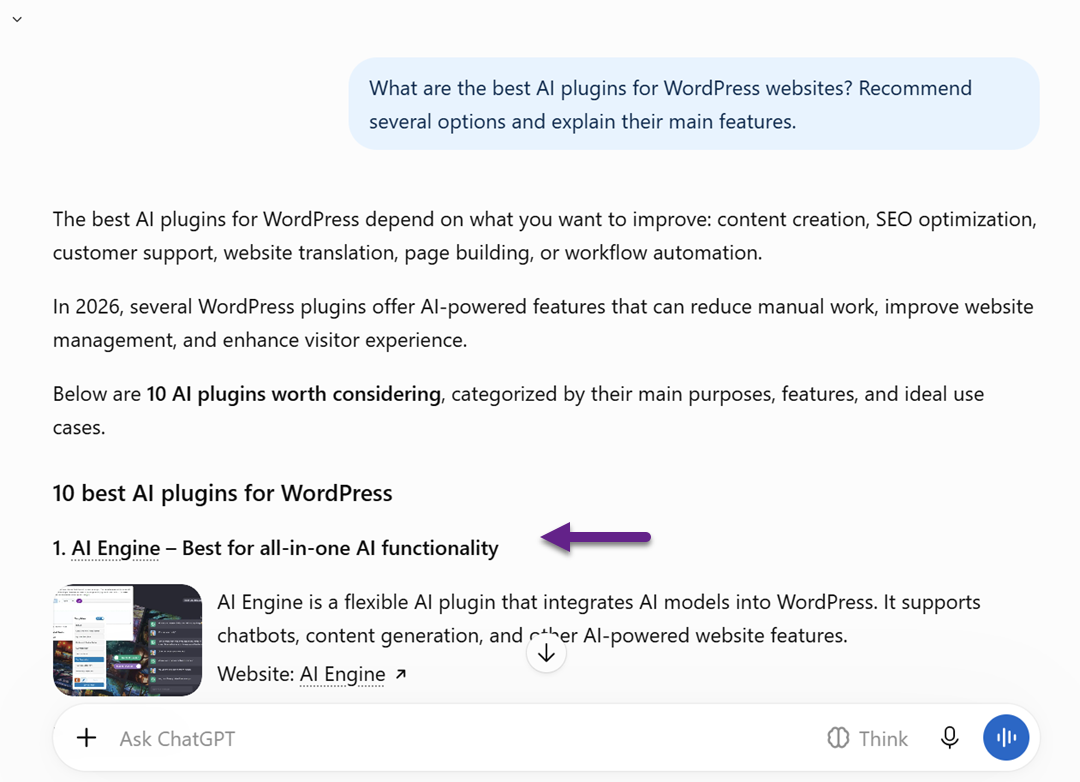
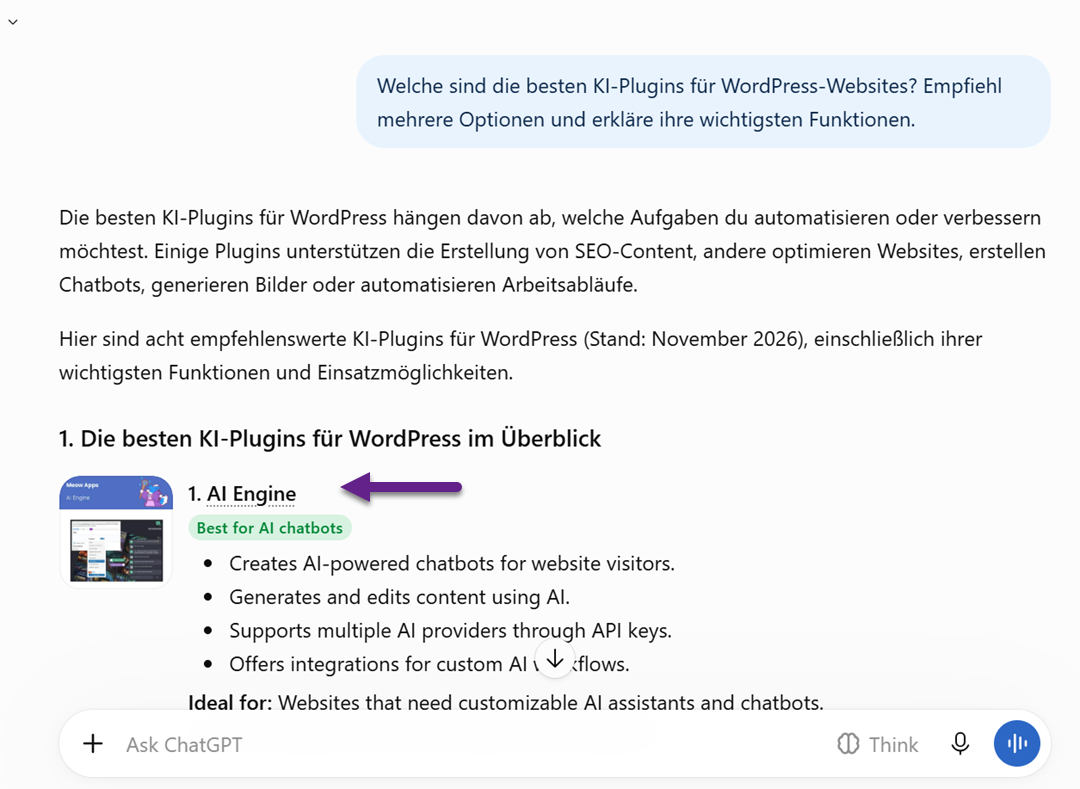
This highlights the importance of providing localized content that reflects how audiences search for information in their own languages. Relevant local-language resources can give AI search engines additional context when retrieving information for different markets.
For businesses targeting multiple markets, localized content can provide AI engines with relevant references, including:
- Local industry trends, regulations, and requirements.
- Regional product information, pricing, and availability.
- Customer reviews and experiences in the target language.
- Local terminology and frequently asked questions.
- Market-specific examples and business information.
The risks of English-only websites
AI models can understand and process multilingual information, and some platforms can retrieve English sources when answering non-English questions. However, relying only on English content can limit a website’s relevance when users search for information specific to another language or market.
For example, a French user searching for website translation services may use local industry terminology and expect information relevant to businesses in France. An English-only page might explain the service, but it may not address the exact terms or local context the user is looking for.
This can create several limitations for businesses targeting international markets:
- Missing opportunities to match local-language search queries.
- Limited coverage of regional topics and customer questions.
- Less use of industry terminology familiar to native speakers.
- Fewer localized pages that AI engines can retrieve and reference.
- Greater reliance on third-party sources to represent the brand in other languages.
Technical requirements for multilingual GEO

Creating content in multiple languages is only the first step. Your website also needs a technical structure that allows search crawlers and AI systems to access, identify, and understand each localized page.
Understanding AI Crawlers
AI platforms use web crawlers to discover and access website content. These bots visit pages, retrieve their content, and may use the information for search features or other AI-related purposes. For multilingual GEO, make sure your important language versions are accessible to the relevant crawlers. Some AI-related crawler names and controls to know include:
- OAI-SearchBot: Used by OpenAI to discover content for ChatGPT search results. Blocking it may prevent your pages from appearing as sources in ChatGPT search answers.
- PerplexityBot: Used by Perplexity to crawl websites and support its search services.
- Google-Extended: A robots.txt control that lets publishers manage how Google may use crawled content for certain AI purposes. It is not a separate crawler or a control for inclusion in regular Google Search results.
To make sure crawlers can access your multilingual pages:
- Check your robots.txt file to ensure that important pages and resources are not unintentionally blocked.
- Allow the relevant AI search crawlers if you want your content to be eligible for their search features.
- Make sure localized pages can be accessed directly without requiring users or bots to select a language first.
- Avoid placing important content behind login screens or interactions that crawlers cannot access.
- Review server logs to identify crawler visits and check whether requests return errors.
For example, if you want to allow OpenAI’s search crawler to access your website, you can add the following rule to your robots.txt file:
					User-agent: OAI-SearchBot
Allow: /
This rule allows OAI-SearchBot to crawl the website, provided that no other applicable rules or server restrictions block access. You can apply similar checks to other relevant crawlers based on your website’s access policy.
Using clean, localized URLs
Each language version of your website should have its own stable, crawlable URL. This helps search engines identify different versions of the same page and makes it easier for users and crawlers to access content in their preferred language.
For example, a product page could use /en/products/, /fr/produits/, and /de/produkte/ for its English, French, and German versions. You can organize localized URLs using:
- Subdirectories: example.com/fr/ or example.com/de/. This keeps all language versions under one domain and is generally easier to manage.
- Subdomains: fr.example.com or de.example.com. This separates language versions into different sections of a domain.
- Country-specific domains: example.fr or example.de. This can help target specific countries, but requires managing separate domains.
Whichever structure you choose, keep it consistent across the website. Also make sure that:
- Each localized URL loads the correct language without relying on cookies or browser settings.
- URLs are accessible through standard HTML links.
- Language versions do not depend on URL parameters or fragments to display different content.
- Each page has a stable URL that can be crawled and shared directly.
Server-side rendering vs. JavaScript rendering
How your website delivers content can affect whether crawlers can access it. With server-side rendering (SSR), the server sends HTML that already contains the main page content. With client-side JavaScript rendering, the browser needs to run JavaScript before the content appears.
Some search crawlers can render JavaScript, but this process may require additional resources and time. Other bots may not execute JavaScript at all. If important text, links, or localized content only appear after scripts run, some crawlers may not see them. To make your content easier to access:
- Use SSR or static rendering to deliver the main page content in the initial HTML response.
- Make sure headings, body text, metadata, and internal links are available without requiring user interaction.
- Avoid relying on JavaScript to reveal essential content only after a click, scroll, or other action.
- Test the HTML returned by your server to check whether the main content is present.
- Keep JavaScript and other resources needed to render the page accessible to crawlers.
Delivering ready-to-read HTML can reduce rendering dependencies and make important content easier for different crawlers to process. This is particularly useful for multilingual websites, where each language version needs to expose its own localized content clearly.
Sitemaps and hreflang tags
A multilingual sitemap and hreflang tags help search engines discover localized pages and understand the relationship between different language versions. This makes it easier to direct users to the version that best matches their language or region.
For example, if an article is available in English, French, and German, you can use hreflang annotations to identify all three versions as alternatives to one another. You can implement these annotations in the page HTML, HTTP headers, or an XML sitemap. When setting them up:
- Include every available language version, including the page’s own URL, in its alternate-language annotations.
- Make sure each version references the other versions consistently.
- Use the correct language and optional region codes, such as en, fr, de, or en-GB.
- Add all canonical localized URLs to your XML sitemap.
- Update your sitemap and language annotations whenever you publish, remove, or change a localized page.
- Use x-default for a fallback page when you provide a general language or country selector.
These signals help Google understand which pages are language alternatives. They do not guarantee AI citations, but they support the discoverability and organization of multilingual content.
For example, if your website has English, French, and German versions of the same page, you can add hreflang annotations to identify their language alternatives:
					<link rel="alternate" hreflang="en"
      href="https://example.com/en/" />
<link rel="alternate" hreflang="fr"
      href="https://example.com/fr/" />
<link rel="alternate" hreflang="de"
      href="https://example.com/de/" />
Each localized page should include the same set of language alternatives, including a reference to itself. This helps search engines identify the relationship between the different versions.
How translated structured data helps AI engines understand your website

Structured data gives search engines and AI systems additional context about the information on your website. For multilingual websites, translating and adapting this data alongside visible content helps keep each language version consistent and easier to interpret.
Structured data for AI information extraction
Structured data is a standardized way to describe the information on a webpage using a format that machines can understand. Instead of relying only on visible text, search engines can use these additional details to identify what a page is about, such as a product, article, organization, or frequently asked question.
For example, a product page may display its name, price, availability, and customer rating. Structured data can describe these details using defined properties, helping search engines interpret the information more clearly.
Common Schema.org types that can provide useful context include:
- Organization: Describes a business, including its name, website, logo, and contact information.
- Product: Identifies product details such as name, description, brand, price, and availability.
- Article: Provides information about an article, including its headline, author, and publication date.
- FAQPage: Represents frequently asked questions and their corresponding answers when the page meets Google’s applicable requirements.
- Review: Describes a review, including its author, rating, and reviewed item.
Structured data does not guarantee that AI engines will cite a page or use its information. However, it provides machine-readable context that can help supported systems understand the entities and details presented on a website.
Translating schema.org and JSON-LD markup
Schema.org provides a shared vocabulary for describing webpage content, while JSON-LD is one format used to implement structured data. When you translate a website, the structured data should also reflect the language and information presented on each localized page.
For example, if a webpage is available in English, French, and German, each localized version should contain language-dependent details that match its visible content. Keeping the structured data in English while translating the page itself can create inconsistencies between the information presented to users and the information described in the markup.
A website with English and French versions of the same webpage, for instance, can use localized values in its JSON-LD markup.
					//English version:
{
  "@context": "https://schema.org",
  "@type": "WebPage",
  "url": "https://example.com/en/",
  "name": "Website Translation Services",
  "description": "Explore website translation services for international audiences.",
  "inLanguage": "en"
}

//French version:
{
  "@context": "https://schema.org",
  "@type": "WebPage",
  "url": "https://example.com/fr/",
  "name": "Services de traduction de sites web",
  "description": "Découvrez des services de traduction de sites web pour les audiences internationales.",
  "inLanguage": "fr"
}
Each version uses localized text and its corresponding URL while keeping the structured data aligned with the visible page content. When adapting structured data for multilingual pages:
- Translate language-dependent properties such as name, description, headline, and text.
- Keep factual information such as product identifiers, prices, and availability accurate and consistent with the visible page.
- Use the appropriate inLanguage value to identify the language of the content where supported by the relevant Schema.org type.
- Make sure each language version uses the correct localized URL and corresponding page information.
- Validate the JSON-LD markup to check for syntax errors and verify that it follows the requirements of the relevant structured data type.
The goal is to ensure that structured data describes the same content users see on each language version, rather than simply duplicating the original markup across every page.
Localized metadata, FAQs, products, and reviews
Structured data is only one part of multilingual optimization. The surrounding page elements, including metadata and visible content, should also be localized so that each language version provides consistent information. Pay particular attention to these elements:
- Metadata: Translate page titles and meta descriptions using natural search terms in the target language. These elements help describe each page in search results and provide context about its content.
- FAQs: Adapt questions and answers to reflect how local audiences phrase their queries. If the page uses FAQ structured data, make sure the markup matches the visible questions and answers.
- Product information: Localize product names, descriptions, features, pricing, and availability where relevant. Keep Product structured data consistent with the details displayed on the page.
- Reviews: Preserve the original meaning of customer feedback when translating reviews. If review structured data is used, ensure that ratings, authorship, and reviewed products remain accurate.
Consistency across these elements helps prevent conflicting information between localized pages. It also gives search engines and AI systems clearer context about the products, services, and information a business provides in each target market.
Building semantic accuracy and brand authority for multilingual AI citations

Getting cited by AI search engines requires more than making your website available in multiple languages. Your content also needs to communicate accurate information, use relevant terminology, and establish your brand as a credible source in each target market.
Semantic relevance and source credibility
AI search engines look for information that matches the meaning and context of a user’s query. A page may contain relevant keywords but still fail to address the actual question if its content is vague, inaccurate, or poorly localized. Clear explanations, consistent information, and credible references help establish the relevance and reliability of your website.
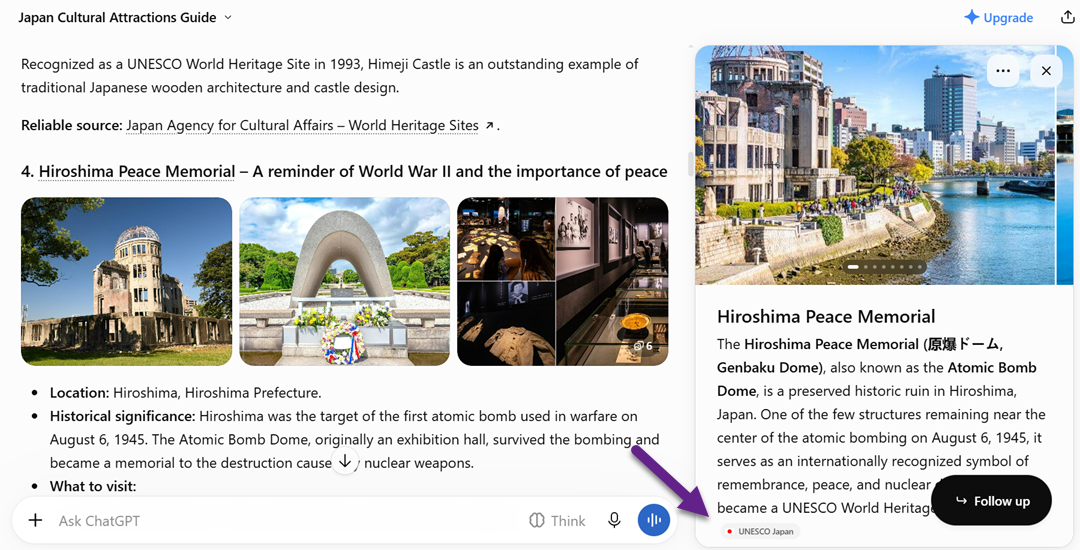
For example, when asked about cultural attractions in Japan, ChatGPT can recommend several destinations and reference authoritative sources such as UNESCO to explain their historical significance. This illustrates how AI-generated answers can draw on credible websites to support specific information and provide users with additional references.
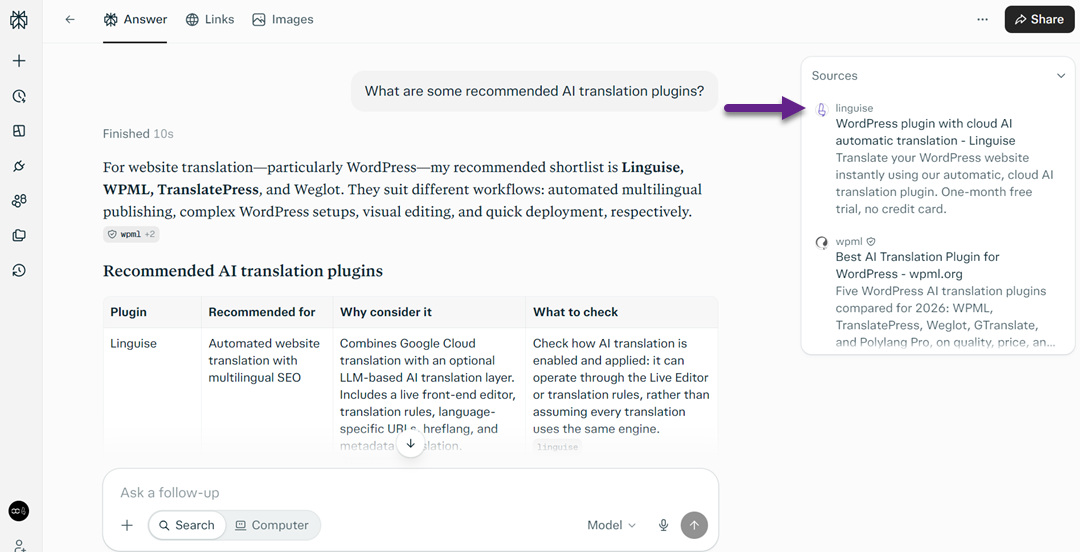
Besides ChatGPT, your website can also be cited by other AI platforms, such as Perplexity. For example, when asked about the best AI plugins for WordPress websites, Perplexity can recommend several plugins and reference their official websites to explain their features and functionality. This illustrates how AI-generated answers can draw on website content as sources to support recommendations and provide users with additional references.
A 2025 study by Yext analyzed 6.8 million AI citations across ChatGPT, Gemini, and Perplexity. It found that 86% of citations came from brand-managed sources, including company websites and business listings. This suggests that businesses should not overlook their own websites when building AI search visibility. Maintaining accurate, structured, and accessible website content can help provide AI search engines with reliable information about their brands.
To strengthen semantic relevance and source credibility:
- Answer specific questions that users commonly ask in each target market.
- Provide accurate facts, examples, and explanations supported by reliable sources.
- Keep brand names, product descriptions, and business information consistent across pages.
- Include author information and relevant credentials to demonstrate expertise.
- Build references and mentions from reputable industry websites, publications, and other relevant sources.
Translation quality and brand authority
Translation quality affects how clearly a brand communicates its expertise and value to international audiences. Literal translations, incorrect terminology, and unnatural sentences can change the intended meaning or make content difficult to understand. This may weaken the brand’s credibility among local readers and reduce the usefulness of the content for answering their questions.
A good multilingual strategy should preserve the original meaning while adapting the wording to local language conventions and expectations. Each translated page should feel like content created for its target audience, not simply a copy of the original page in another language.
To maintain translation quality and brand consistency:
- Preserve the original meaning, facts, and technical details when translating content.
- Use natural expressions that native speakers can easily understand.
- Apply consistent terminology across product pages, tutorials, and other website content.
- Review important translations to identify inaccurate or misleading wording.
- Adapt examples and references when local context requires a different explanation.
Local terminology optimization
Using the right terminology helps your content match how people in each market describe products, services, and industry-specific topics. Direct translations do not always reflect the words that local users actually use when searching for information or asking AI assistants questions. For example, a technical term commonly used in English may have a different established equivalent in French or German.
This is where manual translation editing and replacement rules can help. For better terminology optimization:
- Identify industry-specific terms commonly used by your target audience.
- Research local search phrases instead of translating English keywords word for word.
- Use manual editing to correct translations that do not reflect the intended meaning.
- Create replacement rules for product names, technical terms, and brand-specific expressions.
- Review terminology across different pages to maintain consistency.
By combining accurate translations with locally relevant terminology, businesses can create content that better reflects how their target audiences communicate and search for information. This makes each language version more useful to readers while giving AI search engines clearer context about the brand’s expertise and offerings.
How marketers and agencies can build a multilingual GEO strategy

Marketers and agencies can use multilingual GEO to help businesses reach audiences beyond their primary markets. By combining localized content with AI search optimization, they can create opportunities to build brand visibility and authority in international markets.
Finding international GEO opportunities
The first step is identifying international markets where a business has the potential to reach new audiences through AI search. Rather than targeting every country at once, marketers should look for markets where users actively search for relevant products or services but where competition for useful local-language content may be less intense. To identify these opportunities, marketers and agencies can:
- Find popular questions and industry terms in target languages.
- Review competitors’ localized content coverage.
- Check brand mentions across AI assistants in different languages.
- Identify topics and questions competitors overlook.
- Evaluate market demand, business potential, and localization resources.
These findings help businesses choose target markets based on actual opportunities rather than translating their entire website without a clear strategy.
Pitching multilingual translation to clients
Agencies can position multilingual translation as more than a way to make websites accessible to international visitors. It can also support a client’s GEO strategy by making useful brand information available to AI search engines and users in different languages.
This is particularly relevant when clients want to expand into international markets but face strong competition in their primary market. Localized content can help them address market-specific questions, use familiar industry terminology, and provide information that may be missing from competing websites.
When presenting multilingual translation as part of a GEO strategy, agencies should:
- Align localized content with international business goals.
- Identify market opportunities and competitor content gaps.
- Explain how localized pages support multilingual AI visibility.
- Prioritize key markets and high-value pages.
- Set realistic expectations for AI citations and recommendations.
This approach helps clients understand that multilingual translation is a long-term content and visibility investment, rather than just an additional website expense.
Improving AI search visibility
Once target markets have been selected, marketers and agencies need to maintain and improve the quality of localized content. A multilingual GEO strategy should cover both content optimization and technical accessibility so that AI search engines can discover and understand the relevant pages. Practical steps include:
- Create localized pages answering local audience questions.
- Optimize metadata, headings, and structured data.
- Use natural local terminology and examples.
- Ensure AI crawlers can access localized content.
- Implement language-specific URLs, sitemaps, and hreflang.
- Monitor AI mentions and citations across languages.
- Regularly update translations and business information.
By combining these practices, agencies can help clients build a consistent multilingual presence that supports both traditional search and AI-generated answers. The goal is not simply to translate more pages, but to create useful local-language resources that establish the brand as a relevant source in each target market.
How Linguise supports your multilingual GEO strategy

Building a multilingual GEO strategy requires more than making website content available in different languages. Businesses also need to maintain translation accuracy, use consistent local terminology, and deliver localized content in a format that crawlers can access. Linguise supports these requirements through its translation and content delivery features. With Linguise, you can:
- Create multilingual content automatically: Translate website pages into multiple languages to make your products, services, and information accessible to audiences in different markets. This provides a multilingual content foundation for reaching users who search in their preferred languages.
- Improve accuracy with manual editing: Review and adjust machine-translated content to correct inaccurate wording or adapt expressions to local language conventions using Linguise’s front-end live editor. This helps ensure that localized pages communicate the intended meaning clearly.
- Maintain consistent local terminology: Use replacement rules to standardize industry terms, product names, and brand-specific expressions across your website. Consistent terminology helps keep information clear and aligned across different language versions.
- Support multilingual content delivery: Linguise uses a proxy and cache architecture to deliver translated website content, with a processing time of around 10 ms. This approach helps serve localized pages without relying solely on client-side JavaScript rendering, supporting the technical accessibility considerations discussed in multilingual GEO.
By combining automated translation, manual editing, terminology control, and multilingual content delivery, Linguise helps businesses manage the localized content needed for their GEO strategy. Start with Linguise to simplify multilingual website management as you expand into international markets.
Key takeaways: Future-proof your website for the multilingual GEO era
Multilingual GEO improves your chances of AI citations across languages. Beyond translation, focus on relevant local content, crawlability, localized metadata, structured data, and consistent terminology to help AI engines understand your content.
Building this foundation across multiple languages requires the right translation and management workflow. Linguise helps simplify the process with automatic website translation, manual editing, and replacement rules for consistent terminology. Start with Linguise to manage your multilingual website and support your GEO strategy as you expand into international markets.