
Building a multilingual knowledge base without hiring translators is a practical strategy for businesses growing across borders today. As your product reaches international users, support expectations rise rapidly, while hiring native-language agents or translators can quickly become expensive and unsustainable. A well-built multilingual knowledge base helps customers find answers in their own language, without increasing support headcount.
Building a multilingual knowledge base without hiring translators is possible by combining AI-first workflows, clear support article structures, and smart content management. Instead of manually translating everything, businesses can efficiently scale help centres and FAQs while maintaining quality and consistency across languages. Keep reading to explore the full guide below.
Why multilingual knowledge bases matter?

As businesses expand into new markets, support needs grow faster than support teams can keep up. A multilingual knowledge base helps customers find answers in their own language while allowing businesses to scale support efficiently without increasing costs or operational complexity.
- Customers expect support in their own language: when users seek help, they want answers they can understand instantly. A knowledge base in their language reduces hesitation, builds trust, and makes self-service feel natural instead of frustrating.
- Self-service content scales better than live support: As your user base grows, so does the number of support tickets. Multilingual help articles enable customers to resolve common issues independently, reducing the workload on support teams without sacrificing response quality.
- Consistency matters across markets: Without a centralized multilingual knowledge base, answers can vary between regions or agents. Localized support content ensures users receive the same clear guidance, no matter where they are.
- Cost control is a strategic priority: expanding support by hiring translators or new agents in every market is rarely sustainable. A multilingual knowledge base offers a more efficient way to support global users while keeping costs under control.
Step-by-step building a multilingual knowledge base
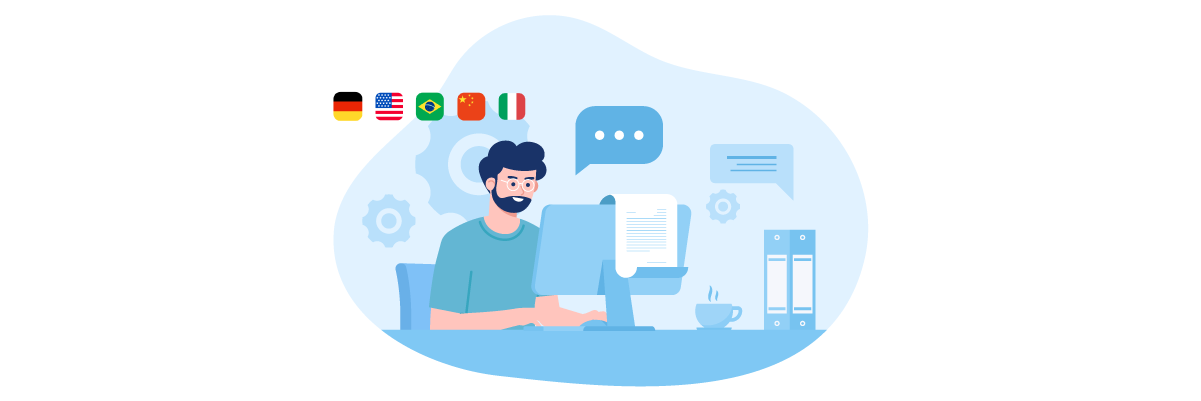
This section walks through a practical, AI-first approach to building a multilingual knowledge base for help centers, FAQs, and self-service support content that scales with your business—without hiring translators or expanding your support team.
Audit support content
Before translating content, it’s important to understand what content actually matters. Most knowledge bases contain a mix of evergreen help articles, outdated guides, and low-impact pages that rarely get views. Translating everything at once often wastes time and resources, especially when some articles no longer reflect the product.
By auditing your support content, you can identify which articles generate the most traffic, answer the most common questions, or help resolve frequent support tickets. These high-impact articles should be prioritized for multilingual support to ensure your effort delivers real value to users.
You can start by reviewing analytics from your help center or support platform. List the most visited articles and those linked to common ticket topics, then mark them as your first translation priority.
Prepare article structure

Well-structured articles are easier to translate and easier to understand in any language. Supporting content that relies on long paragraphs, unclear headings, or inconsistent formatting often leads to poor translation and reader confusion.
A clear structure, using consistent headings, short sections, and simple language, creates a strong foundation for multilingual content. It also makes future updates easier, since changes can be applied consistently across all language versions.
You can start with create a simple support article template with standard sections such as problem description, steps, and expected outcome. Apply this template before translating any content.
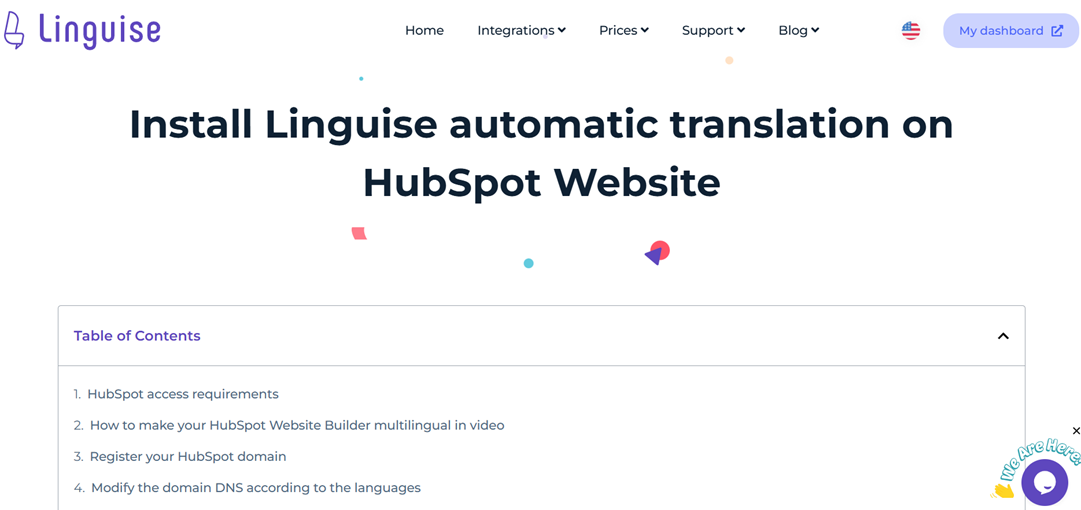
Below is an example of a technical FAQ article structure that prioritizes clarity over length. The article uses a clear title, well-structured headings, and short, step-by-step explanations to guide users through the solution without overwhelming them.
Apply AI translation
AI translation works best as a first pass, not a final answer. It allows businesses to quickly translate large volumes of help content into multiple languages without the cost and delay of manual translation.
When used correctly, AI translation accelerates localization while maintaining acceptable quality for self-service content. This approach enables faster market entry and keeps multilingual knowledge bases up to date as products evolve.
Use AI translation tools to generate initial translations for your prioritized articles. Focus on speed and coverage first, then plan for light reviews rather than full rewrites.
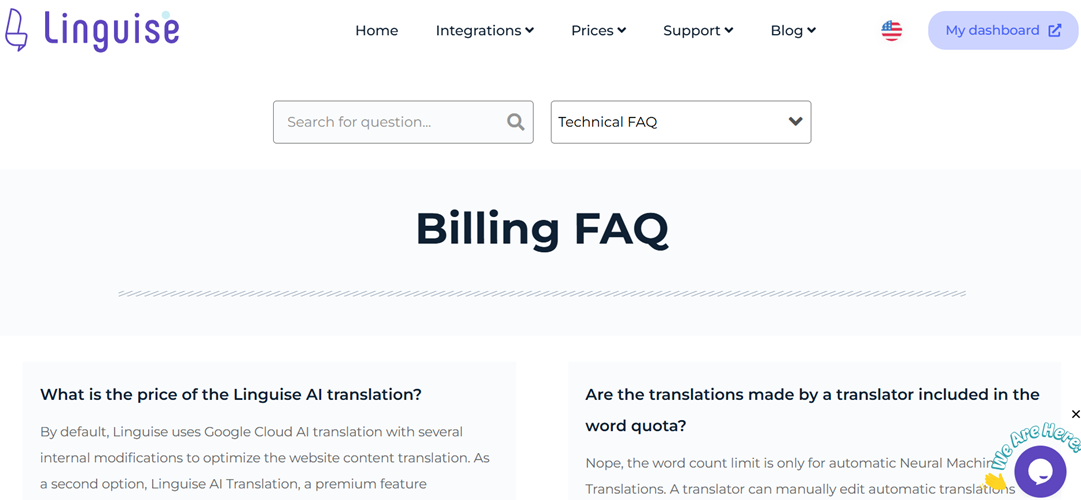
Below is an example of an FAQ page presented in English.
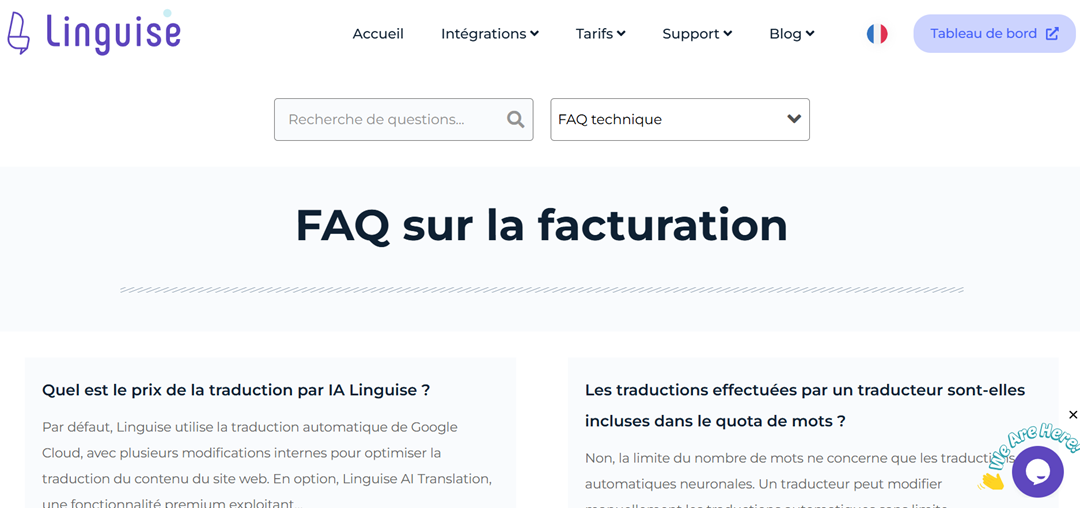
When the content is translated into French, the entire page, including headings, body text, and support details, is automatically adapted to the selected language. This demonstrates that the article structure remains consistent and easy to follow across languages.
Adjust tone and terms
Even accurate translations can feel unnatural if tone and terminology aren’t aligned with user expectations. Support content should feel helpful and familiar, not robotic or overly formal, especially for self-service experiences.
Adjusting tone and key terms helps ensure translated articles sound natural and consistent across languages. This step builds trust and makes users more comfortable relying on the knowledge base instead of contacting support.
Define a short glossary of product terms and preferred phrasing for each language. Review translated articles to ensure they align with your brand voice and style.
Set update workflows
A multilingual knowledge base is not a one-time project. Without a clear update process, translated articles quickly fall out of sync with the original content, leading to outdated or misleading information.
Establishing update workflows ensures that when the source article changes, translations are updated efficiently. This keeps all language versions aligned without adding manual overhead.
Set a rule that every content update triggers automatic AI retranslation, followed by a quick review of key sections before publishing.
Monitor performance and support tickets
Monitoring how users interact with localized articles helps you understand whether the content is actually reducing support demand.
By tracking article views, search behavior, and ticket trends, businesses can refine their multilingual strategy and focus on content that delivers measurable results.
Compare support ticket volume before and after the launch of multilingual articles. Use this data to identify gaps, improve content, and prioritize future translations.
Choosing the right AI translation tool for your knowledge base
As your multilingual knowledge base grows, the tools you use become just as important as the content itself. An AI translation tool should do more than convert text from one language to another, it needs to support ongoing updates, preserve article structure, and fit naturally into your support workflow without adding extra manual work.
The right solution makes it easy to manage help center and FAQ translations at scale, ensuring content stays consistent and accessible as your product evolves. This is especially important for self-service content, where clarity, speed, and reliability directly affect user satisfaction and support ticket volume.
This is where solutions like Linguise fit naturally into an AI-first knowledge base strategy. Linguise enables real-time AI translation for help centers and support articles, allowing businesses to publish multilingual content quickly without hiring translators. It also simplifies ongoing updates, so when an article changes, translations stay aligned, helping teams maintain quality while keeping costs and operational effort under control.
By choosing an AI translation tool designed for scalable support content, businesses can turn their knowledge base into a true self-service asset, one that grows with international demand and reduces pressure on support teams rather than adding to it.
Conclusion
Building a multilingual knowledge base without hiring translators allows businesses to scale support sustainably as they grow internationally. By combining AI-first workflows, structured support content, and continuous performance monitoring, companies can reduce support tickets, control costs, and maintain consistent quality across languages—without expanding their support team or relying on manual translation.
With the right AI translation tool, a multilingual knowledge base becomes a long-term self-service asset rather than an operational burden. If you’re ready to scale your help centre and FAQs efficiently while maintaining high support quality, register with Linguise and start building your multilingual knowledge base with confidence.