As businesses expand globally, localizing cookie consent banners and privacy notices is essential for meeting regional privacy laws such as GDPR, CCPA, and PDPA. Since each regulation has different consent requirements, using the same banner across every market can create compliance risks and reduce user trust.
Whether you operate an e-commerce store, SaaS platform, or multilingual corporate website, your consent interface should reflect both the language and legal expectations of each market. This guide explains the key differences between major privacy laws, what elements should be localized, and how to implement multilingual cookie consent without compromising compliance.
Key points: Localizing cookie consent banners and privacy notices across global markets
Understand global privacy laws
Learn how GDPR, CCPA, PDPA, and LGPD differ in their consent requirements, user rights, and cookie policies to ensure your website complies with regional privacy regulations.
Localize cookie consent and privacy notices
Translate and adapt cookie banners, privacy notices, and consent settings to match each visitor's language, local legal requirements, and expectations for a seamless multilingual experience.
Simplify multilingual compliance
Use a Consent Management Platform (CMP), maintain accurate translations, and regularly audit your consent settings to efficiently manage compliance across multiple languages and regions.
Why cookie consent localization matters
Localizing cookie consent banners and privacy notices goes beyond translating text into another language. It ensures your consent experience aligns with regional privacy laws while making it easier for users to understand how their data is collected and managed. Here are the main reasons why localization matters:
- Meet regional privacy regulations: Different laws have different consent requirements. A cookie banner that complies with GDPR may not fully satisfy CCPA, PDPA, or LGPD, making localization essential for legal compliance.
- Build user trust: Visitors are more likely to interact with a cookie banner when it is presented in their native language with clear, understandable wording, rather than generic or poorly translated legal text.
- Improve consent rates: Users can make informed choices more confidently when consent options and privacy notices are easy to understand, leading to a better user experience and more reliable consent records.
- Reduce compliance risks: Incorrect translations, unclear consent options, or missing legal information can expose businesses to complaints, regulatory investigations, or financial penalties.
- Support a consistent multilingual experience: Localized cookie banners and privacy notices create a seamless experience across all language versions of your website, reinforcing both usability and brand credibility.
GDPR, CCPA, PDPA, and LGPD cookie consent requirements

Privacy laws around the world share the same goal of protecting personal data, but they don’t follow the same rules. Understanding how GDPR, CCPA, PDPA, and LGPD differ is essential before localizing your cookie consent banner or privacy notice. By knowing each regulation’s expectations, you can deliver a consent experience that is both user-friendly and legally compliant across multiple markets.
Consent requirements by regulation
One of the biggest differences between privacy regulations is how and when user consent must be obtained. While GDPR, CCPA, PDPA, and LGPD all aim to protect personal data, they apply different consent models and user rights. Understanding these differences helps businesses choose the appropriate cookie consent approach for each market.
Regulation | Consent Model | Cookie Banner | User Rights |
GDPR (EU) | Opt-in | Explicit consent before non-essential cookies | Withdraw consent at any time |
CCPA (California) | Opt-out | “Do Not Sell or Share My Personal Information” option | Opt out of data sale or sharing |
PDPA (Thailand) | Consent-based | Clear and voluntary consent where required | Withdraw consent easily |
LGPD (Brazil) | Legal basis with consent where applicable | Consent required when it is the legal basis | Revoke consent and exercise data rights |
Although these regulations differ, they all emphasize transparency and giving users greater control over their personal data. Rather than using the same cookie banner worldwide, businesses should adapt their consent experience to meet the requirements of each region.
Cookie banner requirements
A compliant cookie banner should give users clear information and meaningful control over how cookies are used. While the exact requirements vary by regulation, most privacy laws expect businesses to be transparent and avoid misleading consent practices.
Below is an example of a GDPR-compliant cookie preference center on the Crocs website. Users can accept or reject cookies, manage consent by category, and save their preferences at any time.
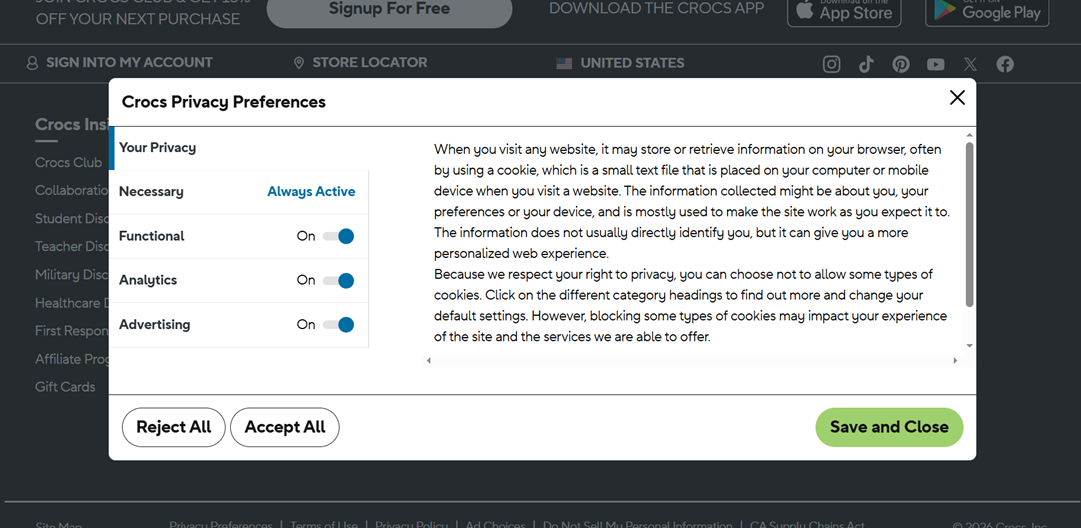
As shown above, users can easily Accept All, Reject All, or customize their preferences by cookie category. Providing clear consent options and equal visibility for acceptance and rejection helps organizations comply with privacy regulations while giving users meaningful control over how their data is processed. A compliant cookie banner should include:
- A clear purpose: Explain why cookies are used, such as for essential functions, analytics, or advertising.
- Granular consent options: Allow users to choose which cookie categories they want to accept.
- Equal consent choices: Make Accept and Reject buttons equally visible, especially for GDPR compliance.
- No pre-selected consent: Keep non-essential cookies disabled until users actively opt in where required.
- Easy preference management: Let users review or change their cookie preferences at any time.
Example: A multilingual e-commerce website serving customers in Europe and California displays a cookie banner in the visitor’s language. European visitors see Accept and Reject buttons before analytics cookies are activated, while California visitors are also provided with a Do Not Sell or Share My Personal Information option.
Privacy notice requirements
A privacy notice explains how an organization collects, uses, stores, and shares personal data. Localizing this document involves more than translation, it should also reflect the legal requirements and terminology of each market while remaining easy to understand. A localized privacy notice should clearly explain:
- What data is collected
- Why the data is collected
- How cookies and tracking technologies are used
- How long personal data is retained
- Whether data is shared with third parties
- How users can exercise their privacy rights
Whenever possible, use plain language instead of overly complex legal terms so users can easily understand their rights and make informed decisions.
Example: A SaaS company provides separate privacy notices in English, French, Thai, and Portuguese. Each version explains the same data practices but also references the privacy rights that apply to users under GDPR, PDPA, or LGPD.
Key compliance differences
Although GDPR, CCPA, PDPA, and LGPD all aim to protect personal data, they differ in how organizations obtain consent and what rights users receive. Understanding these differences helps businesses localize cookie consent without applying the wrong compliance model. The table below highlights some of the most important distinctions.
Regulation | Consent Model | Key Requirement |
GDPR | Opt-in | Obtain explicit consent before using non-essential cookies. |
CCPA | Opt-out | Provide users with a clear option to opt out of the sale or sharing of personal information. |
PDPA | Consent-based | Obtain valid consent when required and make it easy to withdraw. |
LGPD | Legal basis with consent where applicable | Process personal data under a valid legal basis and obtain consent when necessary. |
Although these regulations share the same goal of protecting personal data, businesses should avoid applying a one-size-fits-all consent strategy. Configuring cookie consent based on each visitor’s region helps ensure compliance while providing a smoother user experience.
How to localize cookie consent banners and privacy notices
Localizing cookie consent banners and privacy notices involves more than translating text. You also need to adapt consent options, legal information, and user interactions to meet regional privacy requirements. The following practices can help you create a multilingual consent experience that is both user-friendly and compliant.
Translate cookie consent banners
The cookie banner is often the first privacy notice visitors see, so it should be translated into their preferred language using clear and natural wording. Avoid literal or machine-translated legal text that may confuse users or change the intended legal meaning. When translating your banner:
- Translate all consent messages and button labels.
- Keep legal terms accurate but easy to understand.
- Use language that matches local terminology and reading style.
- Ensure translations remain consistent across all pages.
For example, instead of displaying the same English banner to every visitor, a multilingual website can automatically show French to users in France, Portuguese to users in Brazil, and Thai to users in Thailand. This helps visitors understand their choices without relying on browser translation tools.
Adapt consent settings by region
Different regions have different consent requirements, so your cookie settings should adapt accordingly. Using identical consent options worldwide can result in non-compliance even if the banner has been translated correctly. Depending on the visitor’s location, you may need to:
- Require explicit opt-in before non-essential cookies are activated.
- Display an opt-out option where required.
- Enable category-based consent, allowing users to choose whether to accept necessary, functional, analytics, or marketing cookies.
- Allow users to withdraw or update consent at any time.
For example, a website can require European visitors to actively accept analytics and marketing cookies before tracking begins, while visitors from California are provided with a clear option to opt out of the sale or sharing of personal information. Although the cookie banner may look similar across regions, the available consent options and underlying consent logic should adapt to local privacy requirements.
Localize privacy notices
Your privacy notice should be localized alongside the cookie banner so users receive complete and consistent privacy information. Beyond translation, the notice should reflect applicable legal rights, data processing practices, and contact information for each market. A localized privacy notice should explain:
- What personal data is collected.
- Why the data is collected.
- Which cookies or tracking technologies are used.
- How long the data is stored.
- Whether data is shared with third parties.
- How users can exercise their privacy rights.
Privacy notices should not always be translated literally. Legal terminology, user rights, and contact information may need to be adapted to reflect the applicable regulation in each market while preserving the original legal meaning. Using plain, easy-to-understand language also helps users better understand how their personal data is handled.
Example: An international SaaS provider may offer separate privacy notices in English, German, Portuguese, and Thai. While the core information remains consistent, each version references the privacy rights and legal requirements that apply under the relevant regulation.
Use a multilingual CMP
Managing consent manually across multiple languages and regulations can quickly become difficult as your website grows. A Consent Management Platform (CMP) helps automate cookie consent while ensuring consistency across different regions. A multilingual CMP typically allows you to:
- Display cookie banners in multiple languages.
- Apply different consent rules by country or region.
- Automatically block non-essential cookies until consent is received.
- Store consent records for compliance purposes.
- Update banner content without manually editing each language version.
When choosing a multilingual CMP, look for features such as language support, region-specific compliance rules, automatic geolocation, consent logging, and integration with your CMS or website platform. These capabilities make it easier to manage consent across different markets while reducing manual work.
Popular CMP solutions such as OneTrust, Cookiebot, and Complianz include multilingual support and regional compliance features.
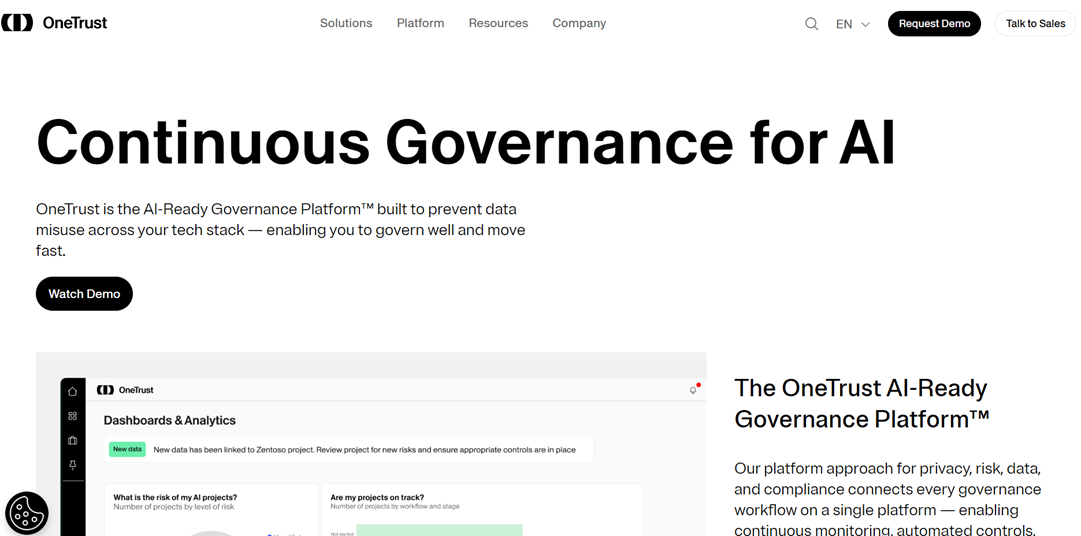
Many of these platforms can also detect a visitor’s language or location and automatically display the appropriate banner.
While a Consent Management Platform (CMP) manages cookie consent and regional compliance, it doesn’t translate the rest of your website. Pairing your CMP with Linguise allows you to provide a fully localized experience, ensuring visitors can understand both your website content and privacy-related information in their preferred language.
Cookie consent localization best practices

Localizing cookie consent banners and privacy notices is not a one-time task. As your website expands into new markets and privacy laws evolve, regular updates and testing are essential to maintain compliance and provide a consistent user experience. The following best practices can help keep your multilingual consent strategy effective over time.
Ensure translation accuracy
Privacy notices and cookie consent banners contain legal information, so translations should be both linguistically accurate and legally consistent. Even small translation errors can confuse users or unintentionally change the meaning of a consent request. To improve translation quality:
- Use professional or legally reviewed translations for privacy-related content.
- Keep legal terminology consistent across all languages.
- Avoid literal machine translations without human review.
- Update all language versions whenever the original content changes.
Example: If the English banner says “Reject All” but the translated version implies “Disable the website,” users may misunderstand the option and hesitate to choose. Accurate wording ensures consent is informed and valid.
Test multilingual UX
A compliant cookie banner should also provide a smooth user experience. After localization, test every language version to ensure users can easily read the banner, understand their options, and manage their preferences. When testing, verify that:
- The correct language appears for the intended audience.
- Text fits properly on desktop and mobile screens.
- Buttons, links, and preference centers work correctly.
- Users can update or withdraw consent without difficulty.
- The banner remains accessible for keyboard and screen-reader users.
Example: A translated cookie banner may fit perfectly in English but become too long in German, causing the Reject button to disappear on smaller mobile screens. UX testing helps identify these issues before they affect users.
Keep up with regulations
Privacy laws continue to evolve, and new guidance or enforcement actions may change how cookie consent should be implemented. Keeping your consent experience up to date helps reduce compliance risks. Good practices include:
- Monitor updates to GDPR, CCPA, PDPA, LGPD, and other applicable regulations.
- Review cookie categories whenever new tracking technologies are added.
- Update banner wording if legal requirements change.
- Train internal teams on new privacy obligations when necessary.
Example: If a regulation introduces new transparency requirements for advertising cookies, your banner and privacy notice should be updated promptly rather than waiting for the next website redesign.
Audit consent regularly
Regular audits help ensure your cookie consent system continues to work as expected after website updates, new integrations, or regulatory changes. They also help identify tracking scripts or cookies that may have been added without proper consent controls. During an audit, check that:
- Cookie banners display correctly in every supported language.
- Consent settings match regional legal requirements.
- Non-essential cookies are blocked until consent is obtained where required.
- Privacy notices remain accurate and up to date.
- Consent records are stored properly through your Consent Management Platform (CMP).
Example: After installing a new analytics or marketing tool, an audit may reveal that cookies are being placed before users give consent. Detecting and fixing this issue early helps maintain compliance and protects user trust.
Document consent changes
Keeping a record of consent-related changes is an important part of maintaining long-term compliance. Whenever you update your cookie banner, privacy notice, or consent settings, document what changed, when it changed, and why. Maintaining clear records helps demonstrate accountability during audits and ensures your team can track compliance updates over time. To document consent changes effectively:
- Record updates to cookie categories and consent settings.
- Keep version histories of cookie banners and privacy notices.
- Log changes made in your Consent Management Platform (CMP).
- Note when updates are made in response to new regulations or website features.
Example: If you add a new marketing tool that introduces additional tracking cookies, document when the cookies were added, update your privacy notice and cookie banner accordingly, and record the changes in your CMP. Having a clear audit trail makes it easier to demonstrate compliance if regulators request it.
Conclusion
Localizing cookie consent banners and privacy notices is essential for businesses serving users across multiple markets. By adapting consent settings to regional regulations such as GDPR, CCPA, PDPA, and LGPD, you can improve transparency, build user trust, and reduce compliance risks while delivering a consistent multilingual experience.
If you’re looking for an easier way to manage multilingual content across your website, try Linguise. With AI-powered website translation, Linguise helps you localize website content efficiently while supporting a seamless multilingual experience. Combined with a compliant Consent Management Platform (CMP), it can help ensure your cookie consent banners and privacy notices are easier for users around the world to understand.