
Expanding your website to Japan requires more than simply translating your existing content. To succeed in Yahoo! Japan, you need to understand how Japanese users search, how Yahoo! Japan’s search results relate to Google Japan, and how localization can affect your SEO performance.
From Japanese keyword research and search intent to localized metadata, user experience, and crawlability, several factors can influence how your translated pages perform in Japanese search results. Keep reading to learn how to optimize your translated website for Yahoo! Japan and build a stronger SEO strategy for the Japanese market.
Key points: Optimizing your translated website for Yahoo! Japan SEO
Optimize for Japanese search intent
Research Japanese keywords and adapt your content to match how users in Japan actually search, including their search behavior, terminology, and intent.
Localize SEO elements
Optimize Japanese titles, meta descriptions, URLs, headings, internal links, and language signals such as lang="ja" and hreflang="ja" to make each translated page clear and relevant.
Make translated pages search-engine friendly
Ensure Japanese pages are crawlable, indexable, and accessible to search engines, while serving translated content, metadata, and links directly in the localized page.
Why Yahoo! Japan requires a dedicated SEO strategy

Yahoo! Japan is one of Japan’s major search platforms, but optimizing for Japanese users requires more than translating your existing SEO content. Differences in search behavior, language, and user expectations make a localized strategy important. Here are the key reasons to build a dedicated SEO strategy for Yahoo! Japan:
- Reach Japanese search users: Optimizing your content for Yahoo! Japan helps your website appear to users who rely on the platform to find information, products, and services.
- Adapt to Japanese search behavior: Japanese users may use different keywords, phrases, and search patterns than users in other markets. Keyword research should therefore reflect how people in Japan actually search.
- Improve content relevance: Direct translations can sound unnatural or miss the intended meaning. Localizing your content helps it better match Japanese language, context, and search intent.
- Build user trust: Japanese audiences may expect localized information, familiar terminology, and a professional user experience. Meeting these expectations can make your website feel more credible and relevant.
- Support better search visibility: A localized SEO strategy ensures that translated pages have optimized content, metadata, URLs, and other elements that help search engines understand and index them correctly
Understanding Yahoo! Japan and Google Japan search

Yahoo! Japan and Google Japan are closely connected because Yahoo! Japan uses Google’s search technology for its web search. However, the two platforms still offer different search experiences, so understanding their relationship can help you create a more effective SEO strategy for Japanese audiences.
How Yahoo! Japan uses Google’s search engine
Yahoo! Japan uses Google’s search technology to power its web search results. This close relationship means that many of the SEO principles you apply to Google Japan can also help your website gain visibility on Yahoo! Japan. You do not need to create an entirely separate technical SEO framework for each platform.
However, appearing in search results isn’t just about using the same SEO techniques. Your website still needs to provide content that is relevant to Japanese users and is easy for search engines to crawl and understand. A translated website should therefore combine a solid technical foundation with proper Japanese localization. This shared SEO foundation includes:
- Quality content: Create useful, original content that clearly answers Japanese users’ questions and needs.
- Japanese localization: Adapt wording, terminology, and cultural context instead of translating content word for word.
- Relevant keywords: Use Japanese keywords that reflect how your target audience actually searches for your products or services.
- Technical SEO: Make translated pages accessible, crawlable, indexable, and easy for search engines to understand.
- Mobile UX: Ensure Japanese pages are responsive, fast, and easy to navigate on mobile devices.
- On-page optimization: Optimize titles, headings, descriptions, URLs, and internal links so search engines can understand each translated page.
In short, Google-focused SEO practices provide a strong foundation for Yahoo! Japan, while Japanese localization helps ensure that your content is relevant to the audience you want to reach.
Key differences between Yahoo! Japan and Google Japan
While their web search technology is closely related, Yahoo! Japan and Google Japan are not exactly the same. Yahoo! Japan has its own ecosystem and integrates various Yahoo! services into its search experience.
Aspect | Yahoo! Japan | Google Japan |
Search technology | Uses Google’s search technology | Uses Google Search |
Search ecosystem | Integrates Yahoo! services and content | Integrates Google services and features |
User experience | Includes Yahoo!-specific search features | Focuses on Google’s search ecosystem |
SEO foundation | Core Google SEO practices remain important | Core Google SEO practices are essential |
Because both platforms share Google’s search technology, optimizing for Google Japan provides a strong SEO foundation for Yahoo! Japan. However, businesses targeting Yahoo! Japan should also consider how Yahoo!’s own services and content appear in its search results. This means your strategy should combine core Google SEO practices with content and localization that fit the broader Yahoo! Japan search experience.
How to optimize for both Yahoo! Japan and Google Japan
You do not need completely separate SEO strategies for Yahoo! Japan and Google Japan. Since Yahoo! Japan uses Google’s search technology, many core SEO practices can support visibility on both platforms. Build a strong technical foundation, then adapt your website for Japanese users. Key areas to focus on include:
- Target Japanese search intent: Research keywords based on how Japanese users actually search.
- Localize your content: Adapt language, terminology, tone, and cultural context.
- Optimize on-page SEO: Use relevant Japanese keywords in titles, headings, metadata, and content.
- Maintain technical SEO: Keep translated pages crawlable, indexable, and properly linked.
- Prioritize user experience: Make Japanese pages fast, mobile-friendly, and easy to navigate.
Together, these practices help create an SEO foundation that works across both platforms while keeping your website relevant to Japanese audiences.
Japanese localization, keywords, and search intent

Translating a website into Japanese is only the first step. To compete in Japanese search results, your content should use the language, keywords, and context that local users naturally understand and search for. This helps search engines connect your pages with the right queries while making the content more useful to Japanese visitors.
Research Japanese keywords
Japanese keyword research should focus on how people in Japan actually search, rather than simply translating keywords from your original language. A direct translation may be grammatically correct but still differ from the phrase Japanese users commonly use.
For example, if you are promoting an online store, translating “buy running shoes online” directly may not produce the most natural keyword. Japanese users might search for 「ランニングシューズ 通販」 (running shoes online shopping) or 「ランニングシューズ おすすめ」 (recommended running shoes), depending on their intent.
You can find relevant Japanese keywords using tools such as Google Keyword Planner and Google Trends, while Yahoo! Japan search suggestions and related searches can reveal phrases users commonly search for. It is also useful to review competitor pages that already rank in Japan to identify relevant keywords, topics, and terminology used by successful local content.
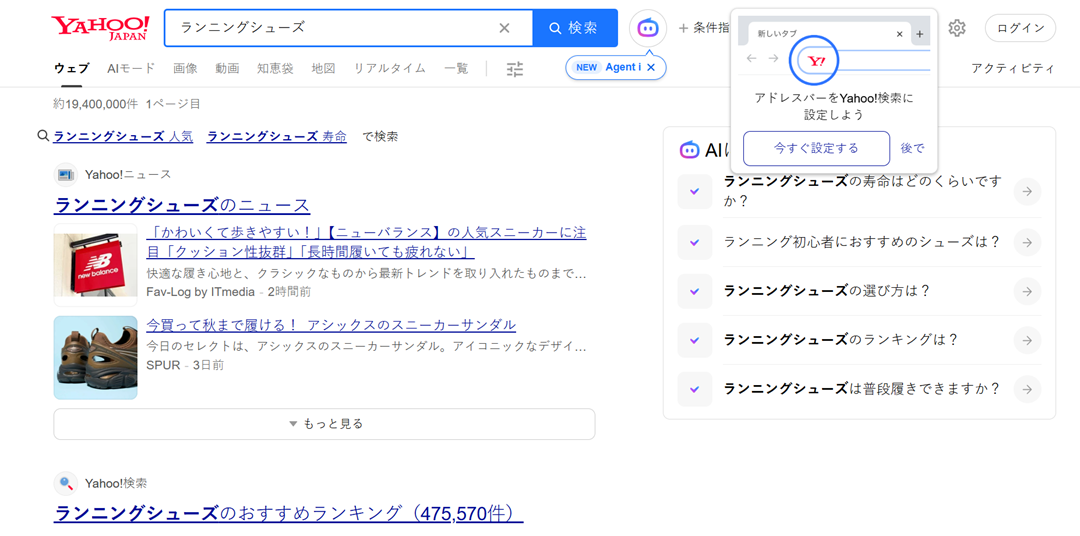
For example, searching for 「ランニングシューズ」 (running shoes) on Yahoo! Japan can help you understand the types of pages and content that appear for a relevant Japanese query. Reviewing these results can also give you ideas for related topics, content formats, and search intent when optimizing your own Japanese pages. When researching Japanese keywords, consider:
- Search volume: Identify terms that Japanese users frequently search for.
- Search intent: Understand whether users want information, comparisons, or products.
- Natural expressions: Check how native Japanese speakers phrase their searches.
- Related keywords: Include relevant variations and terminology throughout the content.
Using Japanese-specific keyword research helps your translated pages target actual search behavior instead of relying on assumptions from another market.
Match search intent
Choosing the right keyword is only part of Japanese SEO. Your content should also match why users are searching for that keyword. The same topic can have different search intents, and Japanese users may expect different types of content depending on their query.
For example, someone searching for 「おすすめのSEOツール」 (recommended SEO tools) is likely looking for comparisons or recommendations, while someone searching for 「SEOツールとは」 (what are SEO tools) is looking for a basic explanation. Creating the same type of page for both queries may not satisfy their needs. Match your content to the intent behind each keyword:
- Informational: Provide guides, explanations, or educational content.
- Commercial: Offer comparisons, reviews, or product information.
- Transactional: Make product or service pages easy to access and convert from.
- Navigational: Help users quickly find a specific brand, service, or page.
Localize beyond language
Effective localization goes beyond translating words from one language to another. Japanese readers may have different expectations around tone, terminology, formatting, and cultural references. Content that sounds natural in English can feel awkward or overly direct when translated literally into Japanese.
For example, an English CTA such as “Get Started Now!” could be translated literally as 「今すぐ始めましょう!」, but the most appropriate wording depends on the context and brand voice. For a Japanese business audience, something like 「まずは無料でお試しください」 (Try it for free first) may communicate the offer more naturally. Consider localizing:
- Tone and formality: Adapt the level of politeness to the target audience.
- Terminology: Use terms commonly recognized by Japanese users in your industry.
- Examples and references: Replace unfamiliar local references when necessary.
- Calls to action: Use wording that feels natural and trustworthy to Japanese users.
- Formatting: Adapt dates, numbers, currencies, and other regional conventions.
The goal is for the Japanese version to feel like content created specifically for Japanese users, rather than a translated copy of the original page.
Optimize Japanese URLs and metadata
Translated pages should also have localized technical and on-page elements. Search engines use URLs, titles, and meta descriptions to understand a page, while users often see these elements before deciding whether to visit it.
For example, Japanese search results can display localized URLs, page titles, and meta descriptions that clearly communicate the page content and match Japanese users’ search intent.
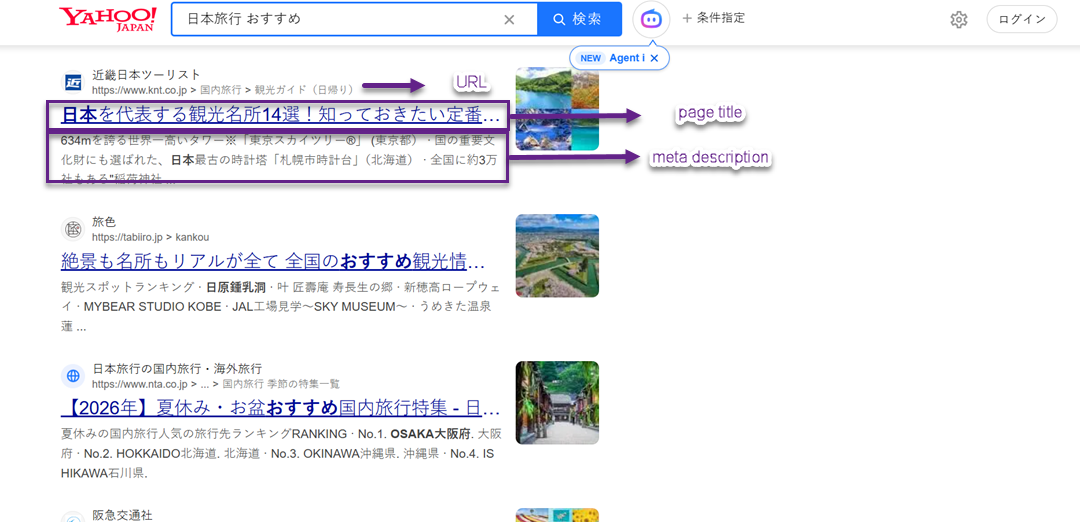
The example above shows a Japanese search result on Yahoo! JAPAN. The result includes a localized URL, a Japanese page title, and a Japanese meta description that briefly describes the page content. These elements make it easier for Japanese users to understand what the page is about before clicking on the result. The page title reflects the page’s main topic, while the meta description provides additional context. The URL also helps indicate the page’s location and structure within the website.
A Japanese website does not necessarily need Japanese characters in its URL. A structure such as /ja/japan-travel/ can also clearly indicate that the page is the Japanese version. The important point is to keep the URL descriptive, consistent, and easy to manage across your multilingual website.
For example, instead of using a completely different URL structure for every translation, you can organize Japanese pages under a consistent language path such as /ja/. This makes it easier to manage localized pages and maintain a clear relationship between language versions. For each Japanese page, optimize:
- Page titles: Write clear Japanese titles that reflect the main keyword and topic.
- Meta descriptions: Summarize the page naturally and provide useful context to encourage clicks.
- URLs: Keep URLs descriptive, consistent, and easy to manage.
- Headings: Use relevant Japanese terminology in H1s and subheadings.
- Internal links: Link to relevant Japanese pages using meaningful anchor text.
These elements help search engines understand the purpose of your translated pages while setting clearer expectations for Japanese users before they click.
Visuals, trust signals, and user experience for Japanese audiences

Optimizing a translated website for Japanese users goes beyond language and keywords. Visual content, trust signals, and the overall user experience can also affect how comfortable users feel when interacting with your website. A page that looks familiar, trustworthy, and easy to use can help Japanese visitors stay longer and take action.
Optimize images
Images should support the localized content and provide a clear experience for Japanese users. Avoid using visuals that contain text in another language or rely heavily on cultural references that may not be familiar to Japanese audiences.
For example, if your original page uses an image showing “Black Friday Sale”, consider replacing or adapting the visual for the Japanese market if the promotion or terminology is not relevant. Localize image text, captions, and alt text where appropriate.
Add trust signals
Trust is especially important when visitors are deciding whether to purchase a product, submit their information, or use an unfamiliar service. Adding relevant local signals can make your website feel more credible and reduce uncertainty for Japanese users.
For example, an e-commerce website targeting Japan can display prices in Japanese yen (¥), provide Japanese customer support, and clearly explain shipping and return policies for Japan. If your business operates locally, you can also include Japanese company and contact information, a local business address, and other relevant business details.
Japanese customer reviews can also help visitors feel more confident about your products or services. Consider highlighting reviews from Japanese customers alongside clear information about shipping, returns, payment options, and customer support. These details make the website feel more relevant to the Japanese market and give visitors the information they need before deciding.
Improve UX
A translated website should feel natural to navigate, not simply have its text replaced with Japanese. Pay attention to navigation labels, buttons, forms, spacing, and page structure so Japanese users can easily understand what to do next.
For example, if the original website uses a short navigation label such as “Features,” the Japanese version could use 「機能」 rather than an unnecessarily long translation. Forms should also use clear Japanese labels and instructions, particularly for important fields such as names, addresses, and phone numbers.
Optimize for mobile
Mobile usability is another important consideration when targeting Japanese audiences. Your translated pages should remain easy to read and interact with on smaller screens, especially because users may discover your website through mobile search.
Check that Japanese text does not create unexpected line breaks, buttons remain easy to tap, and images load correctly on mobile devices. For example, a CTA such as 「無料で試す」 should remain clearly visible and clickable without requiring users to zoom or scroll horizontally.
How server-side translation supports Yahoo! Japan SEO

For a translated website to perform well in Yahoo! Japan search, search engines need to be able to access and understand the Japanese version of each page. Server-side translation helps by delivering translated content directly in the page response, making it easier for search engine crawlers to access localized content and its SEO elements.
Make pages crawlable
Search engines need to crawl your Japanese pages before they can understand and potentially index them. If translated content only appears after JavaScript runs in the browser, crawlers may have more difficulty accessing the complete localized page.
With server-side translation, you can deliver the Japanese content as part of the page response. This means crawlers can access important elements such as translated text, headings, links, and other HTML content.
You should also set the page language to Japanese using the HTML lang attribute, such as <html lang=”ja”>, to clearly identify the page as Japanese-language content. In addition, use hreflang=”ja” to indicate that the page is intended for Japanese-language users and help search engines distinguish it from other language versions.
For example, if /product/ is available in Japanese at /ja/product/, the Japanese page should return its translated content directly rather than showing the original language first and translating it only after the page loads.
Serve translated metadata
Translation should not stop at the visible content. Search engines also use page elements such as title tags and meta descriptions to understand a page and generate search result snippets. Serving these elements in Japanese helps keep the search experience consistent with the translated page.
For example, an English title such as “Best Running Shoes for Beginners” should have an appropriate Japanese title such as 「初心者におすすめのランニングシューズ」 on the Japanese version. Also localize the meta description rather than reusing the English version.
Keep content SEO-friendly
Server-side translation should preserve the original page’s SEO structure while delivering natural Japanese content. Important elements such as headings, links, structured content, and page hierarchy should remain accessible to search engines.
At the same time, automated translation should not be treated as the final step. Translated content should still be reviewed for natural language, keyword usage, search intent, and accuracy. For example, a product description should use Japanese terminology that customers actually search for rather than a literal translation of the original product name.
For websites with many pages, maintaining these translated elements manually can become time-consuming. A server-side translation solution such as Linguise can help automate the translation process while keeping localized content and SEO elements available on each translated page. This makes it easier to maintain consistent Japanese content as your website grows.
Maintain Japanese internal links
Internal links help search engines discover related pages and understand how content is connected across your website. When creating a Japanese version, these links should point to the corresponding Japanese pages instead of sending users back to the original-language content.
For example, if a Japanese blog post links to an English product page, users may suddenly switch languages after clicking. Instead, the Japanese version should link to the corresponding localized product page, such as /ja/products/running-shoes/.
Maintaining a consistent Japanese internal linking structure creates a smoother user experience and makes it easier for search engines to discover and crawl your localized content.
Japan SEO launch checklist

Before launching your translated website in Japan, use this checklist to make sure the key SEO, localization, and user experience elements are ready:
- Research Japanese keywords: Target terms based on how Japanese users actually search.
- Match search intent: Make sure each page answers the intent behind its target keyword.
- Localize on-page elements: Adapt titles, meta descriptions, URLs, headings, and content for Japanese users.
- Set language signals: Use lang=”ja” and hreflang=”ja” for the Japanese version.
- Check crawlability: Make sure search engines can crawl and index translated pages.
- Review internal links: Ensure Japanese pages link to other relevant Japanese pages.
- Optimize visuals and mobile UX: Check images, layouts, buttons, and text readability on mobile devices.
- Add local trust signals: Provide relevant Japanese pricing, support, shipping, return, and business information.
- Review translated content: Check the language, terminology, keywords, search intent, and accuracy.
- Test before launch: Review the complete Japanese user experience and fix any localization or technical issues.
Conclusion
Optimizing your translated website for Yahoo! Japan requires more than simply translating your existing content. Japanese keyword research, localized search intent, natural content, optimized metadata, mobile UX, and crawlable translated pages all help create a website that is relevant to both search engines and Japanese users.
If you want to simplify the process, a server-side translation solution can help deliver translated content and SEO elements directly to search engines while maintaining your existing website structure. For an easier way to manage your multilingual website, you can try Linguise and explore how it can support your Japanese SEO strategy.