
Localizing image alt-text might seem like a small technical detail, but it can quietly unlock a major source of global traffic that many websites overlook. Imagine that you’ve spent hours creating beautiful visuals for your website, yet they’re only reaching users in one language. Meanwhile, potential visitors from other countries are actively searching through Google Images, using different keywords, in different languages, and your content simply doesn’t show up. That’s not because your visuals aren’t good, but because search engines can’t fully understand them across languages.
By translating and optimizing your image alt-text, you’re opening the door to high-intent users who are ready to click, explore, and convert. Keep reading to discover the strategy step by step.
Key points: How localized image alt-text helps you dominate global image search
Localize alt text by language
Each translated page should have its own alt text so the image description matches the local audience and page language.
Keep descriptions clear and useful
Alt text should describe what is visible in the image in a short, accurate way that helps both users and search engines.
Add keywords naturally
Use local search terms only when they fit naturally, so the alt text stays accessible and still supports image SEO.
Why localizing image alt-text is critical for global SEO
When you’re targeting a global audience, image alt-text needs to be localized as well. Alt-text is how search engines understand what an image is about, so if it’s only written in one language (for example, English), your chances of appearing in image search results in other languages become very limited. Meanwhile, users across different countries search using different keywords, and without localized alt-text, your images simply won’t show up where they should.
Beyond that, localized alt-text improves content relevance in the eyes of search engines while also supporting accessibility for users who rely on screen readers. This means you’re not only expanding your SEO reach but also creating a more inclusive experience that aligns with global standards. With this seemingly small step, you’re actually unlocking a major opportunity to capture international traffic that would otherwise be missed.
The hidden opportunity in Google Images traffic

Google Images is often overlooked in SEO, yet it offers a powerful way to drive global traffic. While most websites focus on traditional search, many users rely on image search to find ideas, products, and information across languages. Without proper optimization, this valuable traffic source is easily missed.
Untapped traffic source
Many websites invest heavily in written content but forget that images can rank independently on Google. Every image you upload has the potential to appear in search results, bringing in visitors who may never land on your pages through regular search. Without proper alt-text—especially in multiple languages—this opportunity remains largely unused.
Here’s a simple example of how this looks in practice. Even though these searches refer to the same product, the results can differ significantly depending on the language used. The query “black leather bag” shows results tailored to English-speaking users.
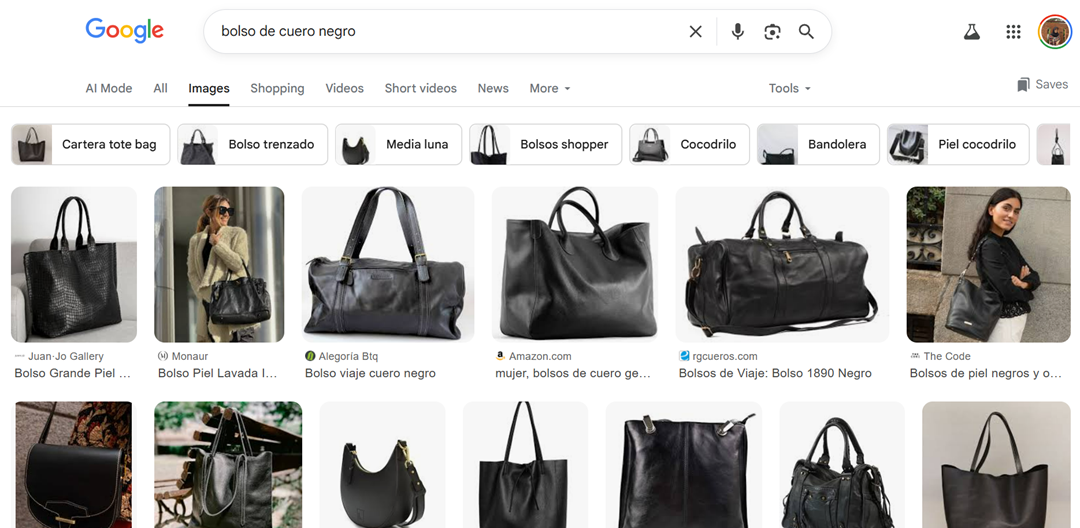
While “bolso de cuero negro” returns content optimized for Spanish-speaking audiences.
By localizing your image alt-text, you enable your visuals to appear in search results across different regions. This means a single image can attract traffic from multiple countries, turning your existing content into a scalable source of international visibility without creating anything new.
Image search intent
Users who search Google Images often have a more specific, visual intent. They’re not just looking for general information—they want to see examples, inspiration, or exact matches for what they have in mind. This makes image search a powerful channel for connecting with users as they’re actively exploring options.
When your alt-text matches the language and intent of these users, your images become more relevant to their searches. This increases the likelihood that your content will be shown and clicked, helping you reach audiences already interested in what you offer.
High-intent users
Traffic from Google Images is often more valuable than it seems. Users who click on images are typically further along in their decision-making process—they’re comparing, evaluating, or looking for something specific. This makes them more likely to engage with your content or take action.
By showing up in localized image searches, you’re not just increasing visibility, you’re attracting users who are ready to explore deeper. This is what makes image alt-text localization such a high-leverage strategy: it brings in not just more traffic, but the right kind of traffic.
How localized alt-text improves Google Image rankings

Localized alt-text helps search engines better understand your images across different languages, making them more relevant to global search queries. By aligning your alt-text with how users actually search in their native language, you increase the likelihood that your images appear in the results you want.
Alt-text interpretation
Search engines rely on alt-text to understand what an image represents. Without it, images become harder to interpret, especially when there’s no surrounding context. When alt-text is clearly written and localized, it provides search engines with stronger signals about the image’s content and purpose.
In a multilingual context, this becomes even more important. If your alt-text matches the language of the user’s query, search engines can connect your images more accurately to relevant searches, improving your chances of ranking higher in image results.
Multilingual keywords
Each language comes with its own way of searching, including different keywords, phrasing, and intent. Simply translating content word-for-word isn’t always enough—your alt-text needs to reflect how users actually search in that specific language.
By using the right multilingual keywords in your alt-text, you make your images more discoverable in different regions. This helps your content appear in a wider range of search results, expanding your reach without creating new images.
Relevance, accessibility, and compliance
Localized alt-text improves relevance by matching your images with the right audience and language. The more relevant your content is to a user’s query, the higher the chance it will appear in search results and attract clicks.
At the same time, alt-text plays a key role in accessibility, helping users who rely on screen readers understand visual content. Many global standards, such as the Web Content Accessibility Guidelines (WCAG), recommend providing clear, descriptive alt text for images. In practice, this means writing alt-text that accurately describes the image in the user’s language.
In some regions, this is also part of legal requirements, so localizing alt-text not only supports SEO but also helps ensure your website meets international accessibility standards.
Best practices for localizing image alt-text in multiple languages
To get the most out of image alt-text localization, you need an approach that is not only effective but also scalable. The goal is to make your images understandable across languages without adding unnecessary manual work.
Automated translation workflows for scale
Manually translating alt-text for every image can quickly become overwhelming, especially if your website has a large media library. Instead of handling each image one by one, automated workflows allow alt-text to be translated alongside your page content, making the process faster, more consistent, and easier to scale.
For example, on an e-commerce site with hundreds of product images, alt-text like “black leather handbag” can be automatically translated into “tas kulit hitam” or “sac en cuir noir” without manual input. This ensures your images become searchable in multiple languages as soon as your content is translated.
To streamline this process, you can use tools like Linguise, which translate not only visible content but also elements like image alt-text in real time. Because it works directly on the front-end, your translated alt-text is applied instantly across all languages without duplicating pages or editing media files individually. The result is a scalable, “invisible” workflow that keeps your images optimized and consistently localized with minimal effort.
Write natural alt-text for each target language
Alt-text should feel natural in every language, not just translated word-for-word. What sounds clear in English may feel awkward or unnatural in another language, which can reduce both user experience and SEO performance.
For example, instead of translating “black leather handbag fashion” directly, a better localized version would adapt to how users naturally describe it, such as “tas kulit hitam elegan” in Indonesian. The goal is to match how people actually search, not just translate words.
Avoid keyword stuffing across languages
Keyword stuffing becomes even riskier in multilingual SEO, especially when keywords are copied directly from one language to another without considering local search behavior. Each language has its own structure, phrasing, and intent.
For instance, repeating keywords like “red shoes sneakers running shoes” in multiple languages creates unnatural and spammy alt-text. A better approach is to use one clear, relevant phrase per language, such as “red running shoes on a white background,” adapted naturally into each target language.
Optimize image file names for multilingual SEO
Image alt-text is also play a role in helping search engines understand your visuals. If your file names are generic, you’re missing another opportunity to strengthen your multilingual SEO.
For example, instead of “IMG_1234.jpg,” use “black-leather-handbag.jpg.” For global targeting, you can also localize file names like “tas-kulit-hitam.jpg.” This reinforces the image context and improves discoverability across different languages.
Write contextual alt-text that matches page intent
Alt-text should not only describe the image but also align with the intent of the page. Search engines evaluate how well your image fits within the overall content.
For instance, if your page is about “summer outfit ideas,” an alt-text like “yellow summer dress outfit” is far more relevant than “woman wearing a dress.” This alignment strengthens your SEO signals and increases your chances of ranking in the right search results.
Maintain consistent meaning across languages
When localizing alt-text, consistency is key. While wording may change, the meaning should remain the same across all languages to ensure a unified user experience and clear search signals.
For example, if your English alt-text is “modern minimalist living room,” the Spanish version should reflect the same concept, such as “sala de estar minimalista moderna.” This helps search engines connect your multilingual content and improves overall indexing.
Prioritize high-impact images for quick wins
You don’t need to optimize everything at once. Start with the images that can deliver the most impact, then scale from there.
For example, begin with images on high-traffic pages, product pages, or blog posts that already rank well. Improving alt-text on these pages can quickly help your images appear in Google Images, bringing in additional traffic without creating new content.
Conclusion
Localizing image alt-text is one of those rare SEO strategies that is both simple and high-impact. While many websites continue to overlook it, you now have the opportunity to turn your existing images into a scalable source of global traffic. By combining localization with automation, you’re building a system that continuously captures high-intent users across languages.
To make this easier to implement, you can start with Linguise, which helps automate alt-text translation as part of your multilingual workflow, so you can scale without the manual effort.