
Going multilingual before you have traffic may seem like a strategy reserved for established businesses, but it can actually give startups and early-stage companies a competitive advantage. Instead of waiting until your website attracts significant traffic, you can start validating international markets early, reach potential customers in their preferred languages, and identify growth opportunities without making a large upfront investment.
By focusing on the pages that matter most, testing demand before committing to full website localization, and expanding strategically as your business grows, you can minimize costs while maximizing your chances of success. Read on to learn how startups can build a cost-effective multilingual strategy that supports international growth from day one.
Key points: How startups can go multilingual before they have traffic
Build a minimum viable website
Translate only essential, high-impact pages first, allowing you to launch a multilingual website quickly without the cost of localizing every page.
Validate market demand
Test new markets with multilingual landing pages and analyze performance data to determine where your startup should invest before expanding further.
Scale strategically
Prioritize languages based on revenue-per-effort and gradually expand your localization workflow as your startup grows and enters new international markets.
Why go multilingual before you have traffic?

Many startups assume they need strong website traffic before investing in a multilingual website. In reality, going multilingual early allows you to test international opportunities before committing significant time and budget. Instead of treating localization as a later-stage project, you can use it as a cost-effective way to validate new markets and support long-term growth.
- Validate international demand early: A multilingual website helps you discover whether users from specific countries are interested in your products or services. Rather than relying on assumptions, you can collect real data on traffic, engagement, and conversions before making larger localization investments.
- Reach customers in their preferred language: People are more likely to explore a website and complete a purchase when content is available in their native language. Even if your startup is still small, offering localized pages can improve user experience and make your business more accessible to international audiences.
- Reduce the risk of expanding into the wrong market: Testing multiple languages early helps you identify which markets offer the best opportunities. This allows you to prioritize countries with the highest growth potential instead of spending your limited budget on markets that may not generate meaningful results.
- Build a foundation for future growth: Starting with a multilingual strategy from the beginning makes it easier to scale as your startup grows. You can gradually add more languages, pages, and localized content without having to redesign your entire localization workflow later.
Build a minimum viable multilingual website

A minimum viable multilingual website (MVMW) helps startups enter international markets without translating every page. Instead of investing in full localization from the beginning, focus on translating only the content that helps visitors understand your business and take action. This lean approach keeps costs under control while allowing you to validate market demand before expanding your multilingual website.
Translate essential pages
Start by translating the pages that international visitors are most likely to see during their journey. These pages should provide enough information for users to understand what you offer and decide whether to contact you, sign up, or make a purchase. For most startups, the essential pages typically include:
- Homepage: Introduces your business, value proposition, and primary call to action.
- Product or service pages: Explains your solution, features, and benefits.
- Pricing page: Helps potential customers understand costs without language barriers.
- About page: Builds trust by introducing your company and mission.
- Contact page: Makes it easy for international visitors to reach your team.
- Key landing pages: Supports specific marketing campaigns or target markets.
For example, imagine a SaaS startup planning to expand into Germany. Instead of translating more than 100 blog posts, the company first localizes its homepage, product page, pricing page, and demo request page. These pages provide everything German visitors need to evaluate the product and request a demo, while the remaining content stays in the original language until demand is proven.
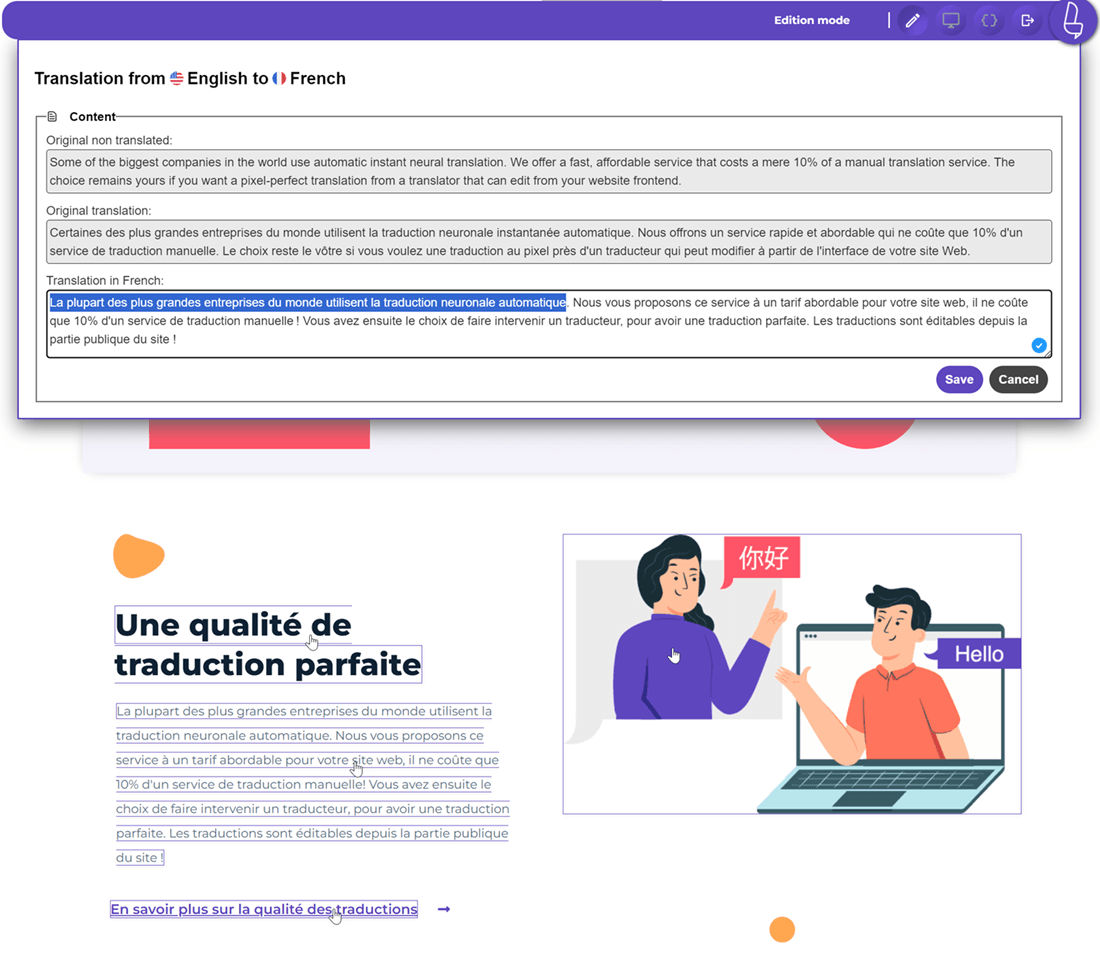
As your translation needs grow, managing multiple language versions manually can become time-consuming. With Linguise, startups can automatically translate their website and then use the front-end live editor to quickly review and refine high-impact pages, such as the homepage, pricing page, and landing pages, without editing code or managing multiple language versions manually.
Focus on high-impact content
Not every page contributes equally to your business goals. Prioritize content that directly influences user decisions, such as signing up for a free trial, requesting a demo, subscribing to a newsletter, or completing a purchase. High-impact content often includes:
- Product descriptions that explain your solution.
- Pricing information that answers buying questions.
- Customer testimonials and case studies that build credibility.
- Frequently Asked Questions (FAQ) that reduce uncertainty.
- Landing pages used for paid advertising or email campaigns.
For example, if your startup runs Google Ads targeting users in Spain, translating the campaign landing page will likely generate a higher return than translating dozens of informational blog articles. Visitors arriving from the ad can immediately understand your offer and complete the desired action without encountering a language barrier.
As your website grows, you can identify additional high-impact pages by reviewing analytics. Pages with the highest traffic, longest engagement time, or strongest conversion rates are usually the best candidates for future translation.
Limit your translation scope
One of the biggest mistakes startups make is trying to translate everything at once. While this may seem like the fastest way to serve international audiences, it often results in higher costs, more maintenance, and unnecessary work if the target market does not perform as expected.
Instead, keep your initial translation scope small and manageable. Focus on the pages required to support customer acquisition, while leaving less important content, such as older blog posts, archived announcements, or low-traffic resources—in the original language. A practical rollout might look like this:
- Phase 1: Homepage, product pages, pricing, contact page, and one campaign landing page.
- Phase 2: FAQ, onboarding guides, and customer success stories.
- Phase 3: Blog articles, knowledge base, documentation, and additional marketing content.
This phased approach allows your startup to validate market interest before committing additional resources. If a particular language generates strong traffic, qualified leads, or sales, you can confidently expand your translated content. If results are limited, you’ve minimized the investment while gaining valuable insights into which markets deserve further attention.
Validate demand before full translation

A lean multilingual strategy helps startups validate market demand before fully localizing their website. By testing markets first, you can reduce risk, optimize your budget, and make expansion decisions based on real data.
Test with multilingual landing pages
One of the easiest ways to validate a new market is to create a multilingual landing page rather than translating your entire website. A landing page requires less time and budget to produce, yet it can reveal whether users in a specific region are interested in your product or service.
Your landing page should clearly communicate your value proposition and include a strong call to action, such as requesting a demo, joining a waitlist, signing up for a free trial, or downloading a resource. It should also be fully localized for the target audience, including the language, currency, date format, and messaging where appropriate.
For example, imagine your startup wants to expand into France. Instead of translating every page on your website, you create a French landing page that introduces your product and offers a free trial. You then drive traffic through Google Ads, social media campaigns, or localized SEO. If the landing page generates qualified leads or trial signups, you have evidence that the market is worth further investment.
Measure demand before investing
Launching a multilingual landing page is only the first step. The next step is measuring whether the market shows enough potential to justify translating additional pages or adding long-term localization resources.
Instead of focusing only on website traffic, track metrics that reflect genuine business interest, such as:
- Conversion rate from visitors to leads or customers.
- Demo requests or free trial registrations.
- Newsletter subscriptions.
- Contact form submissions.
- Cost per acquisition (CPA) for each target market.
- Revenue generated from localized visitors.
For example, suppose your startup launches landing pages in both Italian and Dutch. After one month, the Italian page attracts fewer visitors but generates twice as many demo requests and has a lower acquisition cost. Although traffic is lower, the Italian market demonstrates stronger buying intent, making it a better candidate for further localization.
Using performance data rather than assumptions allows startups to invest their limited budgets where they are most likely to see meaningful returns.
Prioritize languages by revenue-per-effort
Many startups choose languages based on the number of native speakers or the popularity of a country. While these factors may seem logical, they do not always produce the best business results. A better approach is to prioritize languages based on revenue-per-effort—the balance between the potential business value and the resources required to support that language.
When evaluating which language to expand into next, consider factors such as:
- Market demand and customer interest.
- Conversion and revenue potential.
- Translation and maintenance costs.
- Customer support requirements.
- Competition within the target market.
- Existing website traffic from specific countries.
For example, translating a website into Spanish may reach a broad audience, but it also requires supporting users across multiple countries with different regional preferences. On the other hand, translating into Dutch targets a smaller audience but may require less localization effort while generating higher conversion rates for your product. In this case, Dutch could deliver a better revenue-per-effort ratio despite serving fewer users.
By prioritizing languages based on measurable business outcomes instead of assumptions, startups can grow internationally with greater confidence. As new markets prove successful, they can continue adding languages strategically rather than spreading their resources too thin.
Scale as your startup grows

Once you’ve identified promising markets, you can gradually expand your multilingual website. Instead of translating everything at once, grow your localization efforts alongside your startup to keep costs manageable and ensure every investment supports measurable business growth.
Expand languages gradually
After validating demand in your initial target market, consider adding new languages one at a time instead of launching several simultaneously. This allows your team to focus on maintaining quality, monitoring performance, and learning from each expansion before moving to the next market.
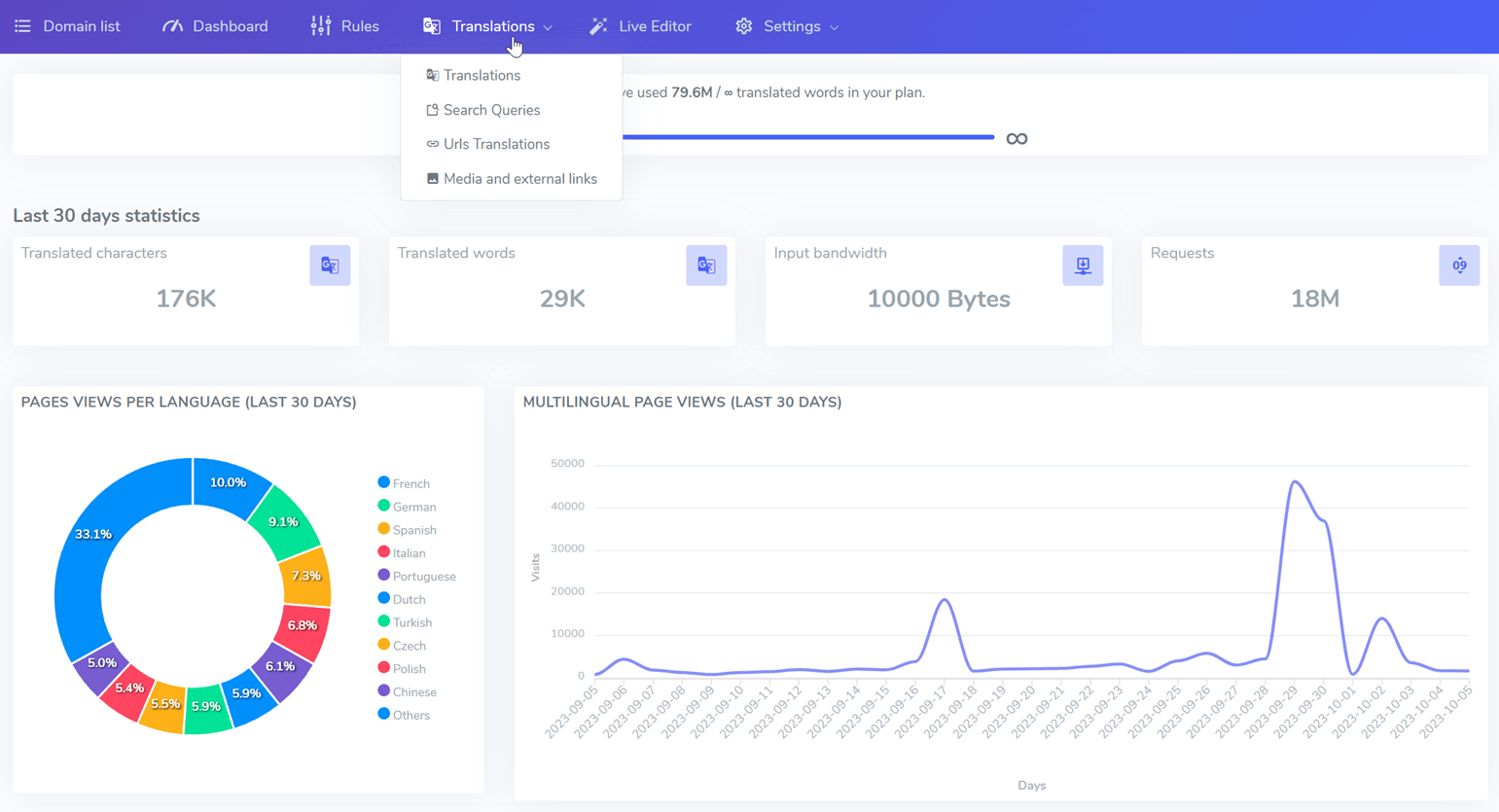
As your startup expands into additional markets, managing multiple language versions manually can quickly become more complex. Using a centralized dashboard, such as the one provided by Linguise, helps you organize and manage translations from a single place, making it easier to add new languages, monitor translation progress, and scale your multilingual website as your business grows.
Translate more pages over time
As your international audience grows, your multilingual website should grow with it. Start by translating only essential pages, then gradually localize additional content that supports the customer journey.
A typical expansion might begin with product, pricing, and contact pages. As traffic and conversions increase, you can translate FAQs, customer success stories, onboarding guides, blog posts, and help documentation. This ensures your translation budget is spent on content that delivers the greatest value at each stage of growth.
Build a repeatable localization workflow
Creating a repeatable workflow makes it easier to maintain your multilingual website as you add more content and languages. Instead of handling translations as one-off projects, establish a consistent process for publishing, reviewing, and updating localized content.
For example, every time your team publishes a new product page, the workflow could include preparing the source content, translating it into your target languages, reviewing the translations, and publishing all language versions together. Having a standardized process helps small teams stay organized, maintain consistency across languages, and scale their localization efforts without significantly increasing their workload.
Conclusion
For startups, going multilingual before you have traffic is a practical way to explore international opportunities without making a significant upfront investment. By building a minimum viable multilingual website, validating demand before full translation, prioritizing languages by revenue-per-effort, and scaling gradually, you can reduce costs while making more informed expansion decisions.
If you’re ready to expand your startup into international markets, try Linguise to translate, manage, and scale your multilingual website more efficiently. With AI-powered translation and an easy-to-manage localization workflow, Linguise helps you focus on growing your business while delivering localized experiences to customers around the world.