

Optimize your multilingual site for AI search engines, it’s becoming a critical strategy for anyone targeting a global audience. If you’ve been relying on traditional SEO and direct translations, you might start noticing that your content isn’t performing the same way in AI-driven search results. That’s because AI doesn’t simply rank pages—it interprets meaning, context, and user intent across different languages.
Traditional SEO begins to fall short when search behavior shifts toward conversational queries and intent-driven results. In this guide, you’ll discover how AI search works differently, what actually influences rankings, and how to structure your multilingual content to stay visible.
Keypoints: Best practices for multilingual AI search optimization
AI search focuses on intent
AI evaluates content based on meaning and intent, making keyword-based translation less effective.
Content & technical SEO matter
Strong content and proper multilingual setup (URLs, hreflang, crawlability) are essential for visibility.
Automation enables scalability
Tools like Linguise automate translation while preserving context and SEO across languages.
Differences between AI search and traditional search

In the past, search engines focused on matching keywords and page structure. Today, AI understands context, intent, and relationships between words across languages, making traditional SEO less effective.
This shift also changes how content is presented—AI delivers direct, relevant answers rather than just listing pages. Here are the key differences you need to know.
Static vs contextual
Traditional search works in a more static way, meaning it relies on indexed data and matches queries with pages based on predefined signals. Content is evaluated using keywords, meta tags, and relatively fixed structures, without a deep understanding of the context behind a search.
In contrast, AI search is contextual. It aims to understand the intent behind a query, including the situation, language, and even how the user expresses their search. This means a single piece of content can appear for multiple query types because AI focuses on meaning rather than exact word matches.
Keywords vs meaning
In traditional SEO, keywords are the core of optimization. Content is often structured around specific keyword usage to make it easier for search engines to identify relevance. This approach can sometimes make content feel rigid and less natural, especially in multilingual contexts.
AI search shifts the focus from keywords to meaning. AI-powered engines understand synonyms, variations in language, and sentence context. So even if users use different words in different languages, AI can still connect them to relevant content as long as the meaning aligns.
Ranking vs answers
Traditional search presents results in the form of ranked pages. Users need to click through these results to find the information they are looking for, making ranking position a key focus in SEO strategies.
AI search changes this approach by delivering direct answers. Instead of just listing links, AI summarizes information from multiple sources and presents it instantly. As a result, content quality and clarity become more important than simply achieving a high ranking.
Queries vs conversations
In traditional search, queries are usually short and keyword-based. Users tend to type simple phrases like “best multilingual SEO tools” to get relevant results.
On the other hand, AI search encourages conversational queries. Users are more likely to ask complete questions or interact in a dialogue format. This means the content needs to be written in a more natural, informative way to effectively answer user questions and match their intent.
Key ranking factors in AI search

AI evaluates content in a more advanced way—looking at how well your content understands user intent, delivers meaningful information, and stays relevant across different languages. That’s why understanding these key ranking factors is essential if you want your multilingual site to stay visible.
Content relevance & semantics
Content relevance in AI search goes beyond mere keyword matching. AI analyzes how well your content answers a topic in depth and whether the meaning aligns with what users are searching for. It looks at sentence structure, context, and how ideas are connected within the content.
Semantics play a big role here. Instead of repeating the same keywords, your content should use natural variations and explain topics clearly. The more your content reflects real understanding rather than keyword stuffing, the more likely it is to be recognized as relevant by AI systems.
Authority & trust
AI search engines prioritize content that appears reliable and trustworthy. This includes signals like accurate information, consistent messaging, and content that demonstrates expertise in a specific topic. Websites that regularly publish high-quality content tend to build stronger authority over time.
Trust is also influenced by how your content is presented. Clear explanations, credible references, and a professional structure help AI determine that your content can be relied on. In multilingual contexts, maintaining consistent quality across all languages is essential to building global trust.
User intent across languages
Understanding user intent is one of the most important factors in AI search, especially for multilingual websites. Different languages often express the same intent in different ways, and AI seeks to connect these variations to a shared underlying need.
This means your content should not just be translated word-for-word, but adapted to match how users in different regions search and think. When your content aligns with intent across languages, AI is more likely to surface it for a wider range of queries.
Content freshness
AI search values content that is up-to-date and relevant to the current user’s needs. Fresh content signals that your website is actively maintained and provides accurate information, which increases its chances of being selected by AI.
Regularly updating your content also helps improve its performance over time. This doesn’t always mean creating new pages—you can refresh existing content with updated insights, improved clarity, or additional context to keep it relevant in AI-driven search results.
Optimize multilingual site for AI search engines
Optimizing a multilingual site for AI search engines goes beyond simple translation. Your content needs to be clear, relevant, and easy to understand across different languages. AI evaluates meaning, structure, and user intent, so every element of your site should support that.
You can improve performance step by step by focusing on the key areas that influence how AI understands your content. Here’s how to get started.
Context-rich content
AI search prioritizes content that provides clear context. This means your content should fully explain a topic, connect related ideas, and avoid being too shallow. The more complete and informative your content is, the easier it is for AI to understand and recommend it.
To optimize this, start by expanding your content beyond basic explanations. Add supporting details, examples, and related subtopics that help clarify the main idea. Make sure each page addresses a specific topic comprehensively rather than spreading information too thin. For example:
- Basic: “This tool translates websites.”
- Context-rich: “This tool translates multilingual websites automatically while preserving SEO structure and context.”
Natural multilingual language
AI understands natural language, so your content should feel human and fluent in every language. Direct, word-for-word translation often results in awkward phrasing that can reduce clarity and relevance.
To optimize this, focus on localization rather than translation. Adapt tone, phrasing, and sentence structure to match how people naturally communicate in each language. You can also review translated content manually or use tools that ensure more natural output. For example:
- Direct translation: “Cheap shoes to buy”
- Natural language: “Affordable shoes to buy online”
This small change makes the content more natural and easier for AI to understand.
Content hierarchy for AI
A clear content structure helps AI understand the relationship between different parts of your page. Headings, subheadings, and logical flow make it easier for AI to process and extract information.
To optimize this, use a consistent heading structure (H1, H2, H3) and organize your content from general to specific. Break complex topics into sections and ensure each section clearly supports the page’s main topic.
Internal linking for semantics
Internal links help AI understand how your content is connected. They provide additional context and signal which pages are related.
To optimize this, link relevant pages using descriptive anchor text. Connect content across languages when appropriate, and ensure your internal links guide users (and AI) to deeper, related information within your site. To optimize this, use clear and descriptive anchor text. For example:
- ❌ “Click here”
- ✅ “Learn more about multilingual SEO strategy.
Multilingual URLs & tags
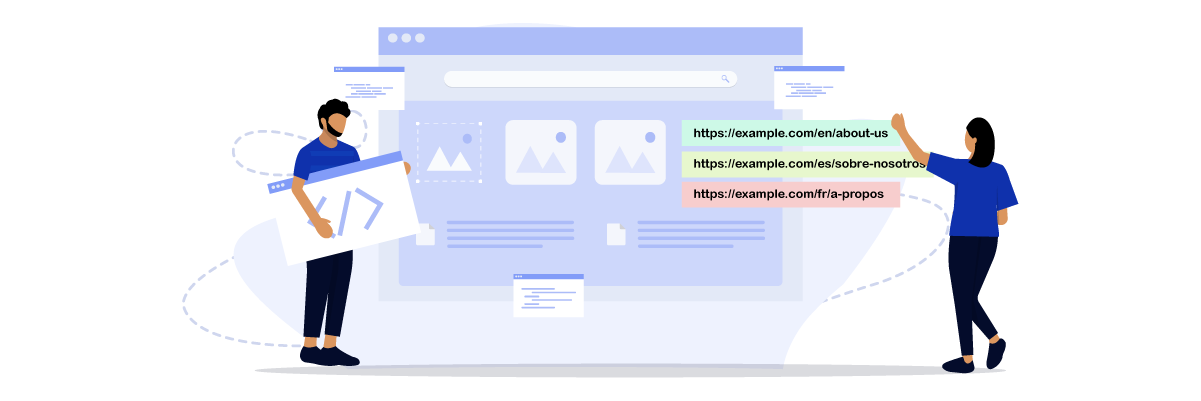
Proper URL structure and language tags help AI identify different language versions of your content. Without this, search engines may struggle to serve the correct version to users.
To optimize this, use clear URL structures (like /en/, /fr/) and implement hreflang tags correctly. This ensures each language version is properly indexed and served to the right audience.
Structured data
Structured data helps AI better understand the content on your site by providing additional context in a standardized format. It can improve how your content appears in search results.
To optimize this, implement schema markup relevant to your content, such as articles, FAQs, or products. Make sure the structured data is consistent across all language versions.
Crawlability & accessibility
If AI cannot properly access your site, it won’t be able to index or understand your content. Crawlability and accessibility are essential for visibility.
To optimize this, ensure your site has a clean sitemap, no broken links, and minimal restrictions for search engine bots. Also, make sure your site is accessible across devices and doesn’t block important content.
Page speed for AI crawling
Page speed affects how efficiently AI crawls and evaluates your site. Slow-loading pages can reduce visibility and negatively impact user experience.
To optimize this, compress images, use caching, and leverage a content delivery network (CDN). A faster site not only improves AI crawling but also keeps users engaged across different regions.
Tools for multilingual AI optimization
Optimizing a multilingual site for AI search engines can be complex, especially when you need to handle multiple languages, maintain context, and ensure consistent SEO performance. This is where tools like Linguise play an important role. Instead of relying on manual translation and fragmented workflows, Linguise helps automate and streamline multilingual optimization while keeping your content aligned with how AI understands language.
Linguise is designed to go beyond basic translation by preserving context, structure, and SEO elements across all language versions. This makes it highly relevant for AI search, where meaning, intent, and consistency matter more than ever. By using the right tools, you can scale your multilingual strategy without sacrificing quality or performance.
Some key features of Linguise that support multilingual AI optimization include:
- Automatic translation with context awareness – Ensures your content remains natural and meaningful across languages, which is essential for AI understanding.
- SEO-friendly multilingual URLs – Automatically generates optimized URLs and handles hreflang tags, helping AI correctly index each language version.
- Real-time translation without database load – Uses external processing to keep your website fast, supporting better crawlability and AI performance.
- AI translation for high-quality localization – Delivers fast and reliable translations while handling idiomatic and technical expressions more accurately. It also understands both page and website context, ensuring better consistency across all content. This makes it ideal for large-scale multilingual websites or projects that require high-quality translation.
By leveraging tools like Linguise, you not only simplify the optimization process but also ensure your multilingual site is better prepared for AI-driven search environments.
Conclusion
To optimize your multilingual site for AI search engines, you need to go beyond traditional SEO and simple translation. AI now evaluates content based on meaning, intent, structure, and consistency across languages, making it essential to focus on context-rich content, natural language, and strong technical foundations. By aligning your strategy with how AI understands information, you can improve visibility and reach a global audience more effectively.
If you want to simplify the process and scale faster, it’s time to take action. Register Linguise to optimize for AI search engines and ensure your content stays relevant, accurate, and AI-ready across all languages.