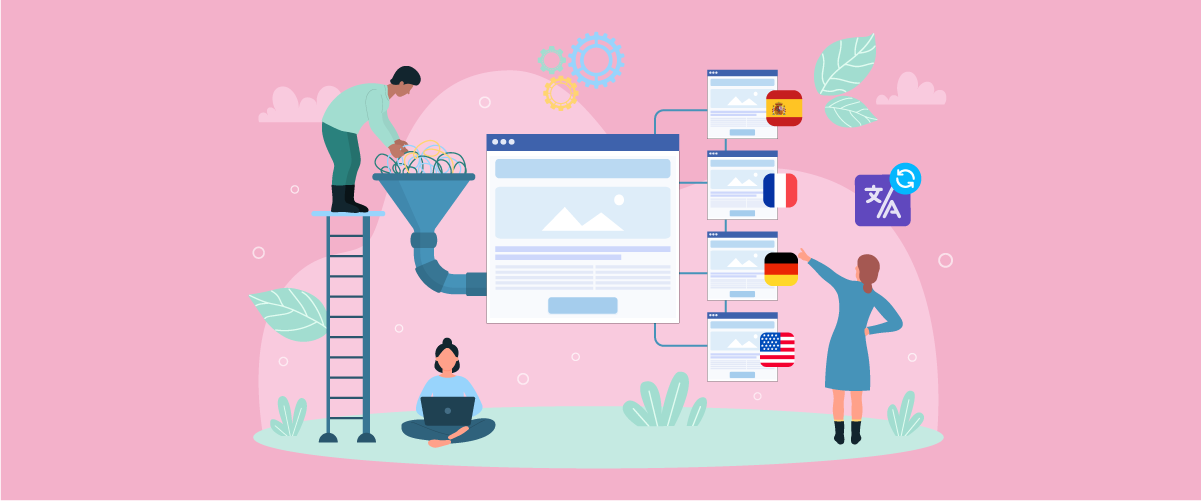
Scaling content for multiple languages is a challenge that even small marketing teams can overcome with the right approach. Many teams hesitate to expand globally because they imagine doubling their workload, managing separate content, SEO setups, and updates for every language.
The truth is, scaling is building a system where most of the work is automated, and your team only focuses on what truly drives results. Once you shift from a “more languages = more work” mindset to a lean, strategic framework, managing multilingual content becomes far more realistic—and surprisingly efficient. Let’s break down how you can make it work.
Key points: Key strategies to scale content for multiple languages
Build scalable systems, not manual work
Use automation to handle repetitive tasks so your team can manage multiple languages without extra workload.
Focus on the 80/20 localization rule
Prioritize high-converting pages while automating the rest to maximize efficiency and impact.
Use data to guide expansion
Leverage analytics to identify high-performing markets and focus efforts where results matter most.
Why is scaling content to multiple languages challenging?

Scaling content to multiple languages feels challenging because it’s often seen as a linear process—one piece of content turns into many versions that all need to be created, updated, and optimized separately. Teams imagine duplicating effort for every language, from rewriting content to managing SEO elements like keywords, metadata, and structure, which quickly becomes overwhelming, especially for small teams with limited resources.
The complexity grows even further when consistency and quality come into play. Without a clear system, translations can become inconsistent, messaging may lose its original intent, and technical SEO elements like hreflang or multilingual URLs can easily break. This is why many teams struggle because they approach it manually instead of building a streamlined, scalable process from the start.
Creating global-ready content

Creating global-ready content starts with one simple idea, what you write in your primary language will shape how well it performs in every other language. Instead of fixing translations later, the goal is to make your original content clear, structured, and easy to adapt from the beginning.
Clear source content
Clear source content means writing in a way that is easy to understand, not just for your audience but also for translation systems. Sentences that are too long, ambiguous, or packed with multiple ideas can lead to confusing translations and inconsistent meaning across languages.
By keeping your sentences concise and focused on one idea at a time, you make it easier for both machines and humans to process your content. This doesn’t mean oversimplifying your message, but rather structuring it so that the core meaning is always clear, no matter which language it’s translated into.
Consistent terminology
Using consistent terminology ensures that the same words and phrases are translated the same way across all pages and languages. Without consistency, the same concept might appear differently in different places, which can confuse users and weaken your brand message.
To avoid this, it’s important to standardize key terms such as product names, features, and industry-specific language. When your terminology stays consistent, translations become more accurate, and your content feels more professional and trustworthy across every market.
Neutral language
Neutral language means avoiding expressions that are too specific to one culture, region, or context. Idioms, slang, and local references may sound natural in your original language, but often don’t translate well and can lose their meaning entirely.
By using more universal wording, your content becomes easier to adapt for different audiences without requiring heavy manual adjustments. This helps maintain the original intent of your message while ensuring it remains relevant and understandable across various cultural contexts.
Translation optimization
Translation optimization focuses on preparing your content so it works smoothly with automated translation tools. This includes structuring content properly, using clear headings, and avoiding formatting issues that might disrupt how text is processed.
When your content is optimized for translation, automation tools can deliver more accurate results with less need for manual correction. This is where platforms like Linguise become especially useful, as they can handle large-scale translations while maintaining consistency and saving significant time for your team.
The 80/20 localization rule

The 80/20 localization rule helps you focus your limited time and resources where they matter most. Instead of trying to perfect every page in every language, this approach ensures you invest effort into the small portion of content that drives the majority of your results.
High-converting pages
High-converting pages are the parts of your website that directly impact business results, such as landing pages, product pages, pricing pages, or lead generation forms. These are the pages where users make decisions—whether to sign up, buy, or contact you.
For example, while a blog article might bring traffic, your checkout page or demo request page is where conversions actually happen. That’s why these pages deserve more attention, including refined translations and localized messaging that feels natural and persuasive for each target market.
Automated content
Not every piece of content needs manual localization. Pages like blog posts, help articles, or lower-impact landing pages can be translated using automation without heavy human intervention, especially if your source content is already well-structured. Tools like Linguise can help automate this process by handling large volumes of content while maintaining consistency across languages.
For instance, a company blog with hundreds of articles can be translated automatically to reach a wider audience, even if not every sentence is perfectly polished. The goal here is coverage and visibility, allowing you to scale quickly without overwhelming your team while letting automation handle the bulk of the work.
Manual prioritization
Manual prioritization means deciding where human effort is truly needed instead of spreading it evenly across all content. Once you identify high-converting pages, your team can focus on refining those translations to ensure clarity, tone, and cultural relevance.
As an example, instead of reviewing 100 translated pages, your team might only manually optimize the top 10 pages that drive most conversions. This targeted effort delivers better results while keeping your workload manageable.
Efficiency vs quality
Balancing efficiency and quality is at the core of the 80/20 rule. Trying to achieve perfect translation quality for every page is not only time-consuming but also unnecessary for most content.
A more practical approach is to accept “good enough” quality for automated pages while reserving high-quality, polished translations for critical pages. This way, you maintain scalability without sacrificing performance where it truly counts.
Automating multilingual SEO
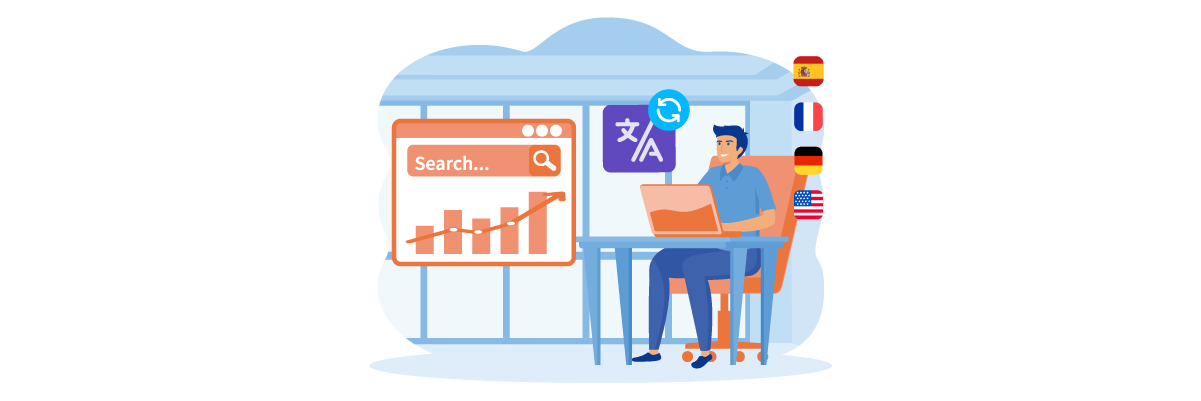
Instead of manually configuring SEO elements for every language, automation ensures your site remains optimized and structured correctly across all versions with minimal effort.
Hreflang automation
Hreflang tags help search engines understand which language version of a page should be shown to users in different regions. Without proper hreflang setup, your pages might compete with each other or show the wrong language to the wrong audience.
With automation, hreflang tags are generated and applied automatically across all translated pages. For example, when you publish a page in English, and it’s translated into Spanish and French, the system will automatically link these versions together so search engines can display the correct one based on the user’s location.
Here’s how hreflang tags connect those pages:
					<link rel="alternate" hreflang="en" href="https://www.yourwebsite.com/en/pricing/" />
<link rel="alternate" hreflang="fr" href="https://www.yourwebsite.com/fr/tarifs/" />
<link rel="alternate" hreflang="es" href="https://www.yourwebsite.com/es/precios/" />
<link rel="alternate" hreflang="x-default" href="https://www.yourwebsite.com/pricing/" />
In this example, all language versions of the same page are linked together, ensuring users are directed to the most relevant version based on their language or location.
Metadata management
Metadata, such as titles and meta descriptions, plays a key role in how your pages appear in search results. Managing this manually for each language can quickly become time-consuming and error-prone.
Automated systems can translate and optimize metadata alongside your content. For instance, when a product page is translated, its title and description are also adapted for the target language, ensuring your pages remain relevant and clickable in search results without needing manual input for each version.
Multilingual sitemaps
A sitemap helps search engines discover and index your website pages efficiently. When dealing with multiple languages, managing separate sitemaps for each version can become complex if done manually.
Automation simplifies this by generating and updating multilingual sitemaps automatically. For example, when a new page or translation is added, it is instantly included in the sitemap. Platforms such as Linguise can handle this behind the scenes, ensuring all versions are properly indexed.
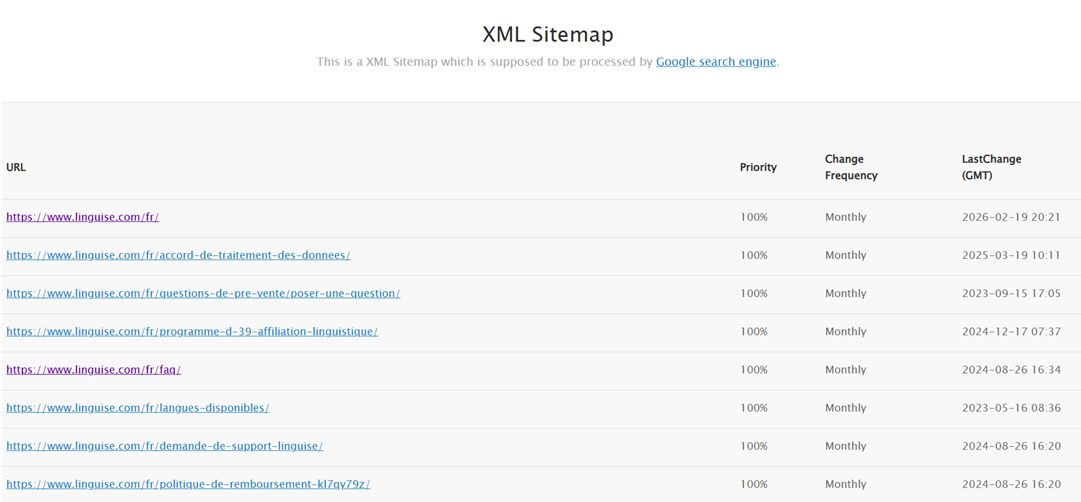
For example, here is a multilingual sitemap for the French version. This structure follows the standard multilingual sitemap approach, where each language version is organized using a language-specific URL path (e.g., /fr/ for French), helping search engines efficiently crawl and index localized pages.
URL structure
A clear URL structure helps both users and search engines understand how your multilingual content is organized. Poorly structured URLs can create confusion and negatively impact SEO performance.
With automated systems, language-specific URLs are created consistently, such as adding subdirectories like /en/, /es/, or /fr/. For example, a page like yourwebsite.com/pricing can automatically become yourwebsite.com/es/pricing for Spanish users, maintaining a clean and scalable structure across all languages.
Identifying high-performing markets

Identifying high-performing markets helps you understand which languages and regions are actually driving results, so you don’t waste time optimizing everything equally. Instead of guessing, you use data to decide where to focus your effort for the biggest impact.
Language performance
Language performance shows how each translated version of your site is performing in terms of engagement and visibility. This includes metrics like page views, bounce rate, and time spent on each language version.
For example, if your Spanish pages are getting significantly more engagement than your German pages, it’s a signal that your Spanish market has stronger potential. This insight helps you decide where to invest more effort, such as improving content quality or expanding pages in that language.
Traffic insights
Traffic insights help you understand where your visitors are coming from and which markets are gaining traction. By analyzing traffic sources, you can see which countries or regions are discovering your content.
For instance, if you notice a growing number of users from Brazil visiting your Portuguese pages, it indicates a rising opportunity in that market. This allows you to focus on strengthening your presence there instead of spreading your efforts too thin across all regions.
Conversion tracking
Conversion tracking shows which language versions are not just attracting visitors, but actually turning them into customers or leads. This is one of the most important indicators of a market’s true value.
As an example, your French pages might have moderate traffic but a high conversion rate on a pricing or sign-up page. This means the audience is highly interested, and improving that experience further could directly increase your results.
Resource allocation
Resource allocation is about using all the insights you’ve gathered to decide where to spend your time and budget. Instead of treating all languages equally, you focus on the ones that show real growth and conversion potential.
For example, if English and Spanish markets are driving most of your conversions, you might allocate more effort to manually refine those pages, while keeping other languages mostly automated. This ensures your team works efficiently while still maximizing overall performance.
Conclusion
Scaling content for multiple languages starting from global-ready content, applying the 80/20 localization rule, leveraging automation for multilingual SEO, and using data to guide decisions, you can turn what feels complex into a streamlined and efficient process. Instead of trying to perfect everything, the key is to focus your effort where it has the most impact while letting automation handle the rest.
If you’re ready to simplify the process, start with Linguise and build a system that handles the heavy lifting for you, so your team can focus on growth, not complexity.