

Post-translation performance tracking is essential, as translating your website is just the first step toward effectively reaching international audiences. Many businesses invest heavily in localization but fail to measure whether it actually drives revenue. Without tracking the right metrics, companies risk relying on vanity numbers that provide little insight into real business impact.
Focusing on metrics that predict international revenue growth enables teams to link localization efforts to measurable outcomes directly. From language-specific bounce rates and engagement to translation-driven conversions and market-specific search visibility, these 12 key metrics provide a clear framework for continuous optimization. By monitoring them, businesses can maximize ROI, make data-driven decisions, and ensure that every translated asset contributes to global growth.
Keypoints: Key post-translation revenue metrics
Revenue-focused localization KPIs
Track behavior, funnel, and revenue metrics by language instead of vanity metrics to see which translations truly drive growth.
Funnel health by market
Measure drop-offs and conversion rates across localized funnels to spot where language friction quietly kills international revenue.
Ongoing ROI feedback loop
Build a recurring reporting cadence that links localization investments to revenue per market so you can double down on what works and cut what does not.
Why post-translation performance tracking matters?

Translating a website does not automatically guarantee business growth in international markets. Without post-translation performance tracking, companies often assume that localization is successful simply because content is available in multiple languages. This approach overlooks how users actually interact with localized pages, leading to wasted resources and missed revenue opportunities.
By tracking meaningful metrics, businesses can move beyond vanity numbers, such as total page views or download counts, and focus on data that reflects real impact. Understanding how different language versions perform across engagement, conversions, and revenue enables teams to make informed decisions, continuously optimize content, and demonstrate the tangible ROI of their localization efforts.
Language-specific behavior metrics that matter

Measuring how users interact with your localized content is critical to understanding the effectiveness of your translations. Language-specific behavior metrics reveal whether audiences in different markets are engaging meaningfully with your website, helping you identify gaps and opportunities for improvement.
Bounce rate by language
Bounce rate by language measures the percentage of visitors who leave a page without taking any action. A high bounce rate in a specific language can indicate that the translation is unclear, culturally misaligned, or that the content fails to meet local expectations. By monitoring bounce rates across languages, businesses can quickly identify which markets need content optimization.
Tracking bounce rate allows teams to prioritize resources effectively. For example, if a key revenue-generating market shows higher bounce rates, optimizing localized content can directly impact conversions and overall ROI. Regularly reviewing bounce rate trends also helps detect issues after updates or new translations are deployed.
Engagement rate by market
Engagement rate measures how actively users interact with your content, including clicks, shares, and other meaningful actions. By analyzing engagement by market, you can see which localized versions resonate most with audiences and which require refinement. This helps ensure that content is not only translated but also culturally relevant and compelling.
Understanding engagement patterns allows businesses to make informed decisions about content strategy. For instance, markets with low engagement may benefit from localized campaigns, improved visuals, or adjusted messaging. Over time, tracking engagement by market provides a benchmark for measuring the success of ongoing localization efforts.
Page time & scroll depth
Page time and scroll depth indicate how long users spend on a page and how far they scroll, reflecting their interest and content consumption. Low page time or shallow scroll depth in a specific language version may indicate that users find the content less valuable or harder to navigate.
By monitoring these metrics, teams can optimize page structure, layout, and content flow for each market. Adjustments based on page time and scroll depth data ensure that localized content effectively engages visitors, increasing the likelihood of conversions and improving overall international revenue performance.
Translation-driven conversion metrics
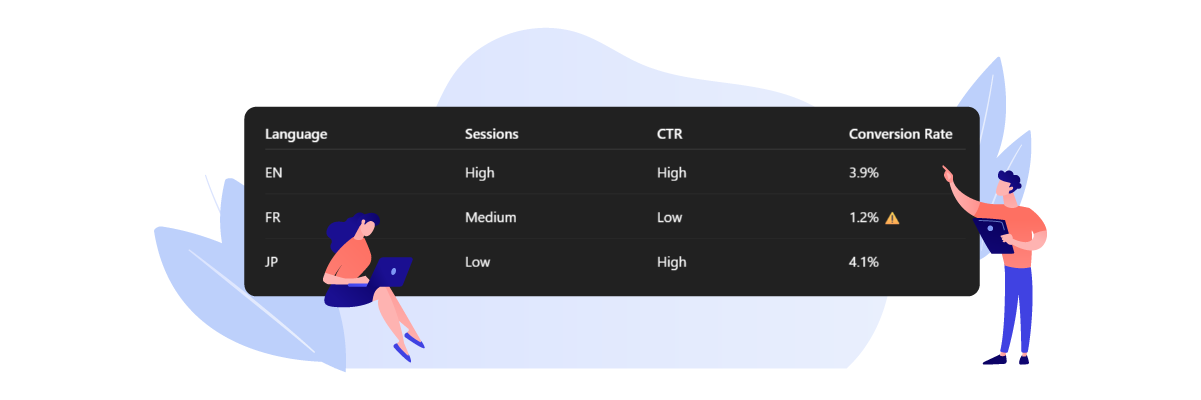
While user behavior metrics show engagement, conversion metrics reveal whether localized content is actually driving business results. Translation-driven conversion metrics help measure how effectively each language version turns visitors into leads or customers, linking localization directly to revenue.
Conversion rate by language version
Conversion rate by language version tracks the percentage of visitors who complete a desired action, such as signing up or making a purchase, for each localized page. Differences between languages can highlight translation issues, cultural misalignment, or usability problems that affect performance.
Analyzing conversion rates by language allows teams to optimize content where it matters most. By focusing on high-value markets with lower conversion rates, businesses can prioritize improvements and increase ROI from localization efforts.
Assisted conversions from localized content
Assisted conversions measure how localized content contributes indirectly to conversions, even if it isn’t the final touchpoint. For example, a blog article in a local language may educate users and lead them to purchase later through another channel.
Tracking assisted conversions ensures that the full impact of localization is captured. This metric helps businesses understand how content supports the broader sales funnel and informs decisions on content investment and strategy for different markets.
Funnel performance across markets
Funnel performance analysis tracks how users progress through the conversion process for each localized version and identifies where drop-offs occur. Differences across markets can indicate language-specific friction, such as unclear instructions or culturally inappropriate messaging.
By examining funnel performance, teams can implement targeted fixes to reduce drop-offs and improve conversion rates. This approach ensures that localization not only translates content but also optimizes the entire user journey for international audiences.
Revenue quality metrics for international growth

While conversions show immediate results, revenue quality metrics reveal the long-term value of international customers. Tracking these metrics ensures that localization efforts contribute not just to short-term gains but also to sustainable revenue growth across markets.
International Customer Lifetime Value (CLV)
International CLV measures the total revenue a customer generates over their relationship with your brand, segmented by market or language. High CLV in specific regions indicates that localized content and experiences are effectively nurturing customer loyalty.
By analyzing CLV across markets, businesses can identify which language versions generate the most valuable customers. This insight helps prioritize investments in high-performing regions and guides strategies for improving retention in underperforming markets.
Repeat purchase rate by market
Repeat purchase rate tracks how often customers return to buy again in each localized market. Differences between regions can reveal gaps in engagement, satisfaction, or the effectiveness of post-purchase communication.
Monitoring repeat purchases allows companies to implement targeted retention strategies, such as personalized offers or localized loyalty programs. Improving repeat purchase rates directly increases long-term revenue and maximizes ROI from translation efforts.
ARPU Internationally
Average Revenue Per User (ARPU) measures the average income generated per user in each market, providing a clear view of revenue efficiency for localized content. High ARPU indicates that localized strategies are successfully converting users into profitable customers.
Analyzing ARPU helps businesses understand which markets provide the greatest revenue potential and whether pricing, offers, or content need adjustment. Combining ARPU insights with CLV and repeat-purchase data provides a comprehensive view of international revenue quality.
Market-specific search visibility metrics

Search visibility is a critical indicator of how easily potential customers can find your localized content. Market-specific search visibility metrics help businesses assess the effectiveness of their SEO and content localization efforts in driving international traffic and generating revenue.
Local keyword visibility and rankings
Local keyword visibility measures how well your translated content ranks for relevant search terms in each target market. Strong visibility indicates that the content is optimized for local search intent and language, while low rankings may signal the need for SEO adjustments.
By monitoring keyword performance across regions, businesses can identify gaps in their localization strategy and improve content discoverability. Optimizing for local keywords ensures that each market receives tailored content that attracts the right audience, driving qualified traffic and potential conversions.
Organic traffic share by market
Organic traffic share shows the proportion of website visitors from each localized market who arrive via search engines. Tracking this metric helps businesses identify which regions generate the most interest and which require additional optimization or marketing support.
Analyzing organic traffic share allows teams to allocate resources effectively, focusing on high-potential markets while identifying underperforming regions for improvement. Over time, this metric provides insights into the overall reach and effectiveness of international SEO efforts.
CTR in local SERPs
Click-through rate (CTR) in local SERPs measures the percentage of users who click on your content when it appears in search results. A high CTR indicates that your localized meta titles, descriptions, and content are engaging and relevant to local audiences.
Monitoring CTR helps businesses refine on-page SEO and content presentation for each market. By improving CTR, companies can drive more qualified traffic, increase conversions, and ensure their localization efforts directly contribute to international revenue growth.
Building an analytics framework for continuous optimization

Tracking metrics alone is not enough; businesses need a structured analytics framework to monitor, analyze, and optimize localization efforts continuously. This framework connects key performance indicators (KPIs) to revenue goals, enabling data-driven decisions that maximize the impact of translated content.
KPIs for revenue growth
Selecting the right KPIs ensures that localization efforts are measured against metrics that directly influence international revenue. Examples include conversion rates by language, customer lifetime value, and market-specific engagement metrics.
Focusing on revenue-linked KPIs enables teams to prioritize markets and content that deliver the greatest business value. By continuously monitoring these indicators, companies can make strategic adjustments to improve performance and achieve measurable growth in global markets.
Actionable localization insights
Actionable insights translate metric data into specific steps for improvement. For instance, low engagement in a particular language version may indicate a need for content updates, better CTAs, or culturally adapted visuals.
Regularly deriving actionable insights ensures localization is dynamic, adapting to user behavior and market trends. This approach helps teams optimize content, improve user experience, and increase conversion rates across all targeted markets.
Proving localization ROI
Demonstrating ROI is critical for justifying localization investments. By linking KPIs such as conversions, CLV, and market-specific traffic to revenue outcomes, businesses can clearly show the financial impact of their translation efforts.
Proving ROI also supports better resource allocation and strategic planning. When stakeholders see tangible results from localized content, it strengthens the case for ongoing investment in international growth and continuous optimization.
Conclusion
Post-translation performance tracking is critical for businesses aiming to drive measurable growth in international markets. By focusing on one actionable metric—from language-specific bounce rates and engagement to conversion performance, revenue quality, and search visibility—companies can move beyond vanity metrics and make data-driven decisions that directly impact global revenue.
Implementing a structured analytics framework not only helps track KPIs for revenue growth but also generates actionable insights and proves the ROI of localization initiatives. For companies looking to simplify and automate multilingual website tracking, solutions like Linguise can streamline performance monitoring, optimize content for multiple markets, and maximize the return on every translation effort.