

Just a few years ago, website localization meant translating everything into as many languages as possible. The more languages, the better. But as we enter website localization trends 2026, smart business owners are realizing this approach often increases costs without improving revenue. After all, 76% of online shoppers prefer to buy in their native language, and 40% won’t purchase if it’s not available, underscoring that quality and relevance matter more than volume.
In 2026, studies show that 73% of companies report revenue growth after localizing their content, while most localization teams now combine AI translation with human review to balance speed and quality. In this article, we’ll explore what’s changing in website localization and what forward-thinking companies are doing differently to stay ahead.
Keypoints: Website localization trends
Focus on high-impact pages first
Smart businesses prioritize localizing high-conversion pages such as homepages, product pages, pricing, and checkout instead of translating the entire website. This focused strategy reduces costs while maximizing revenue impact.
Combine AI translation with human refinement
Businesses use AI to scale translations quickly, then apply human review to key pages for accuracy, tone, and cultural relevance. This hybrid approach balances speed, quality, and conversion performance.
Prioritize 3–5 strategic markets
Rather than launching in many languages at once, companies start with three to five markets based on real traffic data and revenue potential. This allows them to optimize performance before expanding globally.
What’s changing in website localization?

The biggest change in website localization is the way businesses think about it. In the past, localization was treated as a translation task—something done after the website was finished, often handled as a one-time project. The goal was simple, translate as many pages as possible and launch in as many languages as the budget allowed.
In 2026, that mindset is shifting toward a more strategic approach. Businesses now see localization as part of their growth and user experience strategy. Instead of asking how many languages they can support, they ask which markets bring real revenue, which pages influence conversions, and what local elements build trust.
This shift is what’s driving the new localization trends, where precision, user experience, and measurable impact matter more than translation volume.
Website localization trends 2026

In 2026, website localization is about doing what matters. The businesses growing internationally today are not expanding blindly, they are making calculated, data-driven decisions about where and how to localize. Here’s how their approach is changing in practice.
From full translation to selective localization
A few years ago, the typical strategy was simple, translate the website and launch it in every possible market. It sounded ambitious and scalable, but in reality, it often meant stretched budgets, outdated translated pages, and inconsistent quality across languages.
In 2026, smart businesses are moving toward selective localization. Instead of translating every blog post or help article, they prioritize high-impact pages—homepages, product pages, pricing, and checkout flows. The focus is no longer on completeness, but on performance. By narrowing the scope, they maintain quality and see clearer returns.
This shift also makes localization easier to manage over time. Teams can update fewer pages, maintain better consistency, and respond faster to changes in pricing, promotions, or product updates without worrying about dozens of underperforming translated sections.
Focusing on 3–5 priority languages
Previously, expansion often meant launching in 10, 15, or even 20 languages at once. While impressive on paper, this approach diluted resources and made optimization difficult. Teams struggled to maintain consistency and track meaningful results across too many markets.
Now, companies begin with three to five priority languages based on real demand, traffic data, and revenue potential. They test, optimize, and refine their strategy in those markets before expanding further. This controlled growth allows them to build strong foundations rather than manage scattered, underperforming language versions.
By focusing on fewer markets, businesses can invest more deeply in each. They can run localized campaigns, refine messaging, and build trust—turning each language into a strong revenue channel rather than just another translated version of the site.
AI-first drafts with human review on key pages
Before AI became mainstream in localization workflows, companies relied heavily on manual translation. This ensured quality but required significant time and cost, slowing down global expansion.
In 2026, AI handles the first draft across most of the website, dramatically increasing speed and efficiency. However, high-conversion pages still receive human review to refine tone, clarity, and persuasion. This hybrid model balances scalability with precision—saving resources while protecting revenue-critical content.
As a result, localization is no longer a bottleneck for growth. Teams can launch new languages faster, test new markets more easily, and continuously improve important pages without waiting weeks for full manual translations.
Localization as a UX and revenue strategy
Localization used to be about language accuracy alone. As long as the words were translated correctly, the job was considered done. But businesses soon realized that translation without cultural adaptation often felt unnatural or unconvincing.
Localization is treated as a user experience strategy. Companies adapt layouts, calls to action, images, currencies, payment methods, and trust signals to match local expectations. Instead of simply translating text, they design experiences that feel native—because conversions happen when users feel understood.
This approach also changes how teams collaborate. Localization is no longer handled solely by translators; it is now shared among product managers, designers, marketers, and developers, who work together to create a seamless experience for each target market.
Measuring success by revenue per language
In the past, localization success was often measured by output, number of languages launched, or number of words translated. These metrics looked productive but rarely showed business impact.
In 2026, performance is measured by revenue per language. Businesses track conversion rates, customer lifetime value, and average order value for each localized version. This shift transforms localization from a cost center into a measurable growth driver, aligning it directly with business outcomes rather than translation volume.
With this mindset, decisions become clearer. Companies can identify which languages warrant greater investment, which markets need better UX adjustments, and where localization is truly paying off. The result is a more strategic, data-driven approach to global growth.
Staying ahead with modern localization

Businesses that succeed globally in 2026 are not the ones translating the most content, but the ones building the smartest localization strategies. They focus on priority markets, use AI to scale efficiently, and invest human effort where it directly impacts conversions. Instead of chasing dozens of languages at once, they create strong, localized experiences that feel natural and trustworthy to each audience.
This modern approach turns localization into a growth engine rather than a technical task. By combining selective language expansion, AI-assisted workflows, and UX-focused decisions, companies can move faster, reduce costs, and see clearer returns from each market they enter. It also allows teams to adapt quickly as new opportunities arise without being locked into costly, time-consuming translation processes.
Tools like Linguise support this shift by providing AI-powered website localization with practical features designed for real-world workflows. For example, its front-end live editor lets you adjust translations directly on the page, so you can fine-tune wording, tone, or cultural nuances to better match local expectations.
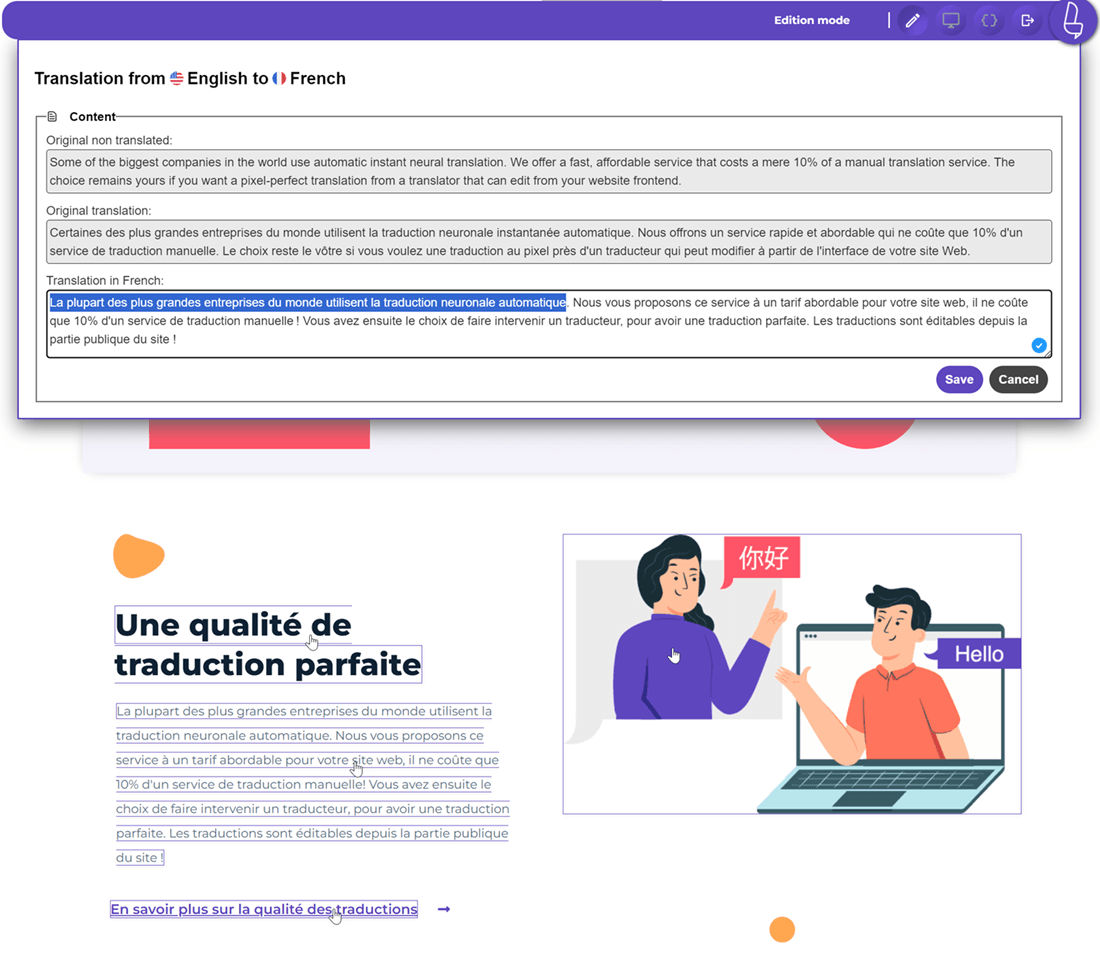
Combined with translation rules, automatic language detection, and real-time updates, these features make it easier for businesses to create accurate, locally relevant experiences without slowing down their global growth.
Conclusion
Website localization trends 2026 show a clear shift: success is no longer about translating everything, but about building precise, high-impact local experiences. From selective localization and prioritizing 3–5 key languages to AI-first workflows and revenue-based measurement, modern website localization is now a strategic growth driver—not just a translation task.
If you’re ready to move beyond outdated localization strategies and build a smarter multilingual website, it’s time to take action. Start optimizing your global growth. Register with Linguise to transform how you approach website localization in 2026.