Multilingual checkout friction points are one of the biggest reasons international customers abandon their carts at the final step. Even when product pages are fully translated, poorly localized checkout flows can create confusion, reduce trust, and stop users from completing a purchase.
For global businesses, checkout is a critical conversion moment. Understanding where multilingual checkouts fail and how to fix those issues is key to recovering lost revenue and creating a smoother experience for international customers.
Why multilingual checkout fail?
Many businesses successfully translate their product pages but still lose customers at checkout. The issue is how well the checkout experience adapts to users’ expectations across different countries.
- Translation without localization: Checkout content is translated literally without adapting to local context, such as familiar payment terms or country-specific address formats.
- One-size-fits-all checkout logic: Checkout flows are built for a single market, leading to form validation, tax handling, and shipping options failing for international users.
- Unclear system feedback: Error and confirmation messages do not clearly explain what went wrong or how users can fix the issue, leading to hesitation and drop-offs.
- Broken language flow: Switching languages during checkout can break the process, reset progress, or empty the shopping cart entirely.
7 Multilingual checkout friction points

Checkout is often the most critical—and the most fragile—moment in an international shopping journey. At this stage, customers are ready to pay, but a small detail that feels unfamiliar can quickly create doubt and cause them to leave.
Below are seven of the most common multilingual checkout friction points, explained through everyday situations customers often experience, along with practical ways to fix them.
Unclear local payment labels
A customer reaches the payment page and sees several payment methods that are actually available in their country. The problem is that the labels feel unfamiliar because they are translated literally or use global terms that people do not normally use locally.
Instead of feeling confident, the customer starts wondering, “Is this really the payment method I usually use?” That small moment of doubt is often enough to stop them from completing the purchase.
Solution:
Use payment labels that are truly familiar to local users, including the names and wording commonly used in that market, rather than direct translations.
Invalid address field formats
A customer carefully enters their address, only to have the form repeatedly reject it. The checkout requires a ZIP code in a specific format, but in their country, postal codes follow a different structure—or are not used at all.
After several failed attempts, the customer feels that the system is not designed for them. What should have been a simple step becomes a frustrating experience.
Solution:
Adapt address fields and validation rules based on the customer’s country, so the form follows local address conventions instead of enforcing a single global format.
Shipping method confusion
On the shipping page, the customer sees options like “Standard” or “Express,” but there is no clear explanation of delivery time or coverage. They are unsure whether the package will arrive in a few days or several weeks.
This lack of clarity makes customers hesitant, especially when shipping costs are high, and the value of each option is unclear.
Solution:
Localize shipping method names and provide clear, easy-to-understand explanations for delivery speed, coverage, and cost.
Poorly translated error messages
When a payment fails, an error message appears that sounds awkward, overly technical, or unnatural in the customer’s language. Instead of helping, the message confuses customers about what went wrong. In addition to payments, error messages can also appear in the following situations. When you enter incorrect information, such as a number, address, zip code, or other details, the error message must be translated into the selected language.
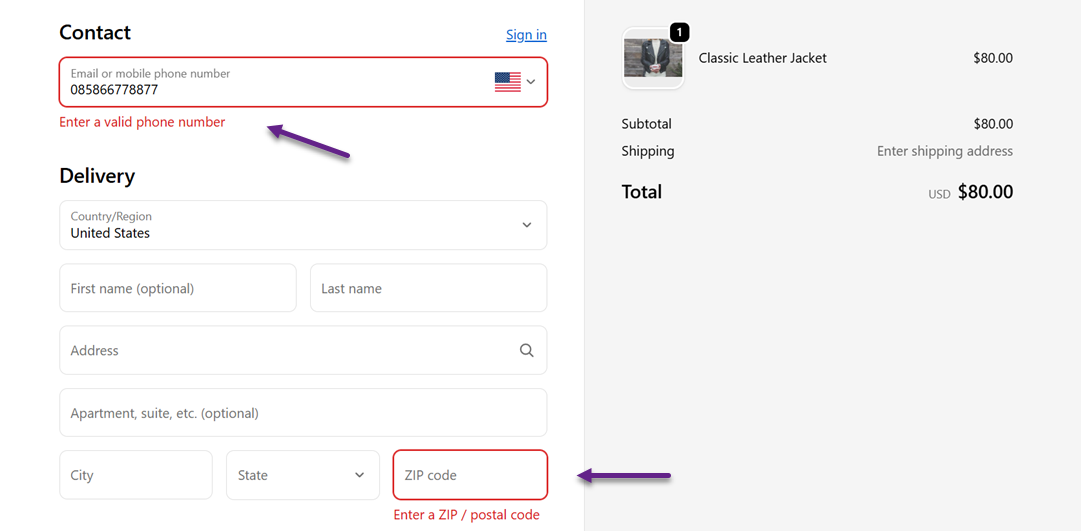
Without clear guidance, many customers choose to give up rather than risk repeating the same mistake during payment.
Solution:
Translate error messages using natural, user-friendly language that clearly explains the issue and tells customers exactly what to do next.
Currency and number format issues
Prices are displayed in the correct currency, but the number format feels unfamiliar. Decimal points and commas may be reversed, or the currency symbol may appear in an unusual position. In some cases, inconsistencies also occur—for example, the interface is displayed in French, but the currency is still in US dollars rather than euros.
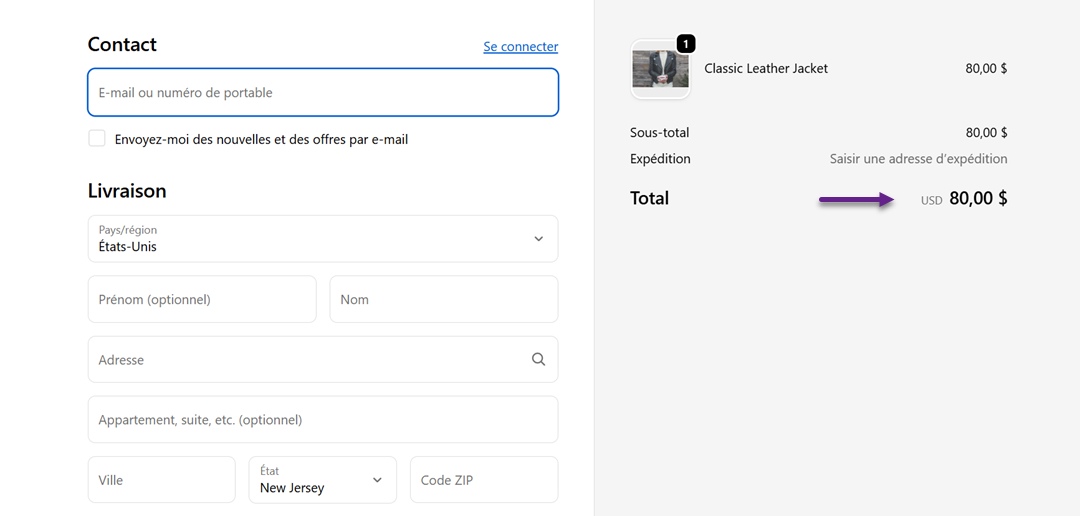
Even when the total amount is technically correct, these unfamiliar formats can make customers hesitate during the final price review.
Solution:
Apply local currency and number formatting rules consistently, including symbols, decimal separators, and placement.
Missing local tax and fee context
A customer is about to complete their purchase when unexpected taxes or extra fees suddenly appear. This last-minute surprise makes them feel misled or unsure about the total cost.
In many cases, unexpected fees at checkout are a major reason international customers abandon their carts.
Solution:
Clearly explain local taxes and additional fees upfront, giving customers the context they need to understand what they are paying for and why.
Language switch breaks checkout
A customer switches languages during checkout to better understand the instructions. Suddenly, the page reloads, the cart is emptied, or the checkout process restarts.
This experience makes the checkout feel unstable and unreliable, especially for international users who depend on their preferred language to complete the purchase.
Solution:
Ensure that switching languages does not break the checkout flow and that cart contents, user data, and progress are preserved.
Reducing cart abandonment in global markets
For many global businesses, cart abandonment is not caused by price or product quality, but by uncertainty at the final step. Customers who reach checkout are already motivated to buy. When something feels unclear—an unfamiliar payment label, a confusing message, or a broken language switch—that motivation quickly turns into hesitation.
In international markets, trust is built through familiarity. When the checkout experience speaks the customer’s language, follows their local conventions, and behaves consistently from start to finish, users feel confident moving forward. Small localization improvements across payment, shipping, formatting, and system messages often lead to meaningful gains in conversion without increasing traffic or marketing spend.
Solutions like Linguise help businesses deliver smoother multilingual checkout experiences by handling translations across the entire checkout flow without disrupting its logic. Instead of relying on manual translations that often break payment steps or the language selector, Linguise ensures that labels, messages, and checkout content remain consistent and easy to understand.
With integrations with popular e-commerce platforms such as Shopify, WooCommerce, and others, Linguise allows businesses to scale into new markets while keeping their checkout experience stable, localized, and conversion-focused.
Conclusion
Multilingual checkout issues may seem small, but their impact on global conversions is significant. From unclear payment labels to broken language switching, each friction point adds uncertainty at the exact moment customers are ready to buy. By addressing these issues with proper localization, businesses can turn checkout into a smooth, trustworthy experience that works across markets.
If you want to reduce cart abandonment and scale confidently into international markets, the right translation approach matters. Start with Linguise translation to ensure your checkout stays clear, stable, and fully localized across platforms, so more global customers can complete their purchases without friction.