

Publishing a podcast is only part of growing an international audience. Since 68% of online experiences begin with a search engine and 73% of U.S. podcast listeners discover podcasts through online searches, optimizing and translating your podcast website can help more listeners find your episodes through organic search.
This guide explains which podcast website elements to translate first and how to optimize multilingual episode pages for international SEO, helping you reach audiences beyond platforms like Spotify or Apple Podcasts.
Key points: Translating podcast content for international SEO
Translate every searchable podcast asset
Don't stop at translating your podcast audio. Localize show notes, transcripts, episode pages, titles, and metadata so search engines can index your content in multiple languages.
Optimize for international search visibility
Use localized URLs, hreflang tags, translated metadata, and language-specific keywords to help every episode rank in its target market and attract more organic listeners.
Scale multilingual podcast publishing
Combine AI-powered translation with human review to produce high-quality localized content, keep translations up to date, and expand your podcast's global reach efficiently.
Why podcast websites need international SEO

Publishing a podcast is only one part of growing an international audience. While podcast directories help listeners discover new episodes, your website is where search engines can index and rank your content. Translating key website elements allows your podcast to appear in localized search results, making it easier for potential listeners to find your episodes through organic search.
Here are several reasons why international SEO is essential for podcast websites:
- Reach audiences beyond podcast platforms – Many users search Google for topics, guests, or episode summaries before deciding what to listen to. Translating your episode pages increases your visibility in these searches.
- Turn show notes and transcripts into SEO assets – Unlike audio files, show notes and transcripts provide crawlable text that search engines can understand. Localizing them helps your content rank for relevant keywords in multiple languages.
- Capture more long-tail search traffic – Translated transcripts naturally include conversational phrases and topic-specific keywords that match how people search in their native language, expanding your organic reach.
- Improve the user experience for global visitors – Visitors are more likely to engage with your content when episode titles, summaries, timestamps, and supporting resources are available in their preferred language.
- Increase the value of every podcast episode –Instead of creating separate content for each market, translating existing episodes allows you to repurpose your podcast into multilingual SEO content that continues generating traffic long after publication.
Which podcast content should you translate first?

Not every part of a podcast website contributes equally to international SEO. If you’re localizing your podcast for new markets, prioritize the content that both search engines and visitors rely on most. Starting with high-impact elements helps you improve search visibility and create a better experience for international audiences.
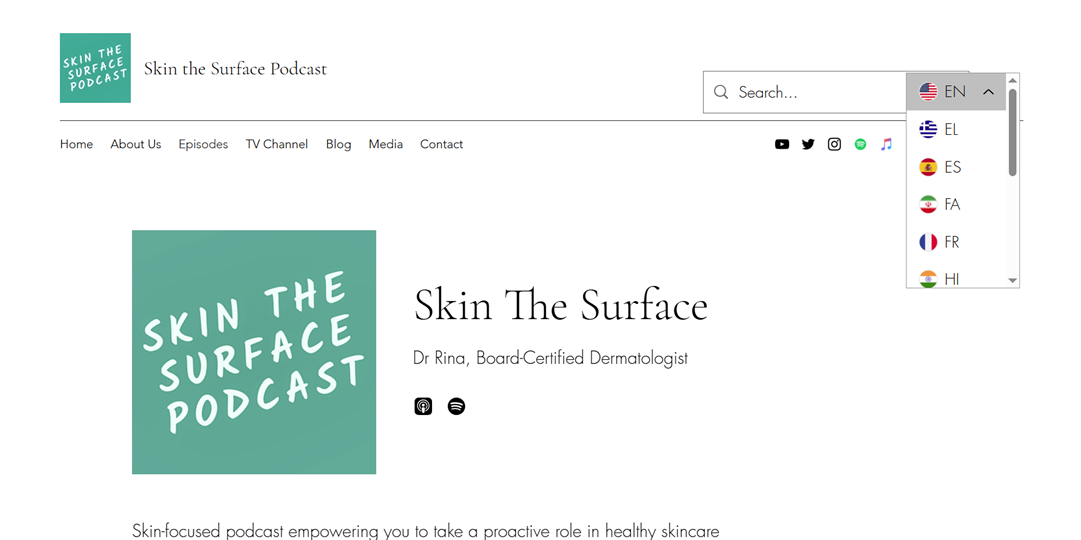
The following sections explain which podcast website elements should be translated first and why each one plays an important role in helping your episode pages rank across different languages. The example below shows a multilingual podcast website with a language switcher, allowing visitors to access localized versions of the site’s content.
Translate episode titles
Episode titles are often the first thing both users and search engines see. A well-translated title helps search engines understand the topic of your episode while encouraging users to click when it appears in search results. Instead of translating titles word-for-word, adapt them to match how people naturally search in the target language. This improves keyword relevance without changing the episode’s original meaning.
For example, an English episode titled “How to Build a Remote Team That Lasts” could be translated into Spanish as “Cómo crear un equipo remoto sostenible” rather than a literal translation. The localized version uses a phrase that aligns more closely with common Spanish search queries while still accurately representing the episode. Pairing translated titles with localized meta titles and descriptions can further improve click-through rates from search results.
The example below shows a multilingual podcast website where episode titles and descriptions have been translated into Spanish, making the content easier for local audiences to understand while improving its relevance for Spanish-language search results.

Translate show notes
Show notes are usually the most valuable section to translate because they provide structured, crawlable content for search engines. Unlike audio, show notes include summaries, key discussion points, links, and important keywords that help search engines understand what the episode covers. Translating them allows your podcast pages to target relevant searches in multiple languages without creating entirely new content.
Suppose you host a marketing podcast that features an episode on email automation. Your English show notes explain the main strategies, tools, and resources discussed during the conversation. A localized version can naturally incorporate keywords that audiences in Germany, Japan, or Brazil actually use when searching for similar topics. Rather than simply translating the text, adjust examples, terminology, and calls to action so they feel natural to readers in each market.
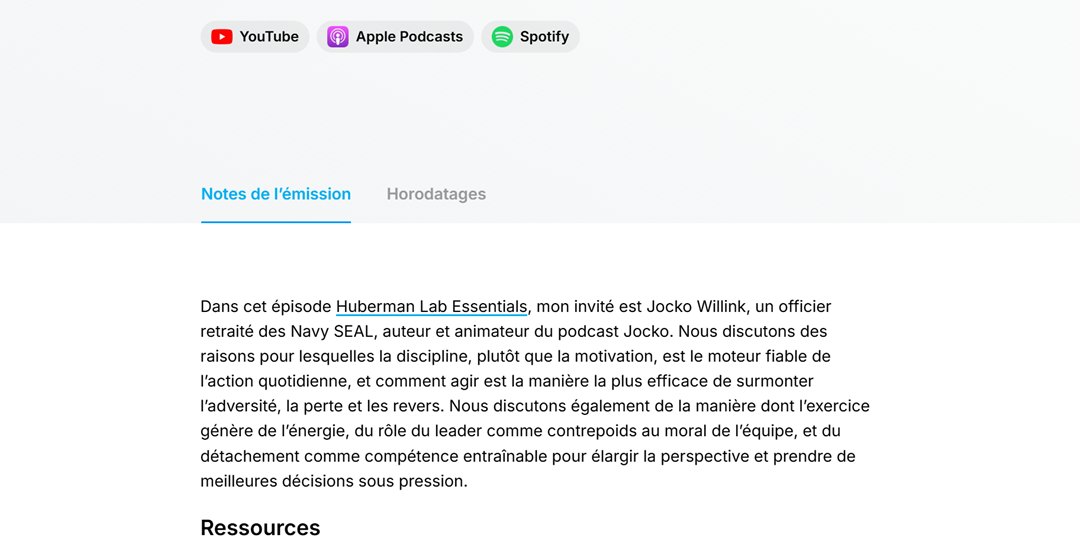
The example below shows podcast show notes translated into French. By localizing the episode summary and supporting resources, podcast websites can make their content easier for French-speaking audiences to understand while improving multilingual SEO.
Translate full transcripts
Full transcripts contain significantly more searchable text than show notes, making them valuable for capturing long-tail keywords. Since transcripts reflect natural conversations, they often include questions, explanations, and niche phrases that users type into search engines. Translating transcripts expands the number of search queries your podcast can rank for across different languages.
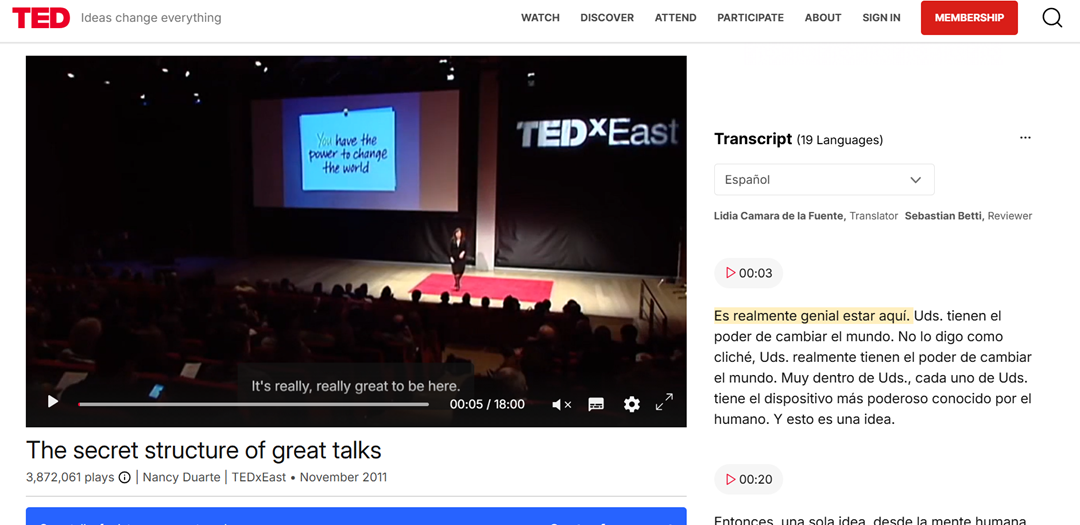
For example, the translated TED Talk transcript shown below contains naturally occurring phrases, explanations, and topic-related terms throughout the discussion. Once translated into Spanish, this content provides search engines with additional localized keywords that may not appear in the shorter show notes alone. Although translating full transcripts requires more effort, it can generate long-term SEO value by improving topical relevance and expanding opportunities to rank for long-tail search queries.
Localize chapters and timestamps
Chapter markers and timestamps make podcast episodes easier to navigate and improve the user experience for international visitors. Translating these elements ensures users can quickly find relevant sections in their preferred language.
If your episode page includes an embedded Spotify, Apple Podcasts, or YouTube player, localize the surrounding headings, descriptions, chapter titles, and timestamps. While the player itself may remain unchanged, the supporting content helps both visitors and search engines better understand the episode.
For example, a one-hour productivity podcast might include chapter headings such as Introduction, Time Blocking Techniques, Common Productivity Mistakes, and Key Takeaways. Localizing these labels alongside the rest of the episode page creates a more seamless multilingual experience and helps search engines better interpret each language version.
How to optimize multilingual podcast episode pages

Translating podcast content is only the first step. To maximize its impact, each multilingual episode page should also follow international SEO best practices. A well-optimized page helps search engines understand the relationship between language versions, improves indexing, and ensures users land on the most relevant version of your content.
Create SEO-friendly URLs
Your URL structure plays an important role in helping search engines crawl and organize multilingual content. It also makes it easier for users to recognize which language version they are visiting. Instead of creating inconsistent URLs for each translated episode, use a standardized structure across your entire podcast website.
A common approach is to organize translated pages using language-specific subdirectories, such as:
- example.com/en/podcast/episode-25
- example.com/es/podcast/episodio-25
- example.com/fr/podcast/episode-25
Some websites prefer subdomains (es.example.com) or country-code domains (example.es), but for most podcast websites, language subdirectories are easier to manage and consolidate SEO authority under a single domain.
When creating multilingual URLs, follow these best practices:
- Keep the URL structure consistent across all languages.
- Use descriptive, readable URL slugs instead of random IDs.
- Translate the URL slug only when it makes sense for local search behavior.
- Avoid mixing multiple languages within the same URL.
- Keep URLs short and easy to remember.
For example, an English podcast episode can be localized into Spanish by translating both the language path and the URL slug, as shown below:
Original (English) | Spanish |
example.com/podcast/ai-for-small-business | example.com/es/podcast/ia-para-pequenas-empresas |
Add hreflang and canonical tags
When multiple language versions of the same podcast episode exist, search engines need clear signals about which version should appear for different audiences. This is where hreflang and canonical tags become essential.
The hreflang attribute tells search engines which language and regional version of a page should be served to users. Without it, Google may display the wrong language in search results or struggle to understand relationships among translated pages.
For example, an English and Spanish version of the same episode could reference each other like this:
Tag | Purpose |
hreflang=”en” | English version |
hreflang=”es” | Spanish version |
hreflang=”x-default” | Default page |
Meanwhile, the canonical tag prevents confusion about duplicate content by identifying the preferred URL for each page. For translated content, every language page should generally have a self-referencing canonical tag, rather than pointing all versions back to the original language. A proper implementation should include:
- Self-referencing canonical tags on every language version.
- Reciprocal hreflang annotations between translated pages.
- An optional x-default page for users whose language isn’t available.
- Consistent URLs in both canonical and hreflang tags.
Using these tags correctly helps search engines index every language version independently while ensuring users reach the page that matches their language preferences.
Optimize episode metadata
Metadata gives search engines additional context about your podcast episode before users even visit the page. Simply translating the main content isn’t enough, your SEO title, meta description, H1 heading, and Open Graph metadata should also be localized. Rather than translating these elements word-for-word, rewrite them to reflect the search intent and the terminology your target audience uses. This can improve both search visibility and click-through rates (CTR).
Beyond visible metadata, remember to localize other technical SEO elements, including:
- Image alt text
- Podcast schema markup
- Episode schema markup
- Breadcrumb markup
- Internal links to related translated episodes
Structured data is also important for multilingual podcast websites. If you use Podcast or Episode schema, make sure properties such as the episode title, description, and inLanguage match the translated page. For example, a Spanish version should use translated metadata with inLanguage=”es”, while a French version should use inLanguage=”fr”. This helps search engines correctly understand and index each language version.
Likewise, if an episode includes an infographic summarizing the discussion, its image alt text should also be translated. Every translated episode page should also include localized Podcast or Episode schema so search engines can associate the correct language, metadata, and content with each version.
Use translated transcripts for SEO
Transcripts are one of the most valuable SEO assets on a podcast website because they turn spoken conversations into searchable text. Unlike show notes, transcripts capture the full discussion, allowing search engines to index more relevant content. This gives your episode pages a better chance of ranking for a wider range of search queries in different languages.
For example, a marketing podcast discussing email marketing might naturally mention topics such as audience segmentation, automation, A/B testing, and conversion rates throughout the conversation. Once translated, these terms become localized keywords that strengthen the page’s topical relevance and increase the chances of ranking for long-tail searches.
To get the best results, follow these best practices when translating podcast transcripts:
- Use natural, localized translations instead of literal wording.
- Keep the transcript structure and speaker labels consistent.
- Update translated transcripts whenever the original transcript changes.
How to automate podcast translation for international SEO

Manually translating every podcast episode can quickly become time-consuming, especially if you publish new content regularly. By automating parts of the translation workflow, you can scale multilingual podcast content more efficiently while maintaining a consistent experience across all language versions.
Convert subtitles into show notes
If your podcast already includes subtitles or closed captions, you already have a strong foundation for multilingual show notes. Instead of creating localized summaries from scratch, you can repurpose subtitle files into structured show notes that include episode summaries, key takeaways, timestamps, and links. This not only saves time but also turns spoken content into crawlable text that supports international SEO.
Many AI-powered tools can automate this subtitle-to-show-notes workflow by translating subtitle files and converting them into well-structured website content. Rather than simply translating the transcript, these tools can help generate readable summaries while preserving headings, formatting, timestamps, and internal links. The result is SEO-friendly show notes that require significantly less manual editing before publication.
For multilingual websites, solutions such as Linguise can streamline the next step by automatically translating podcast pages, including show notes, transcripts, and other supporting content, while preserving your website’s structure and SEO elements. Combined with an AI-generated show notes workflow, this makes it much easier to publish multilingual podcast content consistently and scale your international SEO efforts with less manual work.
Use AI with human review
AI translation tools can significantly speed up podcast localization by generating first drafts of episode titles, show notes, and transcripts. This makes them especially useful for podcasts that publish frequently or manage content in multiple languages. However, AI translations should be reviewed before publication to ensure they sound natural and accurately reflect the original discussion.
A human reviewer can refine industry terminology, correct awkward phrasing, and adapt expressions that may not translate well across cultures. This is particularly important for interview-based podcasts, where humor, idioms, or informal conversations can lose their intended meaning if translated literally. Combining AI with human review helps balance efficiency with translation quality.
Solutions like Linguise can automatically translate podcast pages while allowing editors to refine translations through the front-end live editor. This makes it easy to improve terminology, tone, or CTAs without modifying the original content.
Automate publishing
Once your podcast content has been translated and reviewed, you can automate the publishing process to save time and maintain consistency. Many multilingual CMS platforms and website translation solutions can automatically publish translated episode pages while preserving the original page structure, metadata, internal links, and media embeds. This allows new episodes to go live in multiple languages with minimal manual effort.
Automation also makes it easier to keep multilingual content up to date. If you revise the original episode title, show notes, or supporting resources, the system can notify translators or trigger updates for the translated pages. This streamlined workflow reduces repetitive maintenance and helps ensure every language version stays accurate and consistent over time.
Monitor SEO performance
Publishing translated podcast pages is only the beginning. Regularly monitoring SEO performance helps you understand which languages, topics, and episodes attract the most organic traffic, allowing you to refine your localization strategy over time.
Track key performance metrics such as keyword rankings, organic traffic, click-through rate (CTR), and user engagement for each language version. If a translated episode isn’t performing as expected, review whether its localized keywords, metadata, or show notes align with how people search in that market. Continuous monitoring makes it easier to identify optimization opportunities and improve the long-term SEO value of your multilingual podcast content.
Conclusion
A multilingual podcast strategy goes beyond translating audio—it also requires localizing the website content that search engines can crawl and rank. By prioritizing high-impact elements such as episode titles, show notes, transcripts, metadata, and structured data, you can help your podcast reach new audiences through organic search while delivering a better experience for international listeners.
Combining these optimizations with international SEO best practices, including multilingual URLs, hreflang tags, and automated localization workflows, makes it easier to scale your podcast across multiple markets. With Linguise, you can automatically translate podcast pages while preserving SEO-friendly URLs, metadata, structured data, and your site’s overall structure. This allows you to publish multilingual podcast content more efficiently, reduce manual translation work, and unlock new opportunities for organic traffic in global search results.