
Launching a multilingual website is one of the fastest ways for businesses to test a new international market without committing months of time and budget upfront. Traditionally, companies invest heavily in full human translations and localization before knowing whether a market is truly interested in their product. This approach often slows expansion and increases the risk of investing resources in markets that may not generate meaningful traffic or conversions.
Businesses can take a more agile approach by quickly launching multilingual versions of their websites and using early SEO signals to validate demand. In this guide, you’ll learn how to launch a multilingual website and test a new market in under 30 days that helps you validate opportunities and focus on the markets that matter most.
Keypoints: Launching a multilingual website and testing a new market in under 30 days
Validate new markets faster
Launching a multilingual website lets you test new markets quickly without waiting for full localization, helping you gather real user data early.
Reduce costs and risks
You can avoid large upfront investments by testing demand first, reducing the risk of entering unprofitable markets.
Leverage automation and AI tools
AI-powered tools enable fast translation and deployment, allowing you to launch and optimize your website in under 30 days.
Why international market tests fail

Many businesses struggle when testing new international markets because they invest too much time and budget before validating real demand. Instead of launching quickly and learning from data, companies often delay market entry with lengthy localization processes.
- Overinvesting before validation: Many companies spend large budgets on translation and localization before confirming whether the market has real demand.
- Waiting for perfect translations: Prioritizing full human translations can delay launches for months, slowing the ability to test markets quickly.
- Ignoring early market signals: Without tracking impressions, engagement, or conversions, businesses struggle to gauge genuine interest in new regions.
- Slow testing cycles: Long expansion processes make it difficult to test multiple markets and quickly focus on the most promising ones.
Launching a multilingual website in 30 days
Launching a multilingual website doesn’t have to take months. With the right approach, businesses can publish multilingual pages quickly and use the first weeks to gather real market data. Here are the four weekly steps you can follow to launch a multilingual website and test a new market within 30 days.
Week 1 – Setup and language launch
The first week focuses on preparing your website to support multiple languages and launching the initial translated version. The goal is to make your content accessible to international audiences as quickly as possible.
Start by selecting the target languages you want to test based on potential markets or existing traffic data. Then install a translation solution that automatically translates your website content, eliminating the need for manual translation on every page. A translation solution you can use is Linguise, which enables websites to become multilingual quickly while keeping the original structure intact for SEO. This allows you to publish multilingual versions of your site instantly while keeping your original content unchanged.
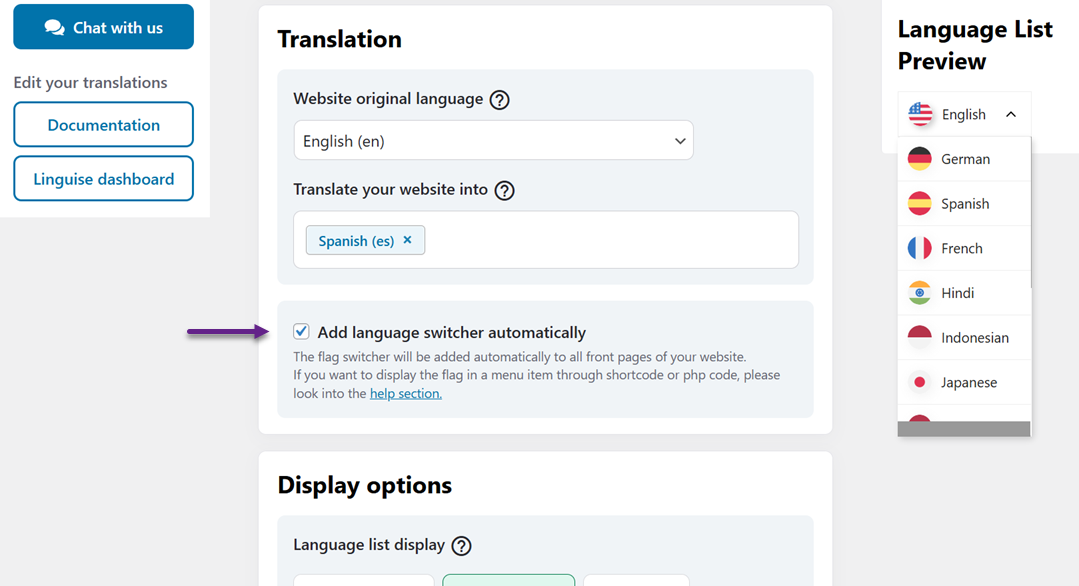
Next, activate the language switcher on your website so visitors can easily change languages. For example, here’s how a language switcher looks on a WordPress website using Linguise, allowing users to seamlessly switch between languages from the front end.
Once everything is set up, review key pages, including the homepage, product pages, and main landing pages, to ensure translations display correctly and the layout remains clean across languages.
Week 2 – Technical SEO and hreflang
After launching the multilingual version, the second week focuses on making sure search engines can properly understand and index your multilingual pages. Proper technical SEO setup ensures that each language version appears in the right search results and reaches the intended audience. To achieve this, you can follow several key technical SEO steps:
- Implement hreflang tags: Add hreflang tags to indicate which language or regional version of a page should appear for specific users. This helps search engines serve the correct page in search results and prevents duplicate content issues.
- Create a clear multilingual URL structure: Ensure each language version has its own crawlable URL, such as a language subdirectory. This makes it easier for search engines to understand and index your multilingual pages.
- Update your XML sitemap: Ensure your multilingual sitemap includes all language versions of your pages. This helps search engines quickly discover, crawl, and index the translated content so each language version can appear in relevant international search results.
After completing these steps, verify that all translated pages are indexable and loading correctly so they can start generating impressions in international search results.
Week 3 – UX polish and microcopy
Once the technical setup is complete, the third week focuses on improving the user experience for international visitors. Even with automated translations, small adjustments can make a big difference in how users interact with your website.
Start by reviewing key interface elements such as navigation menus, call-to-action buttons, and short interface texts. These small pieces of text, often called microcopy, should be clear and natural in each language.
Next, test the website layout in different languages. Some languages require more space than others, so you may need to adjust spacing or button sizes to keep the design readable. Also, check mobile responsiveness to ensure the multilingual pages work smoothly on smartphones.
Week 4 – Market validation and traffic analysis
The final week focuses on analyzing early performance signals from the new multilingual pages. At this stage, your goal is to identify which languages or regions show the most promising engagement.
Start by checking search impressions in tools like Google Search Console. This helps you see whether your translated pages are appearing in search results for different languages or countries.
Next, review user behavior metrics such as bounce rate, time on page, and conversions. These indicators help you understand whether visitors from specific markets are engaging with your content or leaving quickly.
By the end of the fourth week, you should have enough data to identify which markets show real potential. This information can then guide your next steps, such as investing more resources into high-performing languages or refining content for the most promising regions.
How to identify winning international markets

After launching a multilingual website, the next step is determining which markets show real potential. Instead of relying on assumptions, businesses can use early performance data to understand how international audiences interact with their content.
Track search impressions
One of the earliest indicators of market interest is search impressions. When your multilingual pages begin appearing in search results for different languages or regions, it shows that search engines are indexing your content and matching it with relevant queries. Monitoring impressions helps you identify which languages or countries are gaining visibility.
Tools such as Google Search Console allow you to filter impressions by country and search queries. If a particular language version of your website begins receiving more impressions than others, it may indicate growing search demand in that region, making it a strong candidate for further optimization and marketing investment.
Analyze conversions
Traffic alone is not enough to determine whether a market is truly promising. Conversions provide a clearer signal of whether visitors are actually interested in your product, service, or content. These conversions can include actions such as signing up for a newsletter, submitting a form, starting a trial, or making a purchase.
By comparing conversion rates across different language versions, businesses can identify which markets are generating meaningful engagement. If visitors from a specific region consistently complete desired actions, it suggests that the product or offering resonates with that audience and may deserve additional resources.
Monitor bounce rates
Bounce rate is another useful metric when evaluating new markets. A high bounce rate often indicates that visitors leave the page quickly without further interaction, suggesting that the content, messaging, or offer does not align with their expectations.
On the other hand, lower bounce rates usually signal that users are finding the content relevant and are willing to explore more pages. By monitoring bounce rates across different language versions, businesses can identify which markets show stronger engagement and where improvements in translation, messaging, or user experience may be needed.
Turning a 30-day test into a global strategy

After completing a 30-day market test, the next step is turning those insights into a long-term international strategy. The data collected during the testing phase helps businesses understand which markets show real potential and where further investment can generate the best results.
Focus on high-performing markets
Once you analyze impressions, conversions, and engagement metrics, certain markets will usually stand out. These are the regions where your website begins to gain consistent visibility in search results and where users show meaningful engagement with your content or product.
Instead of spreading resources across many regions, businesses should prioritize these high-performing markets. This may involve creating more localized landing pages, running targeted campaigns, or adapting messaging to better match the audience in that region.
Improve translation quality
Automated translations help launch multilingual websites quickly, but once a market shows strong potential, improving translation quality becomes important. Refining key pages, such as product descriptions, landing pages, and calls to action, can help make the content feel more natural and persuasive to local audiences.
Businesses can review high-traffic pages and apply human editing or localization improvements where necessary. This step helps increase trust, improve clarity, and ultimately boost conversions from visitors who are already showing interest in the content.
Expand multilingual content
After identifying promising markets, the next step is expanding the amount of content available in those languages. Adding more blog posts, guides, product pages, or support resources helps increase search visibility and provides more entry points for international users.
Consistently publishing multilingual content also strengthens SEO performance in those regions. Over time, this approach helps build stronger authority in the target market while attracting more organic traffic from users searching in their native language.
How Linguise helps launch multilingual websites fast
Launching a multilingual website quickly can be challenging, especially when businesses need to manage translations, SEO structure, and user experience simultaneously. This is where Linguise helps simplify the process by allowing websites to become multilingual in minutes while keeping SEO performance and usability intact. Linguise also supports a wide range of CMS platforms, making it easy to integrate with existing websites.
Instead of requiring manual translation for every page, Linguise automatically translates website content while preserving the structure needed for search engines to properly index each language. This allows businesses to launch multilingual pages quickly and start gathering real market data without complex development work or long deployment timelines.
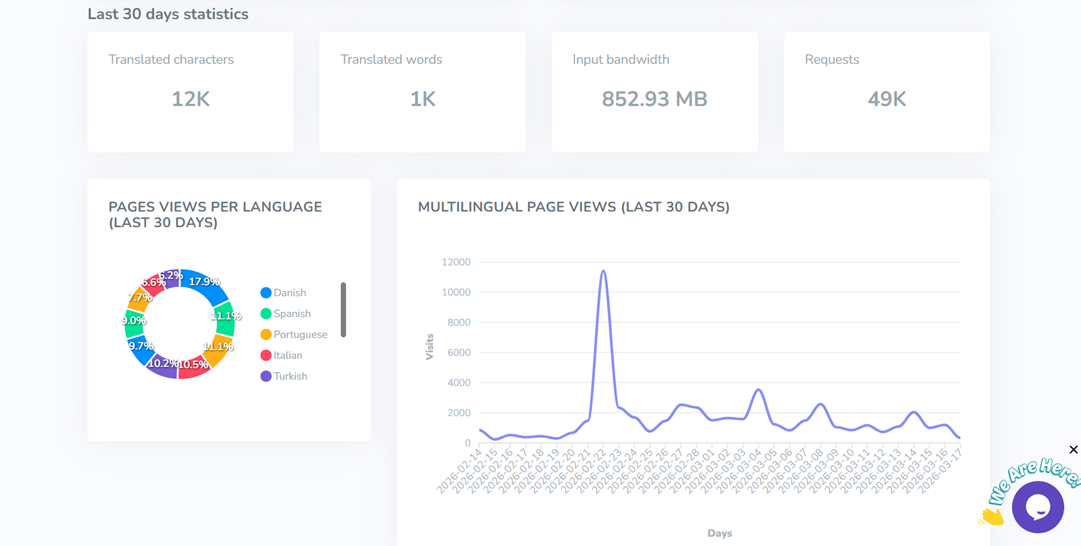
Some of the key features that help businesses launch multilingual websites faster include:
- Automatic website translation: Linguise instantly translates website content, allowing businesses to publish multilingual pages without waiting for manual translations.
- SEO-friendly multilingual structure: The platform automatically handles elements such as translated URLs and indexing, helping search engines understand and rank each language version of the website.
- Built-in language switcher: Visitors can easily switch languages with a customizable selector, improving accessibility for international audiences.
- Live translation editor: Linguise provides a live editor that lets you modify translations directly on your website’s front end. This makes it easy to adjust wording, improve clarity, or correct specific terms without editing the original content or accessing complex backend settings.
With these capabilities, businesses can launch multilingual websites much faster and begin testing in international markets without a complex technical setup or long development timelines.
Conclusion
Launching a multilingual website in under 30 days allows businesses to validate international opportunities without committing large budgets upfront. Instead of spending months preparing perfect translations, companies can quickly launch multilingual pages, monitor search impressions, conversions, and user behavior, and identify which regions show real potential for growth.
If you want to launch a multilingual website faster and start testing new markets with minimal technical effort, Linguise provides an efficient solution with automatic translations, SEO-friendly language structure, and a live translation editor. Try Linguise to quickly turn your website into a multilingual site and begin discovering which global markets are ready for your business.