Back-translation is a useful method for checking whether a website translation conveys the meaning of the original text accurately. It involves translating the content back into the original language and comparing the result with the source.
In this guide, you’ll learn how back-translation works, why its results may differ from the original even when the translation is accurate, and when it is useful for translation QA. You’ll also learn how to review discrepancies and structure the process without bilingual reviewers.
Key points: Using back-translation to verify website translation accuracy
Understand how Back-translation works
Learn how translating content back into the original language can reveal differences in meaning, terminology, tone, and important details.
Focus on high-risk content
Use back-translation strategically for critical pages such as checkout, pricing, legal notices, medical content, product claims, and calls to action.
Turn findings into better translation QA
Review discrepancies, correct genuine meaning shifts, and use the results to improve your glossary, style guide, and future translation workflows.
What is back-translation?

Back-translation is a quality-check method where a translated text is translated back into its original language and then compared with the source text. The goal is to identify potential differences in meaning, terminology, or context that may indicate a translation issue.
Unlike proofreading, which checks a text for spelling, grammar, and style errors, back-translation focuses on whether the translated content preserves the original meaning. It also differs from a bilingual review, where someone who understands both languages directly evaluates the source and target texts. Back-translation can provide an additional quality signal when a team lacks bilingual reviewers.
However, back-translation cannot prove that a translation is completely accurate because it may miss some errors and can also flag natural differences as potential issues.
How does back-translation work?

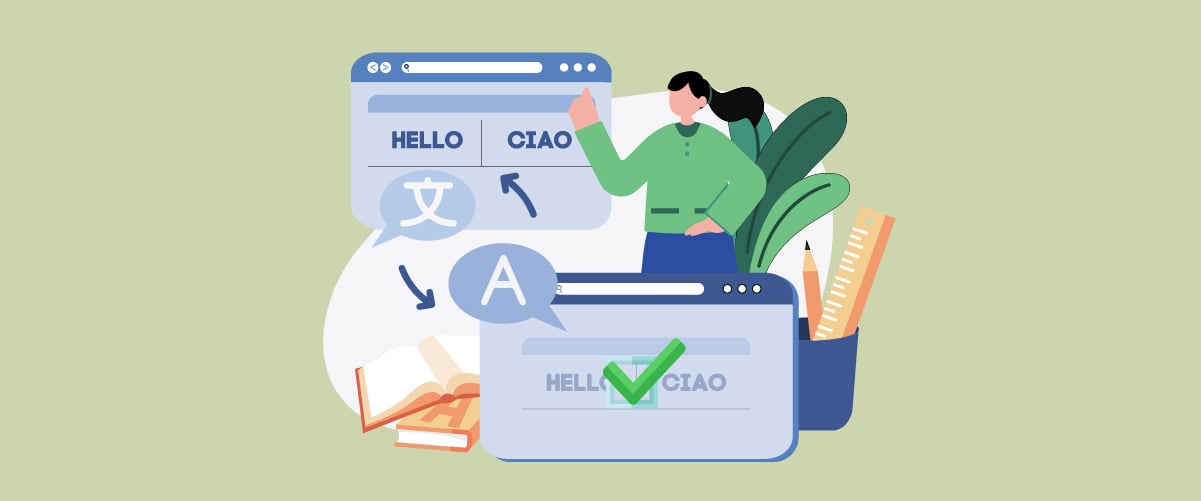
Back-translation follows a simple process translate the original content into the target language, translate it back into the original language, and compare both versions. Each step helps identify whether the intended meaning has been preserved throughout the translation process.
Forward translation
The process starts with the original website content being translated into the target language. The translator should focus on conveying the intended meaning naturally rather than translating each word literally.
Before starting, make sure the translator has enough context about the content, audience, and website. This is especially important for content that includes industry-specific terms, product names, or calls to action. Key points to check include:
- The original meaning and intent are clear.
- Important terminology is translated consistently.
- The tone matches the target audience.
- Cultural or local references are adapted when needed.
Back-translation
The translated content is then given to another translator or translation system to translate it back into the original language. Ideally, the person or system performing the back-translation should work independently without referring to the original text.
The purpose is not to recreate the original word for word. Instead, the back-translation provides another version that can be compared with the source to reveal possible differences in meaning or context. For a more useful check:
- Use a separate translator when possible.
- Avoid showing the original text during back-translation.
- Translate the target text faithfully without intentionally adapting the wording.
- Record notable differences for further review.
Compare the two versions
The final step is to compare the original text with the back-translated version. Look for differences that could indicate a change in meaning, missing information, incorrect terminology, or a misunderstanding of the original content.
Not every difference means that the forward translation is wrong. Natural translations often use different sentence structures, expressions, or word choices. The key is to investigate differences that could affect the intended message. During the comparison, check for:
- Changes in meaning or intent
- Missing or added information
- Incorrect terminology
- Ambiguous or unclear wording
- Differences that could affect important instructions or actions
When a significant discrepancy appears, review the original and target text together to determine whether it is an actual translation issue or simply a natural difference in expression.
Why do back-translations differ?

Back-translations rarely match the original text word for word. This does not automatically mean that the forward translation is inaccurate. Differences can happen because translators often change wording, sentence structure, and expressions to make the content natural for the target audience.
Literal vs. natural translation
A literal translation tries to follow the original wording and sentence structure closely, while a natural translation focuses on expressing the same meaning in a way that sounds appropriate in the target language. A good website translation often prioritizes natural language over matching every word.
When you translate the natural translation back into the original language, the result may use different words or sentence structures than the source. For example, an English phrase such as “Get started today” might be translated using a more natural local expression rather than a direct equivalent. When translated back, it may become “Start using it today,” even though the original intent is still the same. Differences are not necessarily a problem when:
- The original meaning is preserved.
- The intended action remains clear.
- Key information and terminology are consistent.
- The wording sounds natural in the target language.
Context and cultural differences
Translation also depends on context and culture. Some words or expressions can have multiple meanings, and translators may need to choose the version that best fits the page, audience, or situation. Cultural references, idioms, and calls to action may also need adaptation rather than literal translation.
For example, a marketing phrase that sounds natural in English may require a different expression in another language to create the same effect. A back-translation may therefore look quite different from the source while still communicating the intended message. Pay particular attention to differences involving:
- Idioms and culturally specific expressions
- Product or industry terminology
- Calls to action
- Dates, numbers, measurements, or other localized information
- Words with multiple meanings
What discrepancies can tell you
Differences between the original and back-translated text should be treated as signals for further review, not as automatic proof of an incorrect translation. A discrepancy can be harmless if it results from natural wording, but it can also point to a real translation issue.
For example, if the original says “Returns are accepted within 30 days,” but the back-translation says “Customers can return products after 30 days,” the difference changes the meaning and should be investigated. In contrast, a phrase such as “Get started today” may be translated naturally as “Start using it today.” Although the wording is different, the intended meaning and action remain the same.
The goal is to determine whether the difference affects the meaning or purpose of the original content. This is especially important for information that users must understand correctly, such as instructions, legal terms, medical information, or checkout details. A discrepancy may deserve closer attention when it shows:
- A change in the original meaning or intent
- Missing or added information
- Incorrect terminology
- A changed instruction or call to action
- Ambiguous wording that could confuse users
If a discrepancy affects an important part of the message, review the target translation before publication. This makes back-translation more useful as a quality signal rather than treating it as a simple word-for-word accuracy test.
For website teams using Linguise, identified discrepancies can also be addressed directly through its translation management features. The front-end live editor in Linguise allows manual adjustments to translated content, while custom translation rules can help keep specific terms consistent across the website.
When should you use back-translation for QA?

Back-translation can be useful when translation errors could have serious consequences, but it does not need to be part of every translation workflow. The right approach is to use it selectively based on the type of content, available reviewers, and potential impact of a translation issue.
Legal, medical, and checkout pages
High-stakes website content can benefit from additional translation checks because even a small change in meaning can affect how users understand important information. Legal pages, medical content, and checkout flows are examples where accuracy can have a direct impact on users.
For these pages, back-translation can provide an additional signal that important information has been preserved. However, it should support, not replace, qualified human review when the content requires professional or legal expertise. Consider using back-translation for:
- Terms and conditions
- Privacy and legal notices
- Medical information and instructions
- Product safety information
- Checkout instructions and payment-related messages
- Cancellation, refund, or shipping policies
When you do not have bilingual reviewers
Back-translation can also help teams that do not have someone who can confidently review both the original and translated versions. Instead of relying only on the target-language text, the team can use a back-translated version to identify areas that may need closer attention.
For example, a team member who only understands the original language can compare the source text with the back-translation and flag major differences. Send these differences to a professional translator or native-language reviewer for confirmation. A simple workflow can be:
- Translate the original website content into the target language.
- Create a back-translation without showing the source.
- Compare the original and back-translated versions.
- Flag meaningful discrepancies.
- Ask a qualified reviewer to investigate flagged sections when possible.
Back-translation does not replace a bilingual reviewer. Treat it as a screening method that helps teams identify where additional review may be needed.
How to prioritize content for back-translation
Not every page needs the same level of QA. Instead of back-translating an entire website, prioritize content where an inaccurate translation could create the greatest risk or impact.
Start with pages that contain important information or directly affect user actions. Then expand the review to other content if resources and time allow. A practical priority order can include:
- Legal and compliance content
- Medical or safety-related information
- Checkout and payment flows
- Product instructions and important user guidance
- High-traffic landing pages
- Other customer-facing content with lower risk
This approach helps teams use back-translation where it provides the most value instead of adding the same review workload to every page.
When back-translation is unnecessary
Back-translation can create additional time and cost, so it may not be worth using for every type of website content. For lower-risk content, standard proofreading, automated checks, or regular translation review may be enough.
Blog articles are a common example. If a blog post is mainly intended to provide general information and a minor wording difference does not change its meaning or create significant risk, back-translating every article can add unnecessary overhead. It may be unnecessary when:
- The content has low risk if minor wording changes occur.
- The page is frequently updated and requires fast publishing.
- A qualified bilingual reviewer already checks the translation.
- The translation is short and straightforward.
- The additional review effort provides little value compared with the potential risk.
The decision should depend on the content and its potential impact, rather than treating back-translation as a mandatory step for every translation.
How to structure a back-translation review
A consistent review process makes back-translation easier to manage, especially for teams working across many languages or pages. The process should clearly define which content is reviewed, who handles each step, and how discrepancies are investigated. A basic workflow can follow these steps:
- Select the content – Choose pages or sections that require additional QA.
- Complete the forward translation – Translate the source into the target language.
- Create the back-translation – Translate the target text back into the source language independently.
- Compare the versions – Look for meaningful differences in meaning, terminology, and context.
- Investigate discrepancies – Determine whether each difference is a natural language variation or a potential translation issue.
- Revise when needed – Update the target translation if you identify a genuine issue.
- Document the result – Record significant issues and their resolution for future reviews.
For teams without bilingual staff, this process can be combined with external translators, native-language reviewers, or other qualified resources when a discrepancy needs confirmation. The key is to use back-translation to identify potential problems rather than treating every difference as an error.
Managing translations across multiple website pages can make the QA process more time-consuming, especially when content needs to be translated and reviewed in several languages. Using a website translation solution can help simplify the translation workflow while still allowing teams to focus their QA efforts on high-priority content.
If you want to streamline multilingual website management, use Linguise to translate your website and manage your multilingual content from one place.
Conclusion
Back-translation can be a useful way to check website translation accuracy, especially for high-stakes content where preserving the original meaning is critical. However, differences between the source and back-translated text do not always indicate an error, so each discrepancy should be reviewed in context and prioritized based on the content’s risk.
For teams managing multilingual websites, combining automated translation with the right QA process can make translation review more manageable. If you’re looking for a simpler way to translate and manage multilingual website content, try Linguise and explore how it can support your localization workflow.