
Choosing your first international market can be challenging for small businesses, especially when expansion decisions are based only on website traffic or assumptions. A high-traffic market does not always guarantee strong sales potential, as factors such as competition density, purchasing power, and operational complexity also affect long-term growth.
Some markets may have larger audiences, while others offer less competition or greater potential for customer spending. Without a clear market prioritization strategy, it becomes difficult to decide which country to enter first. By analyzing market size, customer demand, localization factors, and regulatory complexity, businesses can reduce expansion risks and choose markets with the highest growth potential.
Key points: Finding the best international market for business expansion
Use data, not assumptions
Analyze traffic, keyword demand, and market trends to identify the best international expansion opportunities.
Evaluate real market potential
Consider competition, purchasing power, and localization complexity instead of relying only on traffic volume.
Combine localization with SEO
Translate and localize content while tracking performance metrics to support international growth.
Understanding market expansion readiness

Before entering a new international market, small businesses need to understand whether they are truly ready for global expansion. Many companies start expanding after seeing international traffic or a few overseas orders, but market expansion readiness involves much more than demand alone. Businesses also need to evaluate localization, logistics, customer support, pricing adjustments, and operational challenges before scaling internationally.
A common mistake is choosing a market based only on popularity or traffic volume. In reality, a smaller market with lower competition and stronger purchasing power may provide better long-term opportunities. Before selecting a target market, businesses should assess:
- Existing international demand and customer inquiries
- Localization and communication readiness
- Shipping, logistics, and customer support capacity
- Budget and resources for international expansion
- Long-term scalability and operational readiness
After understanding expansion readiness, businesses can begin evaluating market potential to identify which international markets offer the best growth opportunities, informed by data and market conditions.
Evaluating market potential
After confirming expansion readiness, businesses need to evaluate market potential to determine which countries provide the best opportunities for sustainable growth. This process helps small businesses compare markets more objectively by using data on demand, competition, customer spending behavior, and overall business potential.
Market size analysis
Market size analysis helps businesses understand how large a potential audience is in a specific country or region. However, this process should go beyond checking website traffic or population size alone. A country with millions of internet users may still have low interest in a specific product category, while a smaller market may contain a more targeted audience with stronger buying intent.
Businesses can analyze market size through tools and platforms such as Google Trends, Statista, Semrush, Ahrefs, and ecommerce industry reports. Google Analytics can also help identify countries that already generate international traffic, while marketplace platforms like Amazon, Shopee, or Etsy can provide insights into product popularity and regional demand trends.
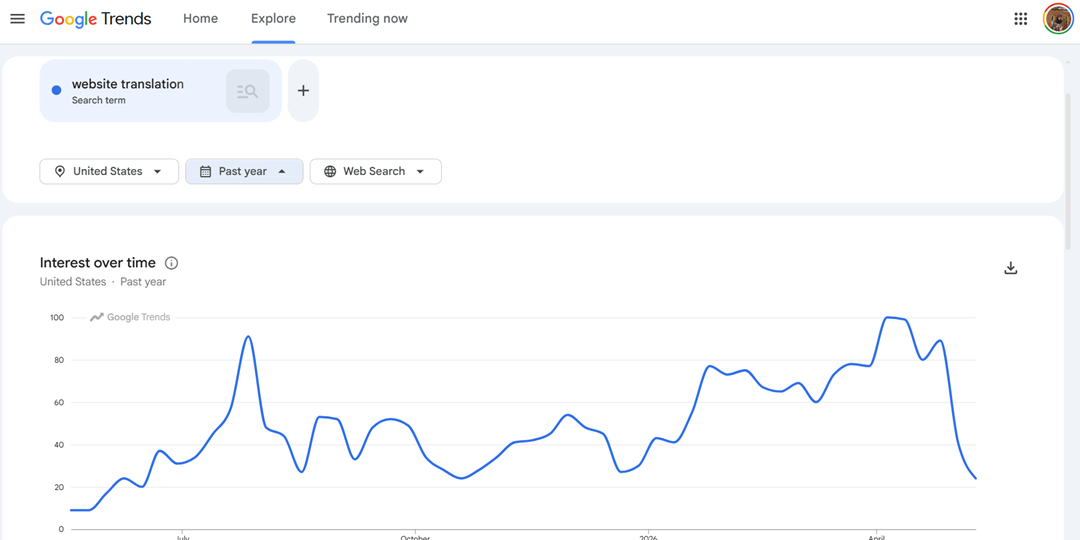
The following Google Trends example shows how businesses can compare global interest in website translation-related topics to identify markets with growing localization demand and international expansion potential.
Competition analysis
A large market does not always mean an easy opportunity, as competition density also affects the success of market entry. Some international markets already have strong local brands, aggressive advertising, and highly competitive pricing, making it more difficult for small businesses to expand.
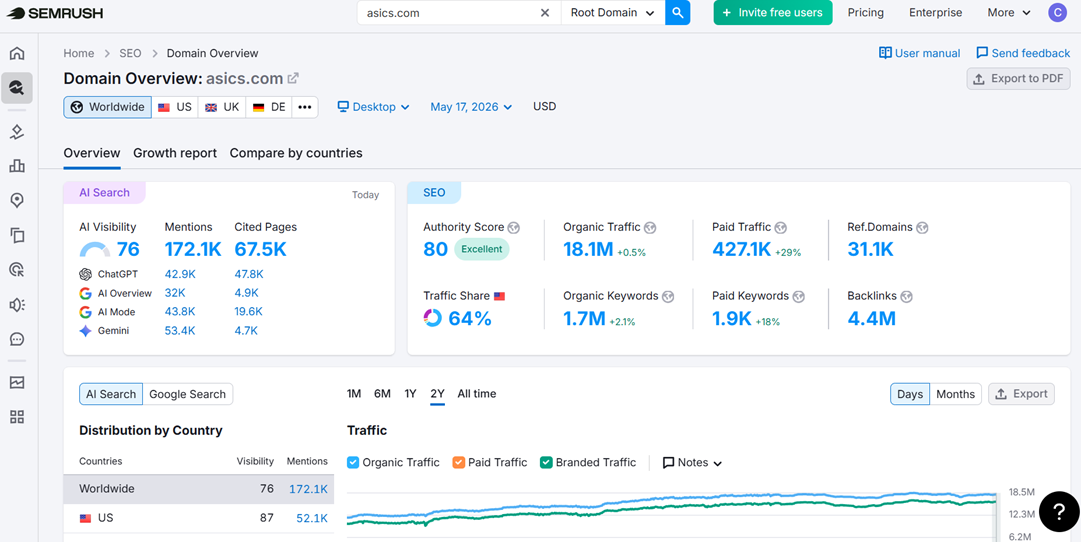
Competition analysis can be conducted by reviewing competitor websites, marketplace listings, search engine results, and social media activity. SEO tools such as Semrush, Ahrefs, and Similarweb help businesses measure keyword competition, estimate traffic, and assess competitor visibility. Businesses can also analyze customer reviews to identify gaps or problems that existing competitors have not fully solved.
The following domain overview example shows how businesses can analyze competitor visibility, regional traffic distribution, and market dominance before entering a new international market.
Purchasing power evaluation
Purchasing power evaluation assesses whether customers in a target market can realistically afford the product or service being offered. A market may show strong demand, but differences in income levels, currency value, and local pricing expectations can still affect profitability and conversion rates.
Businesses can evaluate purchasing power using World Bank data, OECD reports, Numbeo, and purchasing power parity (PPP) indexes. Currency conversion tools and local ecommerce pricing comparisons also help businesses understand how products are positioned within different markets before setting international pricing strategies.
Customer demand validation
Customer demand validation helps businesses confirm whether real buying interest exists before fully entering a market. This step reduces the risk of expanding into markets that appear promising in theory but show weak customer intent in practice.
Demand validation can be conducted using keyword research tools, social media analytics, and small-scale advertising campaigns on platforms such as Google Ads, Meta Ads, or TikTok Ads. Businesses can also test localized landing pages, monitor international inquiries, and analyze marketplace performance to identify which countries show the highest engagement and conversion potential before scaling further.
Localization and operational factors

After identifying markets with strong potential, businesses also need to evaluate localization and operational factors. Even promising markets can become difficult to manage if language, regulations, logistics, and operational requirements are not properly prepared.
Language vs. country targeting
Many businesses assume international expansion should always target countries individually, but in some cases, language targeting can be more effective than country targeting. For example, Spanish-speaking audiences span multiple countries, while English-speaking customers can come from very different regions with distinct purchasing behaviors. Understanding this distinction helps businesses prioritize localization strategies more efficiently.
Businesses can analyze this using Google Analytics, Google Search Console, and multilingual SEO tools to identify which languages already generate traffic or conversions. Tools like Semrush and Ahrefs also help businesses discover keyword demand by language and region. In some cases, creating multilingual content first may provide a broader reach before fully localizing for specific countries with unique currencies, regulations, or customer preferences.
Regulatory and logistics review
Every international market has different regulations related to taxes, import duties, product restrictions, payment systems, and shipping requirements. A market with strong customer demand may still create operational challenges if businesses are not prepared for local compliance and logistics complexity.
Businesses should review regulations on government trade websites, as well as with shipping providers and international ecommerce platforms. Tools and services from DHL, FedEx, Shopify Markets, and Stripe can help businesses estimate shipping availability, taxes, payment support, and cross-border transaction requirements. It is also important to check local privacy laws, return policies, and product restrictions before launching internationally to avoid unexpected operational issues.
Operational complexity assessment
Operational complexity assessment helps businesses measure how difficult a market will be to manage on a daily basis. This includes customer support requirements, currency management, time zones, return handling, inventory coordination, and localization maintenance across different regions.
Small businesses can start by evaluating internal resources and identifying which processes can realistically be managed during early expansion stages. Platforms such as Shopify Markets, WooCommerce multilingual plugins, and localization tools like Linguise can help simplify multilingual management, currency switching, and international customer experiences. Businesses may also prioritize markets with lower operational complexity first before expanding into regions that require more advanced localization or regulatory support.
Building a market prioritization framework

After evaluating market potential and operational factors, businesses need a structured way to objectively compare opportunities. A market prioritization framework helps small businesses make expansion decisions based on measurable data instead of assumptions or temporary trends.
Scoring model creation
A scoring model helps businesses compare international markets using weighted criteria such as market size, competition level, purchasing power, customer demand, and operational complexity. Each factor can be assigned a score based on business priorities, allowing companies to evaluate markets more consistently and reduce subjective decision-making.
Businesses can create simple scoring frameworks using spreadsheets in Google Sheets or Microsoft Excel. For example, each market can be rated from 1–10 for different categories, then combined into a total score. Some businesses may prioritize low competition, while others focus more on purchasing power or logistics simplicity, depending on their expansion goals.
Market ranking
Once scoring data is collected, businesses can rank markets from highest to lowest potential. This process makes it easier to identify which countries offer the best balance between opportunity and operational feasibility, rather than relying solely on intuition or isolated metrics.
Market ranking also helps businesses avoid focusing only on large or popular countries. In some cases, smaller markets with moderate demand and lower competition may generate faster growth opportunities than highly saturated markets. Visualization tools like Google Sheets charts, Airtable, or Notion databases can help organize and compare market data more clearly.
Market entry sequencing
Market entry sequencing focuses on deciding the order in which markets should be entered. Instead of expanding into multiple countries simultaneously, small businesses often achieve better results by entering markets gradually and improving operations step by step.
Businesses can begin with markets that have lower operational complexity, established customer demand, or shared language, before moving into more competitive regions. This phased approach helps businesses test localization strategies, optimize logistics, and build international experience with lower risk before scaling globally.
Conclusion
Choosing your first international market should be based on a data-driven framework rather than assumptions or traffic volume alone. By evaluating market size, competition density, purchasing power, customer demand, and operational complexity, small businesses can prioritize markets more strategically and reduce the risks of international expansion. A structured market prioritization approach also helps businesses scale gradually while maintaining sustainable long-term growth.
As businesses begin localizing content for their first international market, using the right multilingual tools becomes equally important. Start with Linguise to simplify website translation, multilingual SEO, and language management, making it easier to create localized experiences for global audiences without adding unnecessary operational complexity.